3-Ply Vs. 5-Ply Stainless Steel (Does More Layers Matter?)
Introduction
Perhaps holding kitchen utensils leaves you questioning whether more layers mean better cooking? To sum up, the distinction regarding 3-ply vs 5-ply stainless steel is not about counting layers. A good pan ought to exhibit limitless lifespan, withstanding blasting temperatures while remaining exceptional cooking vessels.
Key Takeaways:
-
3-ply offers unmatched thermal responsiveness.
-
5-ply delivers maximum heat retention and warp resistance.
-
Your choice in 3-ply vs 5-ply stainless steel directly depends on your cooktop type.
What Are The Clad Stainless Steel Layers? A Quick Definition
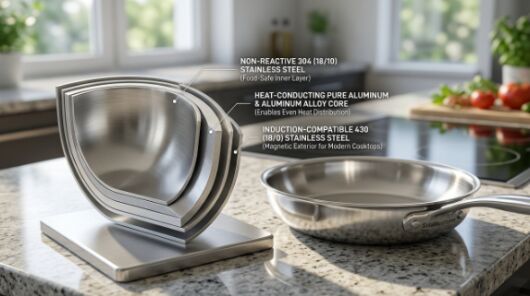
A 1st-class stainless steel pan is built of a multi-metal sandwich. A standard 3-ply pan has aluminum in the middle sandwiched between 2 very tough layers of stainless steel. Traditionally, the inner layer is food safe 304 (or 18/10) grade stainless steel, the main characteristic of which is that it is completely non-reactive; it not actually affects the taste of highly acid food such as tomato sauce or wine reductions.
The exterior material is usually the magnetic grade 430 (or 18/0) stainless steel and is specifically used for complete compatibility with today's induction cooktops. For instance, Stainless steel cookware utilizes this exact standard. Stainless steel cookware layers explained simply means understanding these fundamental materials.
The 5-ply pan follows this as it consists of 2 additional layers between the inner and outer shells. In general, there is a pure aluminum and aluminum alloy as the core material of a 5-ply pan, which enables it to enjoy the excellent heat conduction and control property of aluminum.
The heat conductors are then set between a firm stainless steel exterior. The basic concept is quite simple: more layers mean more even heat distribution and structural stability, in theory. This is multi-ply cookware explained in a nutshell.
However, it's not as simple in the real world. Those layers and especially the thickness of the core heat conducting layer that is important, not the number of layers. The number of layers is not necessarily as important as the core thickness of a pan that will result in even heating and resistance to warping.
The Difference Between 3-Ply And 5-Ply Stainless Steel
Whether you're turning a stove handle, pouring basting juice over a steak or scrubbing the skillet after a decent meal, the difference between a 3-ply and a 5-ply cookware will be noticeable. To appreciate the effect of the layers, you need to get well-versed with the particular metrics of culinary performance when evaluating 3-ply vs 5-ply.
1. Heat Conductivity – Core Materials, And Efficiency
Aluminum has a high heat transfer of about 205 W/m·K, so aluminum is a very rapid and efficient heat conductor, again compared to a stainless steel, which is a pretty bad heat conductor in the 1st place. That inner aluminum core bears the brunt of the load in any clad pan, quickly and uniformly warms up cookware, from bottom to sides.
A thick enough aluminum layer in a high quality 3-ply pan can even heat distribution than a badly designed 5-ply pan with thin and slow to heat, in between layers of steel. A great example of efficiency is found in the Tri-ply hybrid mirror series.
Optimum Heat Conductivity Benefits:
|
Benefit |
Description |
|
Heat quickly & evenly |
The central thick aluminum core powerfully blasts heat directly from the center of the burner to the furthest corners of the pan to reduce uneven cooking. |
|
Hot spot elimination |
Core metals that were designed to high quality means the surface should heat evenly and stop the center from getting hot and the edges colder. |
|
Energy efficiency |
A higher level of conductivity make it less demanding for the pan to hold an efficient cooking temperature and so the burner can be turned down. |
For Heat Conductivity:
-
The thickness of the core is more important than the number of ply: a 3-ply pan with an aluminum core thickness of 3mm will outperform a 5-ply pan with a total aluminum core thickness of 1.5mm.
-
Internal steel layers: Internal layers of stainless steels can actually impede heat transfer from the burner to the food in some 5-ply designs.
2. Thermal Responsiveness & Temperature Control
Is it more important to cook with a pan that is quick to heat vs one that remains at a constant and consistent temperature while cooking? Here's the middle ground to the 3-plies vs 5-plies debate. The 3-ply pans get very hot quickly. Since less metals are required to be used to create it, you can achieve a sizzling hot boil from atmosphere temperature in less than 2 minutes on a typical gas burner.
This pure thermal response can be the cook's best friend. If you need to get the heat off fast to rescue a delicate beurre blanc or if you want to prevent garlic from burning, with 3-ply, you get the perfect immediate and precise control of the cooking environment, which helps answer what is the best ply for stainless steel pans for delicate meals.
Benefits Of A High Thermal Responsiveness:
|
Feature |
Advantage |
|
Fast Response |
3-ply cookware’s fast response to the temperature shift is essential for sauces, custards, and caramel, and will probably come in useful to you. |
|
Less weight |
The decreased weight of a pan gives you faster prep times when compared to other heavier pans. |
|
Fast pan clean up |
Rapidly cooling pans are a boon to cooks who use visual cues and quick adjustments to determine cookery. |
In The Case Of Thermal Responsiveness, The Considerations Include:
-
Longer preheating time for 5-ply: Due to the significantly greater amount of material and thermal mass, it can take 3 to 4 minutes to preheat the material properly in a 5-ply, compared to the preheating time of a 3-ply pan.
-
Heat retention tradeoffs: The same characteristics that make up the 3-ply pan help it cool down quickly will cause it to cool down just as fast if it comes into contact with cold ingredients.
3. Over-All Weight/Daily Handling
There are numbers, and those numbers don't lie in the case of physical reality as it relates to cooking. The heavy weight of a good skillet is usually 2.5 to 3 pounds of this highest quality 12” 3-ply skillet. An alternative 5-ply skillet of a similar size can weigh 3.5 to 4.5 lbs. effortlessly. There, 1 pound or so of weight can seem like a small amount but a few pounds make a big difference when repeatedly lifting vegetables, opening up a fillet with one hand, or carrying a pan from the stove to the oven.
Since a fewer number of layers of metal have been constructed, 3-ply cookware is also much lighter to lift, move and move to the sink in the end for cleaning. A lighter option might look like a 3-ply white ceramic pan.
The Benefits Associated With Lighter Weight Is Seen From Its Very Light Weight:
-
Easy to toss and flip: 3-ply skillets offer better maneuverability, making it easier to toss and flip vegetables or stir pasta dishes.
-
Less physical stress: The decreased construction significantly decreases wrist and forearm weakness, making it extremely reachable for cooks with wrist and arm problems.
When Disks Are Heavier:
-
The added extra 1 pound to a 5-ply pan is really apparent after 20 minutes of being active in the kitchen and makes dinner preparation an unwanted wrist exercise!
-
One upside that the 5-ply extra-heavy pan possesses is that is simply holds up quite solid on stovetop grates, and won't slip or spin around when stirring a rich stew.
4. Durability, Scratch Resistance, Longevity
Both the 3-ply and 5-ply pans are expected to last for decades and be heirloom items, lasting longer than non-stick pans. But there is the inside architecture that can contribute to structural integrity with time. The added metal in 5-ply is heavier, but also equates to an increased overall durability; 5-ply cookware is structurally more solid due to its multiple layers. Knowing these Clad cookware layers ensures you pick the right tool.
Advantages Of Multi-Layer Durability:
-
High impact resistance: 5-ply cookware has a much stronger resistance to dents from external impact when accidentally knocked over and/or on challenging kitchen surfaces.
-
Structural rigidity: 5 layers of ever so complicated stamping give rope and string to the rigid frame, which takes its shape admirably under extreme loadings.
-
Commercial-quality toughness: The extra weight allows it to put up with the heavy-handed use typical of high-volume kitchens.
Factors To Take Into Consideration When It Involves Cooking Pot Longevity:
-
Both 3-ply and 5-ply pans for interior cooking surface are the same, typically 304 stainless steel. So, when it comes to scratch resistance, the cooking surface is not in fact more protected with 5-ply.
-
Care and maintenance counts more than ply count; proper care, no thermal shock (immersing a screaming hot pan in cold water) and proper storage can make this last a long, long time.
5. Resistance To Warp And The Induction Factor
When people talk about durability, they can't stop talking about ‘warping,' as one of the most common reasons behind stainless steel skillets falling apart. Rapidly changing temperatures or intense heat can cause metal to expand and contract asymmetrically, resulting in warping.
The rigidity of the 5-ply is well fortified and this highly resists it from bowing and warping in a great way. This particular feature makes 5-ply a popular choice in today's induction cookstops.
As the heat is transferred quickly and directly to the magnetized pan, the induction burner brings the extreme thermal stress to the pan's base; these thin 3-ply models are much more prone to warping in this high localized hot spot. This durability is a hallmark of excellent 5-ply stainless steel cookware.
Warp Resistance High:
-
100% Continuous Glass Contact: Contact is maintained to flush glass induction cooktops with a rigid 5-ply pan allowing it to remain flat for perfect induction contact.
-
Acoustic dampening: 5-ply adds layers and adds weight and that's the reason why the very irritating buzzing or humming noise that is characteristic of thinner pans is eliminated.
-
Thermal shock protection: No pan is completely immune to abuse; however, 5-ply is less compromised from severe thermal shock, performing with much less deformation of the structure.
When Considering Warp Resistance, Consider These Factors:
-
The 3-ply exception: If the construction is very thick (2.5mm to 3mm of total thickness) the 3-ply will be very thick and will be able to support its own weight on induction without warping, as long as the burner is matching to the base of the pan.
-
Relevance of gas and electric: If a cook is using the traditional gas flame or the standard electric coil, an extreme warp resistance is not nearly as important, and the 5 plys becomes much less significant.
6. Price-To-Performance Ratio
With the cookware having less amount of metal and less intricate procedure to bond the components, 3-ply cookware is virtually always less costly than 5-ply. The 5-ply cookware comes with a higher price tag due to the different type of metals used in the cookware, higher number of raw materials, and the inclusion of a rigorous stamp making process. When buying kitchen gadgets for a lifetime, it is important to assess the value of money to performance in the Tri-ply vs 5-ply debate.
Value & Pricing Benefits:
-
The 3-ply sweet spot: A better 3-ply pan will be about 90% of the top of the culinary apple for about 60% of the price of the 5-ply pan.
-
Budget-friendly: With the cost savings, home cooks may be able to purchase more pan selections and sizes than originally planned or budgeted for without having to spend just as much on a single thick skillet.
Considerations For Investment:
-
Diminishing returns: The price of the skimpy jump from a mid-range 3-ply skillet ($70 to $120 range) to the top of the barrel 5-ply skillet ($130 to $220 + range) has minimal everyday cooking improvement.
-
Specialty cores: If copper is one of the specialized metals used in the manufacture of the 5-ply core, the wholesome value can rapidly double, coming at a substantial financial premium however making for quicker responsiveness.
The Burning Question: Heat Or Speed?
Whenever a quality cut of meat is cooked, the pan has to have a very high heat when the meat is added. A 5-ply pan really throws a lot of weight behind the equation. It is this additional weight that prevents the pan surface from cratering when a frigid chicken breast or a thick ribeye steak is tossed into the hot oil. Since the temperature doesn't drop too quickly, the cook gets a much superior crust, terrific Maillard browning and a lot less boiling or steaming of the meat, especially in heavier pots like the Lyon stock pot set.
Heavy Sealing - The Promised Benefits From The Manufacturer:
-
Massive heat reservoir: keep the heat close, the pan reaches the desired cooking temperature practically right away after food is introduced into the pan, thanks to the 5-ply, which has an almost ferocious grip on heat.
-
Even edge-to-edge solution sear on proteins: Uninterrupted heat transfer ensures consistent crust development.
-
Consistent performance: Easily maintains stability when on high heat for long periods of time.
Things To Consider For Heat Retention:
-
The 3-ply feature: More than enough heat reservoir in a thick, good quality 3-ply pan to cook a steak to perfection provides provided it's pre-heated well and properly.
-
Slower cooling: The plus side of heat retention creates the downside here – the 5-ply pan will take much longer to cool down, which could lead to a scorch if you're wanting to cook up a pan sauce on-the-go after the meat has been removed.
Does Ply Matter For Home Cooks?
The need for a 5-ply in the "home kitchen" has been hotly discussed in the industry, as well as the culinary world in general. The extra layers of metal definitely have a positive impact on the ability of 5-plies cookware to retain heat and to prevent warping; however, culinary students and home cooks alike have time and again, made note of the practical compromises.
In reality, however, more layers do not necessarily equal better performance, rather, it is the thickness of the core, purity of material used, and the type of heat source that will play a role in determining performance.
The Benefits Of Using Contextual Selection Are:
-
Assuming 3-ply caters is a great way to prepare simple weeknight dinners, cook quickly for family dinner, create precise reductions, and toss up stir-fries.
-
Heavy searing power and high output magnetic induction cooking are best handled with 5-ply, an engineered; very specific solution.
The Following Are Considerations For The Final Decision:
-
Marketing vs. physics: sometimes higher marketing "5-plys" in a high-quality 3-ply competitor, for higher prices, and sometimes none at all, even if the internal aluminum core is thinner.
-
Wrist fatigue facts: Too many cooks have upgraded just because they thought that "more is better", and have found their wrist isn't as bad as they feared and are happy with their new purchase!
What Real-World Cooks Say About It?
If you look at the overall sentiment of both the culinary world as well as enthusiastic home cooks, there is a pretty united opinion on the stainless-steel vs ply dispute. Chefs all around the globe use both, but frequently for different stations.
Line cooks furiously working a busy sauté station generally prefer 3-ply skillets. The lighter weight is a necessity when shaking a pan for 8 hours in a row and the fast reaction to temperature is a must when forming the butter into a sauce, and in middle of dinner rush you do not want to have a serving break in the middle of your sauce.
On the other hand, food preparers who cook at busy high-heat searing stoves or very thick meat cuts may prefer to go with no less than 5-ply or even copper-core construction; they use the huge thermal mass to keep hot when they are firing more than one batch of steaks.
As for the home cook, the consensus is a needed reality check. For anyone who cooks regular eggs, pasta or pan sauces, 5-ply is often a super-high weight and slow to heat solution in search of a problem.
You are spending more (both in terms of money and physical labor) for heat retention you may end up using very little. For the buy-it-for-life shopper though, who has a super strong induction stove, the absolute stability of the 5-ply skillet is really down to earth and the fact that they don't make much noise makes them really quiet.
Conclusion
Ultimately, selecting pots and pans requires judging thermal responsiveness alongside raw material thickness. Choosing between 3-ply vs 5-ply stainless steel depends on your specific culinary conditions and cooktop. Both offer limitless lifespan and commercial-quality toughness when matched properly. Discover high-quality cookware for your residence kitchen by visiting SolaMexHome today to elevate every single dinner preparation.
Is Scratched Nonstick Dangerous? A Complete Guide!
Drinkware Bulk Supplier VS Local: Which is Cheaper?