Why a Good Lid Matters? - The Key to Better Flavor & Faster Cooking!
Introduction
People more often discard a perfectly good pan because the lid has cracked. That one habit costs more money than any coating ever will. A good cookware lid retains moisture and flavor, and provides an appreciable reduction in cook time on nearly all burners. Here is some of what I have learned.
Straight Answer, No Hedging
A lid is a heat and moisture valve, not an accessory. Match the diameter to your pan rim within 2 mm, choose glass to see if it is cooking, choose steel for the oven, and you save real minutes out of dinner every single night.
-
The fit of the rim is more important than the brand, price, or appearance.
-
The glass reaches almost 400°F, and the full steel handles 500°F comfortably.
-
Having a lid replaced represents 15 to 30% of pan replacement.
Facts That Settle Most Lid Arguments
-
Covered simmering is about 40% more efficient in burner consumption per hour.
-
Rice requires a domed type of cover; sauces desire a low clearance cover.
-
The silicone rims eliminate rattle and keep the steam at low heat.
-
Phenolic knobs soften at about 350°F, much earlier than glass ever fails.
-
EN12983 is a standard for the cookware body and not the glass lid itself.
Anatomy of a Lid: Rim, Dome, Vent, and Knob
Turn any lid over. All that determines dinner is on the bottom, and very few people bother to consider that before purchase.
The Rim Is Where Sealing Happens or Fails
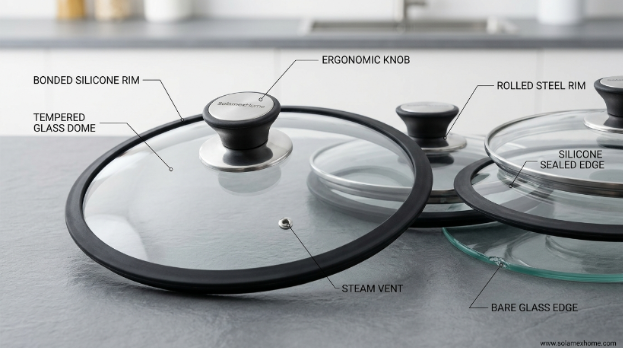
It is all about the rim. Any rocking, even 1 mm on the pan wall, will result in the loss of steam ceaselessly, which you will taste in a braise long before you see it. A tempered glass lid with a bonded silicone edge is quieter and has better adhesion than bare glass, and largely for this reason most factory lines converted to them from 2019 onward.
-
1. Rolled Steel Rims: retain their shape after the pan hits the ground, but chime on a thin gauge.
-
2. Silicone Sealed Edges: eliminate chipping at the edges, eliminate rattle and prevent simmer steam leaking out.
-
3. Bare Glass Edges: least costly, and first to chip when loading the dishwasher.
Dome Height Quietly Changes Your Cooking
Flat versus domed is not a style choice. Cookware with flat lids fits more easily in cabinets and drips condensation back onto the food, making it ideal for sauces and shallow braising. Domed shapes allow rice and beans to expand their volume without raising the lid. I myself keep one of each within easy reach of the stove.
Vents, Knobs, and the Parts That Fail First
The boil-over problem which plagues glass cook-top owners is solved by cookware with vented lids, and the maker's cost is perhaps 40 cents. The true Achilles heel is the knobs. Replacement knobs for pots and pans cost from $4 to $9, and take about 90 seconds to replace with a screwdriver, yet people go and replace an entire lid over a cracked one.
⚠ Pro Tip: Before ordering anything, be sure to measure the inside width of your pan at its broadest part. More outside diameter reading returns come back to us than all the other buyer habits combined.
Why a Good Lid Matters?
Physics, mostly. With a pan lid off, 80% of its upward moving energy ends up in the ceiling of your kitchen, and you pay for that on the electric meter and again in dry food.
Heat Stays Where You Aimed It
The small pressurized chamber that is formed by cooking pan lids is able to hold the headspace above the food within the 200°F to 212°F range. That magic band is the reason covered chicken thighs cook evenly, whereas uncovered thighs brown hard at the edges. Your burner also has to cycle less frequently, which saves thin bases from warping.
-
1. Lower Burner Setting: covered pots hold a simmer on medium-low rather than medium-high.
-
2. Faster Boil Time: four quarts of water boils about six minutes faster with a cover.
-
3. Fewer Hot Spots: trapped air reduces the pan wall temperature as well as the pan base temperature.
Moisture Turns Into Flavor Instead of Window Fog
All of the compounds you can sniff around the room are aromatic compounds that have escaped your food. Cookware with glass lids allows you to observe the reduction clearly without allowing that steam to escape 10 times an hour. This I had to learn the hard way by testing one of my stock batches, first with the cover open and again with it closed. Identical ingredients, crazy different depth.
Your Energy Bill Notices Before You Do
A cookware glass lid on a 2-quart pot can use about 40% less gas to simmer for an hour. Now, project that up a line of burners, eight at a restaurant, working 12 hours a day. That is the math that makes our commercial buyers specify lids on each and every stockpot SKU, including the 6/11/17/20QT Stainless Steel Stockpot with Tempered Glass Lid.
The Key to Better Flavor & Faster Cooking!
1. Braises Come Out Tender Instead of Stringy
Cover a chuck roast and let it cook in its own juices for a long time. Not covered, the same roast will dry on top and scorch on the bottom. I have taken both out of one oven, on the same afternoon. Covered wins, done.
2. Rice and Grains Stop Scorching at the Base
Grains require trapped steam above them, not only water beneath them. A domed cover on a 2-quart saucepan holds enough headspace for basmati to swell and fill it. Lift it too early and you get crunchy centers. Instead, keep it sealed for the full 12 minutes.
-
1. Seal Before Simmering: boil the water without a cover, then cover immediately and reduce to the lowest heat.
-
2. Resist Peeking: each lift costs about 90 seconds of recovery.
-
3. Rest Covered: five minutes off heat cooks the starch without additional fuel.
3. Sauces Reduce Exactly on Your Schedule
The reduction is a dial, and the cover is that dial. Completely sealed, virtually nothing evaporates. Cracked open an inch, you find slow concentration. Off completely, you get aggressive reduction with splatter. A fry pan glass lid provides all three positions without having to speculate as to what is going on in the pan.
4. Vegetables Steam Without a Basket or Insert
Half an inch of water, a tight cover, and broccoli is done in four minutes. No stacked insert, no additional pot to wash afterwards. Here, frying pan lids glass construction proves its worth, as the color can be clearly observed and the pan removed before it goes army green.
-
1. Shallow Water Only: most 10-inch diameter pans only need a half inch of water.
-
2. Medium Heat Maximum: high heat causes water to boil off before the food cooks.
-
3. Vent If Foaming: crack the cover if starchy vegetables are foaming.
5. Searing Then Covering Locks the Juice In
Sear hard, then cover. That order matters. Covering a cold pan steams the meat gray, but covering after a crust forms traps the juices while the middle cooks through. Thick pork chops are the perfect example, since a wok lid provides the extra headroom.
6. Splatter Stops Reaching Your Backsplash
When frying bacon uncovered, an eight-foot radius is covered in grease. A splatter screen frying pan cover prevents the spray but allows moisture to escape, and so keeps things crisp. On a commercial grill pan, I would go with the stainless-steel net cover rather than a solid lid, because a solid one converts your sear into a braise.
-
1. Mesh For Frying: lets the steam out, keeps the oil in, and retains the crust.
-
2. Solid For Simmering: keeps everything wet, makes everything soft.
-
3. Vented For Both: the compromise that works best for most home cooks.
7. Draining and Straining Without a Second Colander
Cookware with strainer lids revolutionized our weeknight pasta menu. A cooker with straining lid tips over the sink, and nothing gets into the drain. Cookware with draining lids features sections with holes instead of full mesh, which are best for small grains. A cookware set with strainer lids will also help preserve space in the cabinets.
-
1. Lock The Handles: squeeze hard before tilting hefty items.
-
2. Angle Slowly: tipping too quickly will allow hot water to pass the holes.
-
3. Check Hole Size: holes for fine orzo are smaller than those for penne.
8. Leftovers Travel, Store, and Reheat Better
A covered pan is ready to store with no transfer. Travel cookware lids with lock clips handle car trips and camping easily. A glass lid for microwave use is $6 and will save your ceiling from wearing your curry. Simple economics, honestly.
⚠ Warning: Do not go from a hot glass cover to a cold sink. Tempered glass in thermal shock cracks immediately, and the shards extend beyond what one can imagine.
Which Diameter Do You Actually Need Before Ordering?
Measure the inside of the pan rim only, not the base of the pan or its outside lip. The rims of a pan are angled, which is why a frying pan lid 10-inch listing sometimes arrives a tad smaller than the size listed. The sizes of the brackets listed in a retail outlet are only approximate; your ruler is not.
|
Pan Rim Measured |
Lid Size to Order |
Retail Search Bracket |
Street Price (USD) |
|
6.0 to 7.5 inches |
6-inch glass lid |
under 8″ diameter cookware lids |
$8 to $14 |
|
8.0 to 9.5 inches |
8-inch glass lid or 9.5-inch glass lid |
8″ diameter to 10″ diameter cookware lids |
$12 to $20 |
|
10.0 to 11.5 inches |
10-inch lid or 11-inch frying pan lid |
10″ diameter to 12″ diameter cookware lids |
$15 to $26 |
|
12.0 to 14.0 inches |
12-inch frying pan lid or universal pan lid 14 |
over 12″ diameter cookware lids |
$20 to $38 |
There are some sizes that muddy the waters more than the others. One brand has a 10-inch frying pan with lid that requires a 10-inch glass lid, and the other requires a 10.5-inch fry pan lid due to a larger flare. Compare that rim measure before ordering a 10-inch frying pan glass lid.
Cast iron operates on its own terms: a lodge 10.25 lid and a lodge 12 lid are the names given to the pan, not the cover. Square pieces require a square answer, so an 11 square pan lid is never a substitute for a round lid. It is the same story with exotic cookware such as a kadai bowl and a tamagoyaki pan: shape determines everything.
Generally, fry pan lids 14 inch and larger suggest commercial equipment. Purchasing an 8 skillet with lid as a package is usually more affordable than buying them individually, so it is worth that comparison before you order a frying pan lid 12 inches wide on its own.
Glass, Steel, or Cast Iron: Which Lid Survives Your Stove?
Material really depends on the temperature of the oven and how hard you are on the pots and pans. It may come as no surprise to you to learn that the cookware glass lids vs stainless steel argument has a very straightforward answer: glass for everyday use on the stovetop, and steel for anything over 400°F.
|
Lid Type |
Oven Rating |
Weight (10 inch) |
Typical Failure Mode |
Replacement Cost |
|
Tempered glass, steel rim |
350°F to 400°F |
1.1 to 1.3 lb |
Rim chip, thermal shock |
$12 to $22 |
|
Full stainless |
500°F and above |
0.8 to 1.0 lb |
Dented rim, slight warp |
$18 to $35 |
|
Cast iron |
500°F and above |
2.4 to 3.2 lb |
Surface rust, enamel chip |
$25 to $60 |
|
Silicone universal |
425°F |
0.5 lb |
Edge tears, permanent staining |
$9 to $16 |
Glass cookware lids are a winner due to their visibility, and that in itself makes for less over-cooking. On abuse tolerance and oven range, stainless steel cookware lids win out, and on weight they are slightly lighter. Cast iron cookware lids keep heat in better than any other cookware, and are excellent for Dutch ovens or no-knead bread, but 3 lbs of cast iron on a thin aluminum skillet would not work well. Also, stainless steel lids for pots are able to take heat that would cause cookware lids glass to crack outright in a broiler.
Stove Type Narrows the Field Further
Induction cookware lids are a bit of a misnomer, since only the pan base is heated by the field, not the lid. What is important with induction is flatness and weight balance, because light lids skid on a smooth glass hob. Pots with metal lids work better there. A glass lid for glass bodied pots stays a specialty product, and I would go directly to the original manufacturer.
Color and Finish Are Not Just Cosmetics
Black cookware lids are best at concealing the scars from scorch marks on the stovetop, which is why they dominate commercial orders. In most municipal water supplies in the United States, hard water spots will appear on white cookware lids within a few weeks.
Blue cookware lids and red cookware lids are highly successful in the retail set due to their strong photos on shelf. Gray cookware lids do well on that shelf as well. That is why the Slant Handle Tiffany Teal Cookware Set combines neutral colors with clear glass lids instead of tinted panels that will look dated.
⚠ Pro Tip: Silicone universal lid options can bend and mold to three or four pan sizes, but will never fit as snug as the original. Use them only as a temporary fix and not the answer.
Buying Guides for Replacements, Brands, and Retail Shelves
-
Matching a Replacement to a Pan You Already Own
You need to know the model number that is stamped under the pan to do cookware lids replacement work, not its looks. Replacement glass lids from the original manufacturer are more expensive than generics, and they fit much better. A 12-inch glass lid replacement from a third party will typically stand higher by 1 mm to 3 mm, which seems like not a lot until your soup dries out.
Yes, there are saucepan lids only listings, and it is the most inexpensive fix to have. Universal lids for pots and pans deserve praise here, because one well-designed lid covers much ground.
-
What Buyers Actually Type Before They Buy
Last spring, a Walmart kid in the housewares department approached me and asked why customers would always bring back the covers that do not fit anything. Easy: they looked by store and not by measurement. Walmart cookware lids and pan lids Walmart both sell at budget price. Macy's cookware lids and Williams Sonoma cookware lids are high quality and are branded.
Circulon cookware lids, Carote cookware lids, Viking cookware lids and Greenpan cookware lids are brand-locked, which typically means that they cannot be cross-fitted. Made in cookware lids and Pyrex cookware lids are no exception. If you are looking to purchase vintage guardian cookware lids or guardian service cookware lids, you will be faced with a real lack of choice.
People wanting to know whether Carote cookware lids oven safe ratings hold over 400°F should consult the box and not the listing page.
-
Where to Look, and What to Pay
If you are searching for the greatest variety of sizes, online cookware lids are the number one spot to look. You will find cookware lids nearby quicker; however, they will only be within the range of what is available on the shelves.
Keep an eye out for any cookware lids sale prior to the vacation season, and clearance cookware lids for sale listings usually have discontinued colors at half cost. Cookware lids under $10 can be found, though practically every one of them is made of plain glass and has unsealed rims.
Much more can be gleaned from reviews cookware lids buyers leave after six months than from any spec sheet. Best cookware lids for most kitchens are the brand cookware lids from the original manufacturer, because they fit the pan.
-
Buying Complete Instead of Piecemeal
Sometimes it is better to skip the replacements entirely. A cookware set with lids costs less per piece than purchasing the covers individually. Frying pans & skillets cookware lids and saucepans & sauciers cookware lids come in matched sets without any shimmy.
Cookware with removable handles and lids stacks down to a minimum space in apartments. The Forge Alum Sauce Pan w/Silicone-rim Glass Lid comes in a 16 cm or 20 cm body with the rim already matched, and the Salamanca Gold Press Casserole offers a black ceramic interior with a silicone-rimmed glass cover in 22, 26 and 32 cm bodies. Buy cookware lids separately only when the pan is worth it.
Care Tips That Keep a Lid Clear, Flat, and Quiet
Glass clouds from mineral deposits, not scratches, and most of it would be removed in 20 minutes in a 50/50 vinegar soak. Do not use abrasive pads on the under surface, since this will permanently haze it.
EN12875 covers the dishwasher resistance testing, and this standard is essential to consult prior to assuming that a cover is dishwasher safe. LFGB and FDA compliance covers the food contact surface, including the silicone.
-
1. Hand Wash Rims: silicone rims last about three years longer by hand than in the dishwasher.
-
2. Dry Immediately: the inside of a rolled rim becomes rusty and smells when there is water inside.
-
3. Check Knob Screws: tighten every three months, because they will become loose over time due to the thermal cycling.
-
4. Store Upright: cookware lid storage racks prevent the chipping that stacking causes.
-
5. Use A Rack: a cookware lid holder that hangs within the cabinet door can clear up a whole shelf.
Now I am being honest: there is no maintenance routine that will save a lid from a tile floor. Not to mention, a drinking glass lid from the drinkware section is not cookware, although I have seen attempts at this as well. Food storage containers cookware lids get confused on a regular basis as well, and the plastic tops do not belong on a burner anyway.
People Also Ask
Are Glass Cookware Lids Oven Safe?
Most say 400°F max, but it is the knob that fails. Phenolic knobs do not soften until they are close to 350°F, while the glass itself remains fine. Steel-knobbed versions handle 500°F. Consult the box rather than taking that for granted.
Can I Replace Just The Lid Instead Of The Pan?
Yes, and it costs from 15 to 30% of a new pan. Match the model number stamped underneath. Generics fit 1 mm to 3 mm high, whereas those from the original manufacturer fit properly.
Do Vented Lids Slow Down Cooking?
Slightly, about five minutes per hour of simmering. That trade will gain you no boil overs on glass cooktops. For rice or braising, use a solid cover and vent by hand as necessary.
How Do I Measure A Pan For A New Lid?
Measure the inside rim at its broadest part. Measurement of the outside diameter is misleading, as are measurements at the base, because pan walls are tapering. Place a ruler flat on the opening for accuracy.
Which Lid Material Lasts Longest In Daily Use?
Stainless steel, easily. There is no glass to shatter, no coating to chip, and it is heat resistant to broilers. Trade off: you are not seeing inside, so you have to lift it more frequently while cooking.
Conclusion
Truthfully, there is not a lid that could fix a warped pan or a weak burner. However, matching the diameter, the vent size and the material to your stove is still the least expensive option in any kitchen. Cookware lids pay you back in flavor, fuel and patience. Shop the full Solamex lid collection at Solamex Home. Cook covered and enjoy the night's flavor difference.
What Is a Grill Pan and What Is It Good For? A Guide to Indoor Grilling!