What Is a Grill Pan and What Is It Good For? A Guide to Indoor Grilling!
Introduction
It is in month one when most people destroy a good steak. They increase the temperature of the burner, place cold meat in a cold pan, then whine about it. The simple act of knowing grill pan uses corrects that in one evening meal. The following comes from 20 years of scarring my fingers.
Quick Answer Before You Buy Anything
Short version: a ridged pan sears, marks and drains fat in the home, on any hob. The straightforward answer to what is a grill pan used for is steaks, chicken thighs, firm fish, halloumi, and vegetables that fall straight through a grill.
-
Ridges raise the food away from its own fat.
-
Char lines require temperature above 425°F, not extended cook time.
-
One pan takes the place of a balcony grill in apartment kitchens.
Numbers Worth Remembering
-
About 30 to 40% of the food surface is covered by ridges.
-
Cast iron requires eight to 10 minutes to preheat, aluminum requires three.
-
Avocado oil withstands nearly 500°F, while butter breaks down at 302°F.
-
Five years of indoor grilling is approximately $85 against $500 plus for charcoal.
-
EN12983 covers the cookware body standard that Solamex manufactures to.
How Does a Grill Pan Work on a Flat Burner?
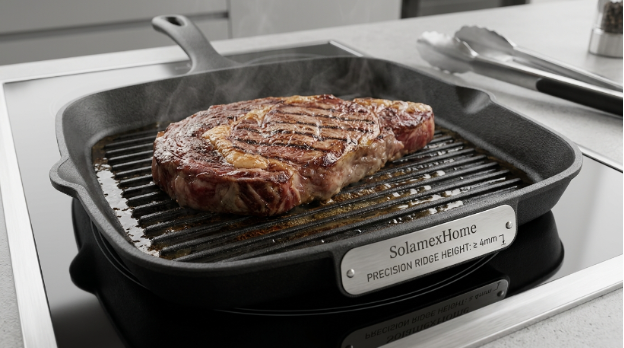
A grill pan works by directing heat from the burner onto metal ridges that sit 4 to 8 millimeters above a cooler valley floor, so protein comes into contact with super-heated metal on the peaks while rendered fat drains below, which gives char lines and Maillard browning without steaming the protein.
That is a difference more buyers do not know. Since only the tops of the peaks touch, the contact area is only about a third that of a flat skillet, so the metal must run hotter to provide the same amount of browning in the same amount of time. Miss that and you get gray meat with slight stripes.
People wonder what is the point of a grill pan when a skillet already browns things wonderfully. Fair question. The answer is drainage and flavor separation, since a skillet cooks your steak in a shallow pool of its own fat, which is soft and delicious. Ridges provide you crust and edge, both on the one cut.
Why use a grill pan instead of the oven broiler? Radiant heat browns the top surface only, whereas the ridges brown from below and let you watch the crust form. The grill pan uses and functions divide up cleanly into three jobs. Searing. Marking. Draining.
⚠ Pro Tip: Do not let beguiling badges or colors fool you, because weighing grill pan uses and benefits is all about ridge height. If it is less than 4 millimeters, the food sits in fat.
Do grill pans work as well as a live charcoal fire? Well, no, you get the conduction char, not smoke. My old boss disagreed for years, for what it is worth, and he was wrong on that point and right on almost every other one. What you do get is repeatability at 7pm on a Wednesday in February.
Metals I Trust After 20 Years, and One I Quietly Stopped Recommending
Material is what determines the pan's performance, not price. Heavy metal holds heat in, so the ridges stay hot when a cold piece of meat is placed on top. Thin budget metal has a rapid cooling effect and never warms up again, which is why those pans stripe so nicely on the first chop and pale on the fourth.
|
Material |
Ridge temp after 90 seconds of contact |
Preheat needed |
Weight, 10 inch |
Where it shines |
|
Heavy cast iron |
455 to 490°F |
Eight to 10 minutes |
5.5 to 6.5 lb |
Thick steak, batch searing |
|
Enameled cast iron |
430 to 470°F |
Nine to 12 minutes |
Six to seven lb |
Acidic marinades, table service |
|
Die-cast aluminum, nonstick |
380 to 420°F |
Three to four minutes |
2 to 2.5 lb |
Fish, weeknight speed |
|
Tri-ply stainless |
400 to 440°F |
Five to six minutes |
3 to 3.5 lb |
Pan sauces after searing |
The classic cast iron grill pan still holds on raw heat storage. There is simply no other thing better through four rounds of seared chicken thighs. However, it is heavy, it rusts if you leave a wet pan on the hob, and it makes me feel uneasy on a glass cooktop. Being honest about my limitations, no one with wrist issues would get one from me.
Where cast iron grill pan uses end, coated aluminum begins. A 10-inch die-cast pan weighs a third of the iron model and heats up faster than the oil does. Athens Elegant Beige Grill Pan operates on that pattern, which accommodates cooks who cook quick and clean faster.
The Coating Question Nobody Asks Until Year Three
Only one number restricts the non-stick grill pan uses, and that is coating service temperature. Repeated pushing past 500°F causes the PTFE to break down, therefore the use of grill pan cookware on full heat is a bad idea, no matter what the packaging claims.
While ceramic coatings handle greater temperatures, they lose their slickness quicker, typically between year two and year four when run in a busy kitchen.
Many customers compare Le Creuset grill pan uses against Lodge grill pan uses and Staub grill pan uses, then discover that size and ridged shape are more important than the label on the handle. Two similar sized pans, with the same height of ridging, will have nearly the same performance, regardless of cost.
What Is a Grill Pan and What Is It Good For?
Well, what to use a grill pan for, exactly, once it is on the heat? Here are nine real-life uses I use mine for, more or less by how often they occur in my kitchen.
1. Steaks and Chops That Sear Instead of Stew
This is where you put thick cuts. The one-inch ribeye browns in three minutes on each side at near 480°F, and drips fat into the valleys rather than boiling in it. All of the trick is in that drainage, and no flat skillet can mimic it perfectly.
2. Chicken Thighs, Which Forgive Almost Everything
Boneless chicken thighs are the winner when it comes to grill pan uses for chicken. Thighs will still be juicy well past 165°F internal, while breasts will already be dry. Pound them evenly, place them skin side down, and allow the ridges to keep the meat off its own rendered fat.
-
1. Even Thickness First: pound the thick end to the thickness of the thin end, or the tips burn.
-
2. Skin Side Down Cold: start on the ridges and let fat render out slowly for a total of four minutes.
-
3. Flip Once Only: each additional flip loses you the crust you just built.
3. Firm Fish That Stays in One Piece
Knowing how to use a grill pan for fish is a lifesaver for dinner. Always oil the fillet, never the pan, preheat until water will skitter, then lay it skin down and leave it unattended for a full four minutes. Well behaved salmon, tuna and swordfish. Cod flakes apart.
-
1. Dry The Surface: pat both sides with paper towel until the surface is no longer shiny.
-
2. Wait For Release: the fillet comes up during the crust phase, but never before.
-
3. Use A Fish Slice: a thin, flexible blade is inserted between ridges, while tongs tear fillets.
4. Vegetables That Char Rather Than Steam
Zucchini planks, green bell peppers cut in half, thick red onion rounds, asparagus spears. Cut everything at least half an inch thick to make sure it crosses the ridges and does not fall through between them. A hot pan and empty space around each piece is more important than seasoning, since vegetables spurt water quickly.
5. Halloumi, Paneer, and Firm Tofu
Grilling cheese is an audacious idea, except when it is halloumi. It has a high melting point, maintains its shape at 400°F, and takes dark stripes in 90 seconds per side. Pressed tofu and paneer are the same. These grilling pan uses turn seasoned skeptics into believers after just one meal.
6. Flatbreads, Naan, and Pressed Sandwiches
The ridges provide a surface for bread to toast in rows, ensuring steam vents beneath and keeping crusts crisp instead of sweating. The time for naan is 40 seconds per side in a dry pan. Sandwiches can be pinned down with a smaller pot to make an adequate panini press for no cost.
7. Shrimp, Skewers, and Fast Weeknight Protein
Shrimp are quick cooks, taking about two minutes total, which makes them ideal when the pan is already hot. Soak wooden skewers in water for 30 minutes first. Metal skewers take heat to the inside and reduce cooking time by one minute, though they become too hot to handle.
8. Stone Fruit and Pineapple for Dessert
Sugar caramelizes when it comes into contact, so peach halves and pineapple rings are covered in deep stripes in two minutes. Remove the savory fat from the pan by wiping it away first. A brush of honey after the sear, but never before, prevents the sugar from becoming bitter on the ridges.
9. Reheating Leftovers Without the Sogginess
Yesterday's chicken is steamed in a microwave. It is reheated in the ridges in approximately three minutes while excess moisture is drained away from the food line down to the bottom, so the skin crisps again. This is the least glamorous on the list, and likely the most frequently used.
⚠ Warning: Never leave a hot grill pan alone with fat pooled in the valleys. Once fat gets above its smoke point it catches fire very rapidly, and a covered pan is all you can do.
A Guide to Indoor Grilling In 5 Steps!
Cooking with a grill pan is no big deal, just the method must be just right. These five things keep the results from being random.
1. Match the Pan to Your Burner
It all depends on the ring size. A gas flame should be contained within the pan base and not licking up the sides, otherwise the sides scorch while the center stays cool.
-
1. Gas Burners: how to use grill pan on gas stove burners comes down to flame width, so keep it under the base diameter and run medium, never max.
-
2. Electric Coils: how to use grill pan on electric stove elements requires matching the diameter of the pan within an inch of the coil's diameter, then increasing the preheat time by two times.
-
3. Induction Hobs: look for a magnetic base, since Vienna White Grill Pan has one, so it heats by the metal of the pan and not by a glowing surface.
2. Preheat Longer Than Feels Sensible
Most failures occur here. Flick water onto the ridges, since the water should bead and sparkle but not hiss and disappear. Cast iron should take eight to 10 minutes on medium heat. Rushing this is the number one reason why people decide indoor grilling does not work.
3. Dry the Food, Then Oil the Food
Surface moisture must go before browning starts, since the boiling point of water is 212°F and browning requires 300°F and higher. Pat everything dry. Next apply a light coat of oil that will not burn too readily to the food itself. Oiling the pan just burns oil into the grooves.
4. Lay It Down, Then Leave It Alone
Arrange food at an angle across the ridges and lay it on with tongs one time, to cover all the way. Then remove your hand from it. Food is released around the 3-to-4-minute mark when the crust is formed.
-
1. Diagonal Placement: place the pieces diagonally at 45 degrees to the ridges, for longer and cleaner stripes.
-
2. Quarter Turn Marks: rotate 90 degrees halfway around one side for crosshatch, if presentation is important.
-
3. Space Between Pieces: crowding rapidly cools the pan and steams anything within seconds.
5. Rest the Food, Reset the Pan
With the pan still hot, remove the meat and allow it to rest for five minutes. Scrape the grooves with a nylon brush now, not tomorrow. Warm residue rises in a few seconds, while cold residue brings a 20-minute chore of soaking and regret.
⚠ Pro Tip: Fat cooks differently when you are cooking on grill pan ridges instead of a flat surface. Half a teaspoon on the food beats a tablespoon in the pan, each and every time.
Which Grill Pan Types Suit Your Stove and Kitchen?
Do not select a shape by how it looks hanging up, but by how your burner is laid out and by household size. Before ordering consider two questions: how many are eating at once, and does my cooktop have a bridge element?
-
Square Pans for Maximum Surface
Most square grill pan uses come down to geometry, since a 10-inch square pan will hold about 27% more food than a 10-inch round pan. Corners accommodate asparagus space while steaks are in the middle. The compromise is the overhang on small burners and the uneven heat at those same corners.
-
Round Pans That Sit Cleanly on One Ring
A round grill pan for stove work is an ideal fit for the burner, giving even heat distribution and no overhang. Sizes range from 9.5 to 11 inches and suit one to three portions. Square Grill Pan for Stovetop is also there for those who went the other way, and both patterns are available in aluminum or cast.
-
Double Burner Models for Bigger Households
The uses of double grill pan designs revolve around volume, since two burners and one long pan cover six to eight portions in one shot. Most double grill pan uses are for family meals and gatherings. Note that the center is sometimes cooler than the ends, unless there is a correct bridge element on your cooking stove.
-
Reversible Pans With a Flat Side
Double sided grill pan uses cover breakfast and dinner, since one side has ridges and one stays flat for pancakes and eggs. The uses of double-sided grill pan models in cast iron add additional possibilities, because the mass supports both jobs. The silent selling proposition is that storage remains simple.
-
Oven-Going Pans for Thick Cuts
Customers inquire about what is a grill pan for oven finishing, and it is simply a pan rated to 500°F with metal or heat-resistant handles. Mark the food on the hob, then bake it in a 400°F oven to bring the center up. Here, Bakelite handles are a no-go, since they do not qualify.
Care Tips That Keep the Grooves Slick for a Decade
One of the keys to the longevity of a pan is maintenance. Long-term uses of grill pan cookware come down to two habits: heat it dry, oil it thin. The uses of cast iron grill pan surfaces expand as seasoning develops, since polymerized oil fills micro-pits and food adheres less each month. Iron grill pan uses genuinely get better with age, which is not the case with all cookware.
-
Nylon Brush Only: metal wool strips seasoning and scores coatings permanently.
-
Warm Water Wash: avoid long soaks, since standing water begins to rust within hours.
-
Dry Over Heat: 30 seconds on the burner dries the moisture out of the grooves.
-
Thin Oil Film: clean cast iron using an almost dry cloth and buff until it resembles a pan with no oil on it.
-
Skip The Dishwasher: EN12875 dishwasher compliance refers to coated aluminum, not to raw iron.
There are different guidelines for coated pans. Before the pan comes in contact with water, cool it down first, since thermal shock can warp thin bases and craze coatings. Cloth should be placed between stacked pans when storing. Daily grill pan use with wooden or silicone utensils will last about twice as long as the same pan used with metal tongs.
Are Grill Pans Worth It Over Five Years?
Yes, because if you do not have any outdoor space the total cost of owning the pan is about $85 over five years, while a charcoal setup with fuel is $500 or up, and the pan is used 200 nights per year versus 20 weekends per year when the weather cooperates.
|
Cost line |
Nonstick aluminum |
Heavy cast iron |
Charcoal kettle grill |
|
Purchase price |
$25 to $45 |
$40 to $80 |
$120 to $300 |
|
Replacement cycle |
Every two to three years |
20 years plus |
Seven to 10 years |
|
Annual consumables |
$0 |
$4 seasoning oil |
$60 to $90 charcoal |
|
Five-year total |
$60 to $110 |
$45 to $85 |
$420 to $750 |
|
Cleanup, per cook |
Two minutes |
Four minutes |
15 to 20 minutes |
Those are in USD, while UK buyers spend about £20 to £65 for similar pans and Canadian buyers about CAD 35 to 105. It happens in each market, and I am told by wholesale partners that the same questions arrive everywhere, including customers asking about grill pan uses in Hindi before they place an order for a container.
Line cooks use grill pan markings as shorthand, and that is why plates look like they do in restaurants. At home the benefits of grill pan cooking are quieter: less splatter, less oil, honest browning. Does a favorite skillet need replacing? Honestly, it is up to how much more than twice a month you eat steak. Determine that number only.
Weight limits are also a consideration for everyone using grill pan cookware on a glass cooktop, since manufacturers often restrict load capacity at around 25 lbs, and a full cast iron pan with contents comes extremely close.
People Also Ask
Do Grill Pans Work On Induction Hobs?
Yes, as long as the base is magnetic. Cast iron always works. Aluminum pans require a bonded steel disk or a perforated induction base, so be sure that this is written on the product specs, particularly on lighter models.
What Is The Best Grill Pan Size For A Family Of Four?
Eleven inches, or a double burner model. Anything lower than 10 inches requires batch cooking, which will lower pan temperature per round and result in unequal marks across the meal.
How Do You Use Grill Pan Cookware On A Glass Cooktop Safely?
Lift, never slide. Cast iron scratches the ceramic glass for good, and dropped pans crack it. Do not exceed the manufacturer load limits, typically 25 lbs including food.
Do Grill Pan Uses In Hindi Home Cooking Translate The Same Way?
Yes, almost entirely. Ridges are good for tandoori chicken, paneer tikka and seekh kebabs, though naan bread requires a hotter, drier surface than the marinated proteins do.
Are Grill Pan Recipes Different From Outdoor Grill Recipes?
Mostly not, with one caveat. Cut down on marinade sugar by roughly one-third, since sugars burn more quickly on a pan that holds oil than they do over an open flame.
Conclusion
I will not be fooling anybody, since there is absolutely no substitute for the live thing. But the uses of the grill pan make up 90% of any Tuesday night in the kitchen. Shop Solamex Home's selection of grill pans and griddles, choose your trusty metal, then preheat accordingly. Heat and patience do the rest, every single time.
Why a Good Lid Matters? - The Key to Better Flavor & Faster Cooking!
The Benefits of Using a Reusable Water Bottle! The Ultimate Guide!