Best Cookware for Gas, Electric, and Induction Stovetops
Introduction
Are all cooking vessels compatible with all stoves? Depending on the heat source you use, material greatly influences thermal properties. Finding the best cookware material provides a highly conductive core and exceptional resistance. Expert insights feature within this definitive reference to achieve top-quality cooking today.
Not all cooking vessels are compatible with all types of stoves. Depending on the heat source you use in your kitchen, the material used in pots and pans greatly influences thermal properties, safety, and energy efficiency. Cookware crafted with clad stainless steel or heavy gauge ferromagnetic metal provides a highly conductive core and exceptional resistance to heat, making it the top choice for gas, electric, and induction stoves.
Depending on the unique mechanics of your stovetop, other materials like raw cast iron, seasoned carbon steel, and hard-anodized aluminum may work even better for your culinary techniques. This is the definitive reference for every type of burner, featuring expert insights into material science to achieve top-quality cooking at home.
Key Takeaways
-
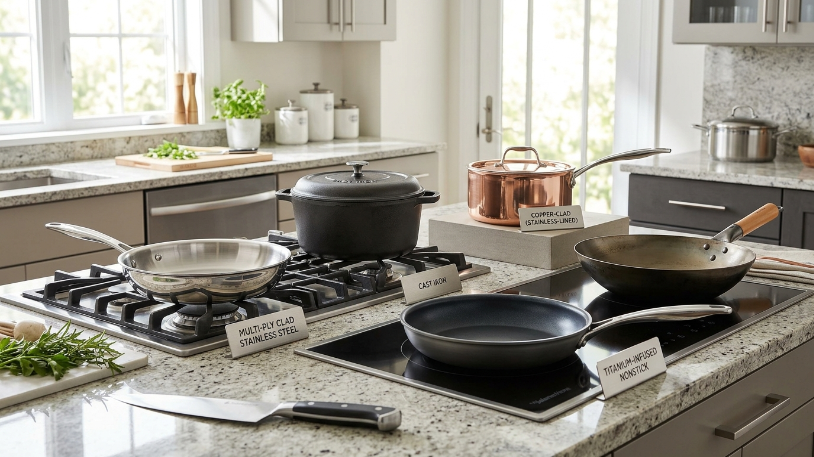
Optimal Versatility: Multi-ply clad stainless steel with an aluminum or copper core provides reliable performance on gas, electric, and induction surfaces.
-
Induction Requirements: An induction hob strictly requires a ferromagnetic base. Use a regular refrigerator magnet to test whether you can use your pots and pans before buying higher-quality cookware collections.
-
Gas Precautions: For gas flames, heavy-duty stainless-steel rivets and well-insulated, stay-cool handles are an absolute safety factor for any pan used every day.
-
Electric Requirements: Do not use thin, unclad aluminum pans on smooth glass electric tops, since this may cause a "spinning pan" effect due to the buckling of the base and thermal shock.
Material Performance Comparison
|
Feature |
Clad Stainless |
Cast Iron |
Carbon Steel |
|
Heat Retention |
High |
Unrivaled |
Moderate |
|
Gas Performance |
Excellent |
Great |
Excellent |
|
Induction Ready |
Yes |
Yes |
Yes |
How To Select The Most Effective Cookware?
The ultimate distinction between a perfect sear and an unevenly cooked meal lies in the matchup between the metallurgy of the pan and the physics of the stove. These materials represent the cutting edge of culinary engineering.
What is Multi-Ply Clad Stainless Steel?
Multi-ply clad stainless steel is defined as cookware where each layer is coated with an aluminum or copper core that guarantees fast, uniform heating and maximum product durability.
Each layer of the stainless steel cookware is coated with an aluminum or copper core that guarantees fast, uniform heating and maximum product durability. Multi-ply clad stainless steel is often considered the best cookware for gas stove setups.
Not only is the surface non-reactive while cooking, but it also possesses exceptional heat retention. You can use it with medium heat in high-heat cooking techniques, especially searing, to prevent localized hot spots that burn and stick to the food.
Dishwasher safe and more warp-resistant than most models on the market, it remains the single best solution for any modern stovetop. Explore 3-Ply Stainless Steel Cookware for top-tier durability.
Performance & Application Breakdown
-
Ideal for: Daily cooking, searing, and the reduction of acid marinades.
-
Gas Stoves: Excellent. It is resistant to direct flames and will not scorch the inside base.
-
Electric Stoves: Excellent. The base is extremely stiff and heavy, maintaining absolute flatness for uninterrupted conductive contact.
-
Induction Stoves: Excellent. Most higher-grade clad sets are made from a magnetic 430-grade stainless steel exterior designed specifically for induction coils.
-
Heavy-Duty Cast Iron
Cast iron pots and pans guarantee unrivaled heat retention, ensuring even, consistent temperatures throughout, regardless of what is put in the pan. When used on electric stovetops, the power cycling may feel excessive, but the density of the cast iron holds it together through all cycles, casting heat far more evenly than gas flames distribute it.
Performance & Application Breakdown
-
Ideal for: Deep roasting, slow braising, baking, and heavy crust searing.
-
Gas Stoves: Great. It resists very hot flames and spreads the heat evenly across the surface area.
-
Electric Stoves: Good. It can be used safely on glass tops if positioned properly and not dragged across the ceramic.
-
Induction Stoves: Excellent. Being ferromagnetic by nature, it is extremely responsive to induction energy.
-
Carbon Steel
When seasoned correctly, carbon steel cookware reaches a boil in lightning-quick time and develops a beautiful, natural nonstick surface. Compared to cast iron, it is much lighter and easier to handle, making it a favorite among the best cookware brands in the restaurant industry for high-heat situations.
It provides quick heating and cooling to ensure precision cooking alongside the durability needed for heavy use, easily making it the best cookware for induction cooktop models.
Performance & Application Breakdown
-
Ideal for: High-heat foods, stir-frying, fast searing, sautéing, and gentle protein cooking.
-
Gas Stoves: Excellent. It is ideal for tossing things on an open fire to use the Leidenfrost effect.
-
Electric Stoves: Great. The flat base design of quality carbon steel allows highly stable contact.
-
Induction Stoves: Excellent. It offers precise temperature adjustments through the immediate reaction of the iron composition to magnetic fields.
-
Copper-Clad (Stainless-Lined)
Premium copper-clad cookware is made of a pure copper exterior, a pure copper conductive core, and a non-reactive stainless steel interior. The thermal conductivity of copper is the absolute highest available on the market, reacting to a temperature change immediately when the dial is turned. It is the most sought-after option among master chefs who need complete granularity regarding their heat sources.
Performance & Application Breakdown
-
Ideal for: High-precision cooking, making refined sauces, sugar work, and temperature-sensitive proteins.
-
Gas Stoves: Exceptional. It increases the visual feedback and immediate response of an open flame.
-
Electric Stoves: Good. It needs careful handling when placed on glass tops to prevent metal transfer marks.
-
Induction Stoves: Fair to Poor. A special induction interface disk must be used with pure copper, which greatly reduces heating efficiency.
-
Titanium-Infused Nonstick
Clad with heavy gauge stainless steel, advanced titanium-fused nonstick cookware features a finely milled, highly durable, reinforced nonstick cooking surface. Made entirely free from harmful chemicals, making titanium-infused nonstick the best cookware material for health, it is perfect for cooking delicate ingredients. This ensures the best cookware nontoxic performance while cooking delicate ingredients.
The multi-ply construction guarantees the pan does not warp when heated directly, maximizing contact with the burner at all times.
Performance & Application Breakdown
-
Ideal for: Low-fat diets, making perfectly sliding eggs, sliding fish, and easy cleanup.
-
Gas Stoves: Great. The clad base offers excellent protection to the nonstick coating from localized flame hotspots.
-
Electric Stoves: Excellent. It lies perfectly flat on glass tops for even, low heating.
-
Induction Stoves: Excellent. Fitted with a magnetic steel base, it offers quick, efficient nonstick action for uniform results.
-
Hard-Anodized Aluminum
Hard-anodized cookware has been chemically hardened to be much stronger than regular aluminum, making it lighter in weight and resistant to scratches while being a top-notch heat conductor. Highly efficient and economical, it usually features a nonstick coating, meaning it handles only the medium or low-heat applications commonly used in everyday domestic kitchens. Check out Granistone Tube for an economical choice.
Performance & Application Breakdown
-
Ideal for: Daily use, low-heat cooking, and basic sautéing.
-
Gas Stoves: Good. It heats quickly, but care must be taken with flame size to prevent damage to the outer layer.
-
Electric Stoves: Excellent. The smooth platform is highly suitable for normal glass-top ranges.
-
Induction Stoves: Poor. Unless specially prepared with a bonded magnetic base plate, hard-anodized aluminum will not trigger an induction coil.
-
Enameled Cast Iron
Enameled cast iron combines the beautiful warmth retention found in raw iron with a protective, non-reactive glass-enamel finish. This successfully avoids manual seasoning and allows for the lengthy simmering of acidic liquid seasonings, like tomato sauces or wine reductions, without influencing the food with a metallic flavor, effectively providing the best cookware for health.
Performance & Application Breakdown
-
Ideal for: Slow-cooking stews, braising meats, and day-to-night cooking.
-
Gas Stoves: Great. It easily accepts long, low-flame simmers and seamlessly maintains the heat temperature.
-
Electric Stoves: Good. The smooth enameled underside won't harm a glass-top stove like raw cast iron does.
-
Induction Stoves: Excellent. The total magnetic strength and efficiency of the iron core remain complete.
Understanding The Qualities Of A Versatile Cookware Set
|
Cookware Base |
Thermal Transfer |
Warp Resistance |
|
Thick Base |
Optimal |
High |
|
Thin Budget Base |
Poor |
Low (Fails test) |
Versatile cookware consists of skillfully designed pots and pans made from multi-layered metals to conduct heat with the highest levels of efficiency on gas stovetops. They maintain absolute flat-bottom stability on electric stoves and remain highly responsive to instant cooling and heating on induction hobs. Consider the Forged Aluminium Dark Green Series Cookware Set for absolute flat-bottom stability.
These premium products feature a ‘tri-ply’ or ‘fully clad' construction, fusing surgical-grade stainless steel to highly conductive materials such as aluminum or pure copper.
Cookware addresses three conflicting problems: rapid heat transfer, thermal energy conservation upon loading cool ingredients, and structural integrity under massive thermal stresses. After just six months of high-heat abuse, about 80% of budget pans completely fail the flatness test.
The Importance of Material Thickness
With a thicker cookware base, hot spots and warping disappear because substantial mass spreads the heat evenly throughout the cooking surface. On an electric stove, where the heating element intensely cycles on and off to achieve a desired temperature, a thick base acts as a thermal battery.
It actively maintains the cooking temperature even when the burner is required to cycle off. If your ingredients stop sizzling during one of these cycles, the material used to make that pan is far too lightweight to distribute the heat effectively.
The Heat Of Gas Cooking
Gas cooking relies on the direct combustion of natural gas or LPG to produce a visible, adjustable flame that conveys thermal energy to the base and side walls of the cookware through convection and radiation.
While this traditional approach is known for being highly responsive and providing immediate visual feedback, it remains hugely inefficient from an energy perspective. According to normal industry data, the heat transfer efficiency of a domestic gas stove is only 35% to 40%.
Most of the resulting heat is lost to the kitchen environment as waste heat. Furthermore, gas flames form a continuous "ring of fire," aggressively heating the perimeter of the pan rather than the absolute center.
Since thermal energy eagerly climbs the sides of the cookware as it escapes, using pots with good, heavy-duty insulation in the handles is crucial. Lower output gas burners will not cause a synthetic handle to soften or melt outwards.
How About Gas in Real Life?
Gas stoves facilitate kinetic cooking methods in the kitchen, like tossing food over an open flame. This briefly vaporizes the oils and juices, giving unique char flavors strictly associated with the Leidenfrost effect. Because the thermal distribution in a gas ring is inherently uneven, cooks need to use materials with a high level of thermal conductivity—such as copper or thick-clad aluminum—to quickly remove heat from the edge of the pan and prevent burning.
Problems And Remedies For The Electric Stove
Electric stovetops include all the old-fashioned exposed coils and the newer smooth, glass-topped variants. They heat entirely by direct conductive contact with the base of the skillet, pot, or cooking pan.
The heat that envelops a gas flame is quite different from electric conduction, as absolute precision is necessary in the latter. Heat transfer efficiency drops significantly when there is even a small gap or bow between the pan and the glass surface. This structural failure results in the "spinning pan" effect. The problem with an imperfect base is that the pan will wobble on the plate, heat unevenly, and easily scratch the thin ceramic surface of the cooktop.
Premium 3-ply cladding (steel-aluminum-steel) is strongly recommended as the best cookware for glass top stove variants, as this special construction withstands the thermal warp caused by the accelerated expansion of thin metals.
Pans that warp are almost always made from thin, unclad aluminum subjected to high thermal stress that caused the metal to bend. Options like Ceramic Cookware seamlessly withstand the thermal warp caused by the accelerated expansion of thin metals.
Can Cast Iron Be Used on Glass Electric Tops?
Yes, cast iron cookware is perfectly safe for use on a glass electric cooktop, provided it is lifted rather than dragged from the spot. Micro-scratches or cracks will occur if heavy, rough iron is slid over the ceramic glass. The superior thermal characteristics of cast iron offer an overwhelming benefit on electric stoves, counteracting the inherent power cycling they regularly exhibit.
Efficiency Of Induction And Magnetic Requirements
Induction cooking employs elaborate copper coils that produce an oscillating electromagnetic field, creating a current directly within the molecular structure of the cooking vessel. This technology actually transforms the pan itself into the heating element.
Induction thermal transfer rates between 84% and 90% are the ultimate standard in heat transfer. Wasteful heat is almost entirely eliminated since the ceramic surface of the stove cannot heat itself; it is only warmed by the residual heat of the hot pan. However, this technology has a very stringent operational requirement: the cookware base must possess high ferromagnetic properties.
Kitchen utensils like pure aluminum pots, traditional copper pots, and non-magnetic stainless steel pots are unusable if you are converting your kitchen from gas to induction. If the ferromagnetic base is absent, the induction sensors will not engage, and the stove will not warm up.
How Exactly Does Induction Compatibility Work?
Using induction technology, the cooktop utilizes an electromagnetic field to speed up the induction of iron electrons within the metal matrix, which is exactly why the base must be ferromagnetic. A regular magnet should easily stick to your cookware's bottom if it can communicate with induction technology.
Some manufacturers try to stamp a thin layer of magnetic steel onto the bottom of an aluminum pan as an after-treatment, but this ‘impact-bonded’ base is not nearly as effective, nor is it free from the annoying acoustic noise avoided by fully clad, multi-ply cookware.
Choices To Make For Your Kitchen
When choosing the absolute best pot and pan options for a gas, electric, or induction stovetop, one needs to examine material details rather than marketing jargon. Fully clad, multi-ply stainless steel has always been the most logical, professional, and user-friendly option if you intend to invest in a heavy-duty cookware collection that will stand up to all these challenges and endure future kitchen improvements.
It effortlessly withstands the harsh peripheral heat of an open gas flame, maintains the absolute structural flatness necessary for glass-top electric conduction, and works perfectly with the electromagnetic sensors of high-end induction ranges.
High-quality cookware directly impacts the day-to-day efficiency of your lifetime. Investing a little more in a premium pan set now means you will not be replacing warped, inefficient, or incompatible pans in three years.
You should evaluate your choices based on your existing stovetop setup, the possibility of an induction transition in the near future, and the composition of cookware that will comfortably fit into your culinary home. The basic science of heat transfer will never change, and by making a smart material investment today, you will see the absolute benefits throughout your continued culinary career.
Conclusion
Evaluating choices based on your existing stovetop setup remains crucial for success. Selecting the best cookware set 2026 directly impacts the day-to-day efficiency of your lifetime. Basic science regarding heat transfer will never change. Making a smart material investment today guarantees absolute benefits throughout your continued culinary career. Visit SolamexHome to explore premium multi-ply pan sets.
Common Cookware Mistakes That Can Damage Your Pans
What Cookware Do Professional Chefs Use At Home?