Drinkware Bulk Supplier VS Local: Which is Cheaper?
Introduction
Do you want to lower your hydration costs in a corporate setting? Purchasing from a drinkware bulk supplier decreases unit prices compared to local retail networks. Our technical breakdown evaluates global freight logistics alongside specific margin differences for industrial manufacturing buyers. We use material tolerances to guide professional purchasing decisions in the current year.
Direct Cost Analysis: Drinkware Bulk Supplier vs Local Sourcing!
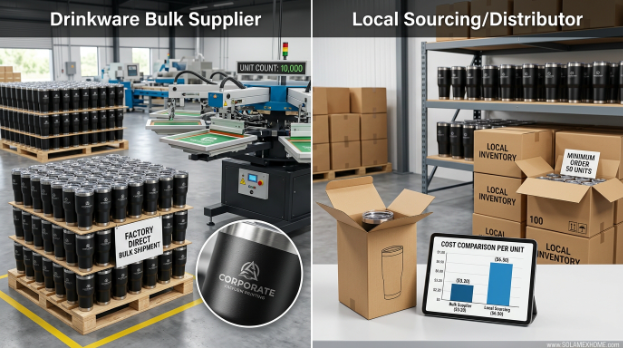
Buying agents must decide to buy from the factory or to purchase from regional distributors. Selecting a drinkware bulk supplier removes the mid-level warehousing margins from the final bill. Local suppliers apply a large markup of 30 to 50% to cover their storage costs and regional logistics.
Factories run on massive economies of scale, and continuous molding cycles at high-volume plants decrease the price per unit. Are you calculating landed costs or looking at raw unit pricing for your items?
To perform a true cost assessment, you need to evaluate the whole supply chain and its moving parts. I remember my 1st large corporate order where a local vendor overcharged us by 40% for simple water bottles. 10,000 double-wall vacuum tumblers from a domestic warehouse may cost $6.50 each. A direct drinkware bulk supplier prices that same unit at $3.20, and this leaves enough money for ocean freight and customs duties.
|
Cost Metric |
Drinkware Bulk Supplier |
Local Regional Distributor |
Justification |
|
Raw Unit Price |
$2.80 - $3.50 |
$5.50 - $7.50 |
Eliminates wholesale broker margins. |
|
Customization Cost |
$0.15 per color |
$0.50 per color |
Factories utilize automated multi-station silk screen machines. |
|
Lead Time |
35-45 Days (Sea Freight) |
5-10 Days (Ground) |
Local holds inventory; direct requires manufacturing time. |
|
MOQ Requirements |
1,000 - 3,000 units |
50 - 100 units |
Direct manufacturing requires massive raw material inputs. |
Material Specifications from a Drinkware Bulk Supplier!
Industrial purchasers need materials with high metallurgical and chemical compositions for their daily production. A certified drinkware bulk supplier will show raw material data sheets that prove regulatory compliance for the buyer.
In manufacturing, vague terms like high quality have 0 meaning, so buyers need clear data and statistics that they can verify. According to the Action Stainless, "Stainless steel is a material of choice for food contact applications due to its excellent corrosion resistance."
Stainless Steel Alloys: 304 vs 316 Grade
Factories use austenitic stainless steel for thermal containers to keep beverages hot or cold. Alloy grades determine the corrosion resistance and the maintenance of structural integrity when the metal is under pressure.
-
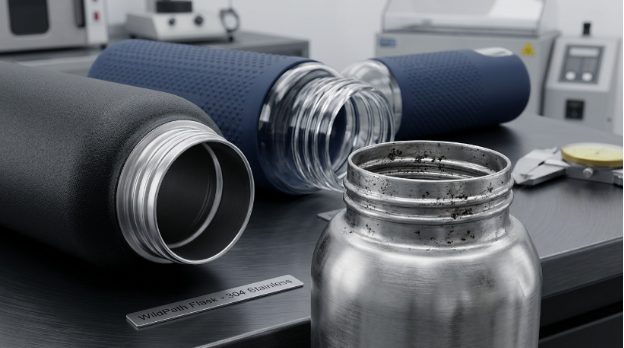
304 Stainless Steel (18/8): It contains 18% chromium and 8% nickel, and the yield strength hits 215 MPa. This makes it a perfect foundation for 3 Ply Stainless Steel Cookware.
-
316 Stainless Steel (18/10/2): It increases the mix with 2 to 3% molybdenum, and it withstands high salinity environments.
-
Wall Thickness Tolerances: Premium models have an inner wall thickness of 0.4mm and an outer wall of 0.5mm to prevent dents.
Borosilicate Glass Tolerances
High thermal shock resistance is critical to glass components used in modern manufacturing facilities. The standard soda-lime glass breaks when it goes under a rapid temperature change.
-
Coefficient Of Thermal Expansion: The borosilicate glass has a standard rating of 3.3 x 10^-6 per Kelvin.
-
Thermal Shock Resistance: The glass survives a sudden temperature change of 165°C, and it stays free from structural damage.
-
Annealing Process: Factories hold the glass at 560°C in an annealing lehr, and this reduces internal manufacturing stresses.
Tritan Copolyester Metrics
Polymer drinkware faces the challenge of eliminating harmful bisphenol chemicals while it withstands commercial industrial dishwashers.
-
Impact Resistance: The Tritan material features a notched Izod impact strength of 650 Joules per meter to improve overall durability for products like the Premium Cookware with Silicone Grip.
-
Glass Transition Temperature: The material is able to handle up to 110°C of heating before the shape begins to deform.
-
Chemical Resistance: The plastic is resistant to breakdown by typical citrus oils and standard industrial alkaline cleaners. According to the FDA, "Food contact substances must be safe for their intended use before going to market."
Manufacturing Components: How a Drinkware Bulk Supplier Engineers Quality?
An entire bottle coordinates ultra-precise sub-components to deliver the best user experience. A top-tier drinkware bulk supplier monitors the exact tolerances of each individual gasket, thread, and vacuum seal.
Vacuum Insulation Technologies
Thermal retention relies on the vacuum gap located between the 2 metal steel walls.
-
Vacuum Level: The industrial brazing furnaces can achieve a deep vacuum down to 10^-3 Pascals.
-
Getter Materials: Factories pump an alloy pill of zirconium, vanadium, and iron into the vacuum chamber to absorb any residual outgassing.
-
Copper Plating: Factories immerse the outer surface of the inner steel wall in a 0.1-millimeter copper layer to reflect thermal radiation.
Lid Sealing Mechanisms
Leak-proof designs depend on perfect thread alignment along with the proper amount of gasket compression.
-
Silicone Gaskets: Facilities must use food-grade liquid silicone rubber with a Shore A hardness level of 50 to 60.
-
Compression Set: The gaskets should not have more than 15% permanent compression set deformation after 1,000 testing cycles.
-
Thread Pitch: The injection-molded polypropylene lids must register using a 3-millimeter thread pitch to lock against the steel collar.
|
Component |
Material Parameter |
Specification |
Tolerance Limit |
Technical Function |
|
Vacuum Gap |
Brazing Pressure |
10^-3 Pa |
10^-9 mbar L/s |
Thermal Retention |
|
Getter Pill |
Zr-V-Fe Alloy |
400 C Temp |
10 Torr L |
Absorb Outgassing |
|
Inner Wall |
Copper Plating |
0.1 mm Thickness |
0.02 Emissivity |
Radiation Reflection |
|
Lid Gasket |
LSR Silicone |
Shore A 50-60 |
15% Set 1000 Cycles |
Leak Prevention |
|
Lid Thread |
Polypropylene |
3 mm Pitch |
1.5 Nm Torque |
Collar Locking |
Drinkware Manufacturing Tolerances And Technical Specifications!
Supply Chain Logistics: Drinkware Bulk Supplier in Global Markets!
Importing large shipping containers is a hard task that calls for serious mathematical planning. A verified drinkware bulk supplier optimizes carton dimensions, and this action maximizes the payload of the shipping containers.
Freight Capacity and TEU Metrics
Shipping empty air destroys your profit margins in the global trade business. Factories use standardized master cartons that match trade-related ISO shipping container dimensions.
-
Standard 20ft Container (TEU): This container presents about 28 cubic meters of cargo space, and it holds 18,000 units of standard drinkware or Light Weighted Fry Pans.
-
40ft High Cube (40HQ): This container gives 68 cubic meters of usable space, and it accommodates 45,000 individual units.
-
Palletization: European buyers need to ship their cargo on Euro pallets wrapped in 25-micron stretch film to provide structural strength.
Regional Port Constraints
Local geographic factors drive the speed and cost of global shipping logistics. Metal cargo needs special attention and moisture mitigation in the humid atmosphere near ocean ports.
-
Desiccant Usage: Montmorillonite clay packets sit inside each master carton to absorb moisture and prevent flash rusting on unprotected steel components.
-
Drayage Logistics: Taking on the chassis shortage at large ports requires you to book trucking assets 2 weeks before the vessel arrives.
Troubleshooting Defect Rates with Your Drinkware Bulk Supplier!
Manufacturing realities lead to a certain level of defective units on the assembly line. Professional buyers negotiate acceptable defect rates before they wire the initial deposit to the factory.
Does your existing vendor give you certified testing reports for your corporate inventory? We lost an entire shipment because the vacuum seals broke inside the curing oven during powder coating.
-
Scenario 1: Some internal vacuum seals break during the powder coating phase of production.
-
The Reality: Tumblers run through a hot curing oven at 200°C for 20 minutes, and this melts inferior vacuum brazing.
-
The Fix: A commercial drinkware bulk supplier uses lead-free solder with a high melting point over 600°C for the bottom bead.
Customization Tolerances: Drinkware Bulk Supplier Print Capabilities!
Applying a brand logo takes a lot of industrial precision and advanced printing technology. Local print shops employ lower-tier equipment, yet a true drinkware bulk supplier uses $1,000,000 automated printing lines.
Laser Engraving Depths
Laser machines take off the outer powder coating, and this exposes the raw stainless steel.
-
Focal Length Precision: The entire amplification of a fiber laser is carried out at a specific 1064nm wavelength.
-
Ablation Depth: The precise ablation depth of the beam must be between 0.05 millimeters and 0.08 millimeters to protect the steel wall.
-
Rotary Attachments: CNC-controlled rotary axis mounts must be included for cylindrical objects to prevent the distortion of the image on the curve.
Silk Screen Adhesion Standards
Ink flaking destroys a brand reputation in the consumer goods market. The ink adhesion must endure intense physical stress and harsh chemical stresses during daily use. My team spent weeks trying to fix a flaking logo issue until we switched to a vendor using proper UV curing.
-
Ink Curing: The special UV-curable inks travel under a 395nm LED lamp for rapid polymerization and fast drying times.
-
Cross-Cut Tape Test: Quality control engineers cut a lattice design into the ink, and they use pressure-sensitive tape to tear it.
-
Scenario 2: The printed logo becomes loose and falls off after running through an industrial dishwasher.
-
The Reality: The powder coated surface has a high tension that does not allow the wet ink to bond.
-
The Fix: Factories must put the metal tumblers through a corona treatment station to bring the cup surface energy to optimal values.
Evaluating the Total Cost of Ownership with a Drinkware Bulk Supplier.
Procurement is about much more than looking at the final invoice price. The total cost of ownership takes into account the defect rates, communication delays, and regulatory compliance risks.
Have you experienced a broken vacuum seal during a large powder coating run? According to the Global Supply Chain Quality Report, "Working with a compliant supplier mitigates legal liability."
-
Compliance Audits: The manufacturing factories are required to have up-to-date business social compliance initiative audits to prove their ethical labor practices.
-
Material Testing: The purification units need proper migration test certificates from recognized agencies because the components are in contact with liquid, which is an essential standard for Stockpots & Soup Pots.
-
Payment Terms: The standard terms require a 30% deposit before the raw material purchase, and the balance is payable against the copy.
5 Common FAQs!
Find out the simple answers to common questions among our corporate procurement customers.
Is It Cheaper To Buy Drinkware In Bulk?
Yes, buying in bulk from a drinkware bulk supplier cuts out local warehousing markups, and this results in much lower unit prices.
How Do I Find A Reliable Wholesale Drinkware Supplier?
Check their audit reports and material testing certificates to see if the drinkware bulk supplier owns its own injection molding and vacuum brazing factories.
What Is The Minimum Order Quantity For Custom Drinkware?
A real manufacturing drinkware bulk supplier has a minimum order quantity of around 1,000 to 3,000 pieces to justify machine setups.
Can You Put A Logo On Bulk Stainless Steel Tumblers?
A professional drinkware bulk supplier uses rotary fiber laser engraving or silk screening to fuse your logo onto the powder-coated surface.
What Is The Difference Between 304 And 316 Stainless Steel Drinkware?
Some buyers call for 304 grade stainless steel as a standard option, while others add molybdenum to create a corrosion resistant 316 grade.
Conclusion
You can achieve high margins when you remove regional middlemen. A proven drinkware bulk supplier gives you tight quality control and predictable global supply chains. You can optimize your corporate inventory in the current market without standard retail markups. Visit SolamexHome to learn about engineered hydration solutions and request specific technical specifications for your next order.
3-Ply Vs. 5-Ply Stainless Steel (Does More Layers Matter?)
Glass Water Bottle Manufacturer: How To Source Elite Solamex Quality?