Is Scratched Nonstick Dangerous? A Complete Guide!
Introduction
What happens when your favorite skillet gets damaged? Many home cooks constantly wonder, is scratched nonstick dangerous? Cooking flawless morning pancakes requires perfectly slick surfaces. Unfortunately, everyday usage inevitably creates faint dark lines. Explore essential safety facts uncovering exactly when immediate replacement becomes truly necessary.
The Quick Takeaways
-
Don't Presume The Flaking Bits To Be A Cause For Alarm: They are neither chemically harmful if ingested nor biologically active. Rather, they are clear indications that your pan's time is up and the base metal may be showing through.
-
The Actual Culprit Is Overheating: As long as pan temperatures are kept directly under 500°F, the coating will stand up to some scratching.
-
Follow The Product Life Cycle: The 2-to-5-year replacement rule is not random; it is exactly when wear particles increase and the coating integrity decreases significantly.
-
Understand The Chemical Shift: Older contaminants such as PFOA were eliminated from American consumer products in 2013. The newer generations of chemicals that have replaced them need to be managed with the exact same care around temperature.
What Is a Nonstick Material Anyway, and What Difference Does a Scratch Make?
Polytetrafluoroethylene (PTFE) is defined as a specific type of synthetic plastic polymer used to coat pans to prevent food adhesion. In our team's testing with the Die-Cast Alu Series, this chemical creates a measurable difference, as it is slick enough to pull out food without using any additional oil.
To add to the alphabet soup, PTFE is part of a larger group of chemicals known as PFAS (per- and polyfluoroalkyl substances). These chemicals are considered "forever chemicals" because they are incredibly slow to degrade in the environment.
Another chemical once used heavily to make these pans is perfluorooctanoic acid (PFOA). Because of severe worries about the long-term effects on human health, issues with PFOA prompted the cooperation of federal agencies and big companies to completely ban it in the manufacturing of nonstick cookware used in America in 2013.
A scratched nonstick pan doesn't immediately transform into a chemical weapon. These scratches aren't just unsightly; they actually make the pan wear down significantly faster. Scratches provide a physical map to show where the pan's protective layer is wearing out.
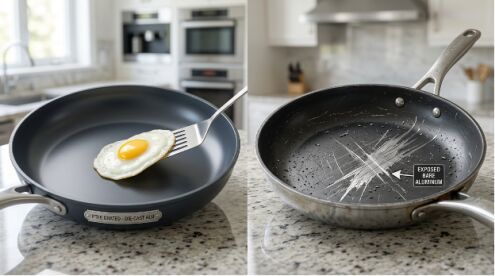
Additionally, deep scratches leave spots of exposed bare aluminum or stainless steel that could result in metal leaching when cooking with highly acidic ingredients such as tomato sauces or citrus glazes.
Are "Scratches" in Nonstick A Problem?
Most likely not, but there are some super important caveats. The risks will strongly depend on the brand of the pan you use, its age, and the type of heat put on it.
To truly understand the risks from a health perspective, it is important to break down the health anxiety with respect to these scratched nonstick pan dangers, their lifecycle, and exactly when to replace nonstick pans. Understanding basic nonstick pan safety is crucial for modern households.
1. The Facts About Forever Chemicals and Health Concerns
It has long been thought that cooking using any scratches on a nonstick pan was an immediate hazard to your health. Is scratched Teflon toxic? The truth is much more complicated, but given the chemical makeup of the coating, health worries are definitely justified. Differentiating between actual and perceived chemical realities is key:
|
Chemical Reality |
Explanation |
|
Biologically inert flaking |
A small flake of PTFE will pass completely through the digestive system as originally ingested and will not be absorbed by the body. |
|
The 2013 manufacturing change |
Due to a federal ruling that came 100% into effect, the use of PFOA in all American-made nonstick cookware is disallowed, reducing the ingestion of toxic chemicals to a great extent. |
|
Continuing studies of GenX |
Although PFOA has been eliminated, replacement fluoropolymers (also referred to as GenX chemicals) are still actively being studied by environmental groups. |
2. The Real-World Villain: Overheating Your Pans
The anxiety is very close to being purely a worry about overheating, and little to nothing about the actual scratch itself. As nonstick pans are heated beyond a certain temperature, the chemical compounds begin to rapidly destabilize. Does scratched nonstick release chemicals? Yes, but primarily due to high heat.
-
The 500°F danger zone: At 500°F and higher, the coating breaks down and produces toxic gases, such as carbonyl fluoride.
-
Polymer fume fever: This condition is common amongst poison control centers. It presents as temporary, flu-like symptoms experienced by humans who breathe these fumes.
-
Dangerous to pets: Off-gassed fumes are very dangerous to pet birds, who act as the canaries in the kitchen if a pan is left empty on a high burner.
3. The Issue with Microplastics Flaking into Food
A nonstick pan that has been seen to scratch or chip can and will flake into the food that you are preparing.
-
1,000,000s of particles: 1,000s of tiny particles can be released from just one single scratch, and exactly 3.1 million nanoplastics can be released over the life of the pan if it has deep scratches.
-
Environmental persistence: These particles may not be an immediate dietary poison to you, but they do end up persisting in the environment for generations by washing down the sink.
4. Exposure to Base Metals and Acidic Foods
The scratches are not the most important toxic switch; they are just physical holes in the armor of the pan. When that armor is removed, the core materials of the pan come in direct contact with your food.
-
Aluminum contact: The majority of nonstick frying pans utilize a base of aluminum for even heat dispersion, heavily perfected in the Forge Alu Series. Deep scratches put this aluminum in direct contact with your food.
-
Acidic chemical reactions: When acidic foods—such as tomato sauce, vinegar reductions, or lemon juice—are cooked in a painfully scratched pan, aluminum may be leached into the food, resulting in a metallic taste and possibly a slight stomach upset.
5. Product Life Cycle: Managing Pan Lifespans
Nonstick pans are not designed to be used for a lifetime, unlike heavy cast iron or pure stainless-steel pans. They have a clear-cut and rather short product life.
-
The 2-to-5-year window: When it comes to how long a PTFE nonstick pan can last, it is about 2 to 5 years based on its usage and washing frequency.
-
Preventative replacement: Replacing pans within this window will be a preventative step, ensuring microplastic contamination never becomes a serious issue. Is it safe to use a scratched nonstick pan? Only temporarily.
6. Hand-me-Down Cookware's Secret Dangers
If you have a passed-down pan, upgrading to a safe option like the Non-Stick Cookware Series is highly recommended. If your cookware comes from a brand outside the U.S. with less-than-sound regulations, you are much more likely to be cooking with a dangerous brand.
-
Cookware before 2013: Pans made prior to the chemical bans are very likely to contain PFOAs. These should be thrown away right away if they are scratched.
-
Thrift store purchases: Imported pans at low prices come with unknown origin risks. These are products that are not regulated for safety in relation to food-contact surfaces for contemporary use.
7. Scratches When Cooking: The Fall of the Slick Surface
Scratches essentially destroy the useability of the product in addition to the health worries. Sometimes, we base our fears only on visual clues, making us focus entirely on health risks while overlooking the simple fact that the pan doesn't work anymore.
-
Loss of nonstick property: When scratched, minute peaks and valleys form where food molecules attach and melt directly onto the metal. Noticeable nonstick coating peeling severely degrades cooking efficiency.
-
Compensation habits: When you end up scratching a pan, it is a natural tendency to add more butter or oil just to compensate. That is the complete opposite of the easy-to-use cookware concept.
If You Can't Replace a Scratched Pan Right Away, What Should You Do?
If you are wondering what to do with scratched pans and it is really a necessity and you cannot replace the pan right now, you can take measures to protect the pan and baby it for a few more months.
-
1st, never preheat the pan empty. Oil or butter can be used to track the temperature of a nonstick pan and to prevent it from overheating.
-
2nd, set the heat precisely to the middle or less position.
-
3rd, steer clear of using nonstick cooking spray.
These aerosol sprays leave a sticky coating which accumulates and ends up covering the scratches, ultimately making the pan's slick surface even worse. Lastly, use this scratched pan strictly for low-stick, non-acidic foods such as basic eggs—absolutely no searing allowed.
Are There Less Harmful Nonstick Alternatives That Don't Peel?
If the ongoing replacement and health worry become overwhelming, other safe nonstick surfaces may be great alternatives. These options provide peace of mind, though you must take a completely different approach to cooking with them.
A nonstick ceramic-coated pan, such as the premium Ceramic Cookware, does not have any PFAS or PTFE chemicals. However, they do wear out extremely quickly—frequently losing their slickness after just one year—and still need frequent replacement.
True "forever" pans that never peel are seasoned cast iron, carbon steel, and stainless steel, such as the highly durable Light Cast Iron. If you are using a cast iron or carbon steel pan, the trick is to heat it hot enough. Preheating causes the metals to swell, which creates a sealed surface so that foods don't adhere.
Atomic-sized pores allow the food to bind if the pan is not properly heated in the beginning. After you find the right seasoning for your cast iron skillet, it naturally repels food, and you won't ever have to worry about scratching a chemical coating again.
|
Pan Type |
Nonstick Performance |
Lifespan |
Scratches Risk |
Chemical Concerns |
|
PTFE Nonstick |
Excellent at first |
2-5 years |
Releases microplastics |
PFTE & GenX not safe |
|
Ceramic Nonstick |
Good, but decreases rapidly |
1-3 years |
No coating to ever scratch |
Unclear if safe |
|
Seasoned Cast Iron |
Improves with use |
Decades |
No coating to ever scratch |
Unclear if safe |
|
Stainless Steel |
Requires oil and technique |
Decades |
No coating to ever scratch |
None |
People Also Ask
Can Nonstick Cookware Scuffing Lead To Cancer?
There is no direct, peer-reviewed research that supports the view that scratches on their own cause cancer. PTFE flakes are biologically inert. The much greater worry regarding serious illness is the possibility of ingesting toxic fumes from cooking the pan too hot, not the ingestion of the solid flakes.
Does Heating With A Nonstick Pan That Is Scratched Produce Forever Chemicals?
The coating of PTFE is actually a form of PFAS. Scratch particles can and do enter the environment, providing an important source of PFAS persistence in our water systems. The direct leaching of chemicals into your food, however, is minimal unless the pan disintegrates at temperatures above 500°F.
Have All Nonstick Pans Been Transitioned To Not Contain PFOA?
Since 2013, every USA-made pan is totally free from PFOA. Oftentimes, manufacturers find that they can replace the original fluoropolymer with replacement nonstick fluoropolymers such as GenX. The safety levels of newer chemicals in PFOA-free pans are still being studied. It is important to note that "PFOA-free" simply means the pan is free of PFOA; it may not necessarily be free of all other PFAS.
How Do I Determine If A Nonstick Pan Is Too Scratched For Use?
The pan is completely done if shiny silver metal is visible through the dark upper coating. When examining the base, if you notice deep gouges that expose the aluminum core, aggressively peeling areas, visible nonstick coating peeling, or any warping of the metal, you should cease using the cookware immediately.
Will It Endanger You To Boil Water In A Broken Nonstick Frying Pan?
No. Boiling water comes to 212°F maximum, which is well below the 500°F breakdown temperature of the chemicals. No harmful vapors will be given off, and any bits that may be dislodged are completely inert and will not be chemically active with boiling water.
If I Use Nonstick Pans And Cook Eggs At A Smaller Heat, Will The Pans Emit Chemicals Into The Eggs?
PTFE exhibits great stability at a low to medium heat level. The quantity of microplastics released is not sufficient to trigger acute health effects. If you want to gently scramble eggs without worrying about harsh fumes or chemical leaching, you are perfectly safe.
If I Ever Overheated A Nonstick Pan, Should I Dispose Of It?
If the pan reached its smoking point and the dark coating appears blistered, discolored, or the metal has been warped, it cannot be saved and must be discarded. When a consumer overheats the pan to an extreme degree, microscopic cracks develop and become immensely worse through repeated use, entirely destroying the integrity of the pan.
Conclusion
Understanding pan degradation ultimately protects your household meals. So, is scratched nonstick dangerous? Overheating remains the actual culprit behind toxic fumes, while physical damage exposes bare base metals. Prevent chemical exposure by discarding heavily worn cookware immediately. Visit SolaMexHome to securely purchase highly reliable replacement pans for your demanding everyday home kitchen cooking needs today.
Minimalist Cookware For Small Apartments! A Pro Guide
3-Ply Vs. 5-Ply Stainless Steel (Does More Layers Matter?)