Plastic Tritan vs. Glass Water Bottles: The Durability vs. Purity Debate
Introduction
Does your bottle live in a bag? A customer once sent me three chips! That one return inspired me to counsel clients who want to choose between a Tritan vs glass water bottle. This is what I have learned from 18 years of shipping components.
What You Actually Need to Know
-
Myth: Glass is always purer than tastes. Fact: This is true if gaskets remain clean.
-
Tritan can withstand a drop of 1 m on tiles whereas soda lime glass cannot.
-
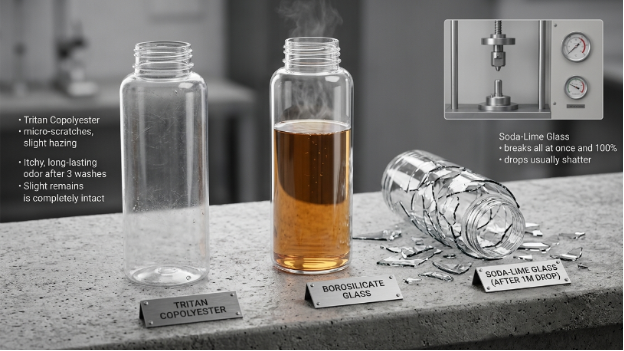
Borosilicate withstands a thermal shock of 150°C while soda lime withstands 40°C.
-
A 600 ml glass bottle weighs 330 to 460 g empty. Tritan weighs 120 to 160 g.
-
Since January 2025, BPA no longer received approval to be used in food contact.
-
Three-year running cost is Tritan $18 to $36, glass $32 to $70.
What Actually Separates Tritan From Glass?
They are impact resistant, BPA free copolyester in the case of Tritan or an inert silicate in the case of glass. Neither of which absorbs flavor. The split is crucial as one material safeguards the bottle and the other material safeguards the water. All other aspects mentioned here relating to comparison arise out of that one sacrifice.
Both are food safe. Both undergo the same Migration tests. Even if half the Internet says it is the healthy one, it is not. It is the way each fails that they differ.
Polymer has itchy, long-lasting odor after 3 washes, hairline scratches and hazing. When glass breaks, it breaks all at once and 100%. I prefer to sell a customer a bottle which does not age up very well rather than one that is put on a kitchen floor at 6am.
The Two Glasses Nobody Distinguishes
The word glass occurs in the majority of people's shopping vocabulary as if it is referring to one material. It does not. Query about the one that is being purchased. That said, half would not say, and usually that is the answer to that question.
-
Borosilicate Glass: Low thermal expansion, withstands hot tea and cold rinse back-to-back and has a higher molding cost range of 25 to 40%.
-
Soda-Lime Glass: This is the common glass found in the ordinary bottle; it is cheap and heavy, and breaks easily when put into boiling water after it has been cold.
|
Property |
Tritan Copolyester |
Borosilicate Glass |
Soda-Lime Glass |
|
Empty weight, 600 ml |
120 to 160 g |
330 to 390 g |
380 to 460 g |
|
Thermal shock tolerance |
~100°C service max |
~150°C differential |
~40°C differential |
|
1 m drop onto tile |
Usually intact |
Rim chips, often breaks |
Usually shatters |
|
Soft flooring (1m) |
Complete or near complete drop without loss |
Loss or chipping of the rim often |
Drops usually shatter with loss or chipping |
|
Typical service life |
3 to 5 years |
2 to 4 years |
1 to 3 years |
|
Oil Capillary Refill Time |
~30 min |
<15 min |
<10 min |
The Durability vs. Purity Debate.
There are eight fronts which determine this argument. I have seen all of them play out from sample rooms to return in stores to my own ride.
1. Drop Survival: What Happens at Sink Height
The majority of the bottle deaths occur at low levels below waist height and not as a result of spectacular falls. The killer is counter edge to tile and there is a good bit of momentum from a full 600ml of water before it even gets to the tile.
1.1 Tritan Under Impact
Copolyester has the ability to bend, take the blow and recoil. Most typically, a dropped Tritan bottle goes first with the lid clip, then with its shape.
1.2 Glass Under Impact
Silicone sleeves for the base and so little for the shoulder. Based on my experience, a sleeved glass bottle is able to withstand not more than one insect strike out of 3. Unsleeved ones do not bother counting.
2. What Leaches, and What Doesn't?
As long as the product is accompanied by current migration test data to demonstrate that there is no significant leaching of either material under the product's typical use, nothing much significant leaches from either material. Tritan does not contain any bisphenol A monomer. Glass is chemically inert. The real danger lies in those areas not covered by pictures.
2.1 The Post-BPA Reality
Commission Regulation EU 2024/3190 restricted the use of BPA, as well as of some harmonized classified bisphenols in food contact materials, that entered into force 20th January 2025. A supplier should already consider that and if it does not, any bottle they quote you today should consider that.
2.2 Glass's One Weak Point
Body Bottle has an inert body. The lid liner, spout gasket and straw are not. I have witnessed high quality glass bottles with silicone rings which were not used for any laboratory use. Ask for data regarding migration on closure, gasket and straw separately.
3. Taste Carryover and the Coffee Test
That is a no brainer and, in my case, I am not being modest, glass wins. Pour cold brew in a bottle on the first day, wash it on day two, and glass brew gives you some coffee memory.
3.1 Where Polymer Holds Odor
Trimated odor is not actually contained in the resin, but rather in micro scratches. The bottle is on the last month of eighteen and is dotted with scratches. This bottle smells of everything it has carried.
3.2 Why Glass Resets Clean
Non porous, non-reactive, and not fazed by citrus, protein powder or electrolyte tabs. It is where our Paris Pastel Water Bottle at 600 ml continues to end up on a desk and never in a gym bag.
4. Weight, Carry Fatigue, and Shipping Math
The point about weight is that no one at the shop cares and everyone at kilometer four cares. A filled 600 ml glass bottle runs about 950 to 1060 g. The average capacity of the same in Tritan is around 720 to 760 g. That deficit is 250 grams that hangs on each strap.
With the buyers moving volume the calculation becomes agonizing, similar to shipping Stainless Steel Cookware. Glass is added on top for every carton in each container, and added on top of the carton for each container as well as carton weight and added breakage allowance for each container.
I have had landed cost per unit change 18 to 30% on glass programs due to freight and packaging, before we get to units that have been cracked.
5. Heat Tolerance and Dishwasher Cycles
Many people are surprised, but just like Dishwasher Safe Cookware, Tritan can take repeated dishwasher cycles and borosilicate glass can better withstand temperature changes than any polymer. Both the statements are true and that is why this section puzzles buyers.
5.1 Thermal Shock Limits
Bottles with 90°C tea poured straight from the fridge with their glass walls having differentials of 40°C can be thought of as a small bomb. Borosilicate is not so susceptible to the very test.
5.2 Cycle Counts
Cloudiness that happens after hundreds of cycles in the dishwasher, when washed on the top rack and washed at less than 65°C is not a fault of the material and is beyond the control of any warranty.
6. Scratches, Clouding, and Cosmetic Aging
Polymer ages. But glass does not, until it no longer exists.
6.1 Micro-Scratching in Polymer
Both over a year the most damage a bottle does cosmetically is this stiff nylon bristle brush. Using silicone tipped brushes and it looks two years younger forever.
6.2 Etching and Hard-Water Film
Glass appears to have a cloudy film of a mineral in hard water areas. It can be cleared up by a weekly vinegar soak. Water resistant etching that is caused by dish detergent will not wear off.
7. Regulatory Standing on Both Sides
Both of these materials meet the key schemes and success or failure of certification is the true differentiator between a good and a lazy supplier. Polymer bottles are regulated by various food contact laws such as FDA food contact guidelines, EU Regulation 10/2011 on plastics and the German law LFGB protocol. Glass is governed by much less stringent rules and tested accordingly.
7.1 What Changed in 2025
This bisphenol ban led to a reshuffle in supplier qualification throughout Europe. Programs involved with fine shipping in 2023 required re documentation.
7.2 Test Reports Worth Requesting
Tests results, dated within 18 months, from SGS or TÜV RHEINLAND or EUROFINS, which test everything that comes in contact with the liquid. This is why Solamex has their own lab, so they can avoid having to wait for reports from outside during production; this delays deliveries.
8. Cost Per Year of Real Service
There is an issue of sticker price both ways. Because the resin used for making glass bottles is expensive while making up glass bottles is mostly sand, glass comes across as higher grade and is usually cheaper on par with copolyester molded correctly on a per unit basis of glass versus copolyester.
8.1 The Replacement Cycle Nobody Budgets
The expense of replacing assets seldom gets on the budget. 26 bottles of beer cost $26, but a break is a very expensive habit that costs you $70 for three years. This should not be the shelf tag; this is the number retail merchants ought to be modelling.
Which Bottle Survives a Real Commute?
Tritan necessarily outperforms the others in terms of the commute. Bags get tossed, lockers get banged up and bike bottle cages provide vibration, which glass cannot handle well over months. Use glass for a purpose that does not move around, such as in a desk, bedside table or kitchen counter alongside your Lunch Box, and bottles will only move a few meters.
There are two questions to ask yourself before making the decision: Is it true? Is it honest? Does your bottle live in a Bag or on a Surface? Does anybody under 12 years use it?
The debate stops if either answer leads towards movement or children. There is a reason why the Zoo Kids Bottle is available in both 350 ml and 480 ml sizes. School bags are an enemy and no parent would want to take the risk of having glass in their child's bag.
Pro Tip: Capacity is more important than material for gym and trail. On long refills sessions a 960ml sports bottle such as the Santorini Ombre Sports Bottle, reduces refills by half.
What Should Buyers Check Before Ordering in Bulk?
The factors that determine the success of a drinkware program are closure quality, component cert, drop test data at 1 m and realistic breakage allowance on glasslines. Suppliers who volunteer all the four without prompting are the one worth giving a sample order. The remainder will give you a spec sheet and talk about you not asking.
This was a mistake in my younger years. I used to qualify suppliers on the bottle and its lid was an accessory. At that time a leaking batch of gaskets cost a client his whole retail window on Europe, and I discovered that a closure fails long before the vessel does.
-
Drop Test Data: Request 1m on Ceramic tile in 3 orientations with 10 units minimum.
-
Leak Test Protocol: Filled, inverted, under mild pressure for 24 hours and NOT a five-minute shake.
-
Breakage Allowance: Glass programs should include in the contract 2 to 4% breakage allowance. A statement by someone displaying a zero is a guess.
-
Component Traceability: All silicone and polypropylene parts are named, sourced and tested.
The First 90 Days With Each Material
Honeymoon phase ends after three months, and it is time for the truth to come out. By day 90, glass owners were divided into two groups. One camp has gone a little nut over where to put down the bottle. The other camp already has the same sort broken and purchased quietly another in plastic. You will not often find a middle ground.
The Tritan owner is faced with other reckoning. The bottle is the one that takes a beating, takes on a bit of wear and tear and if the water used to transport anything other than water, it will absorb odors if not properly used. It can be reset by soaking each month in warm water and a tablespoon of baking soda.
Do not do it for a quarter and you will see the difference. Both are okay results. These materials do just that, both.
What Long-Term Ownership Actually Costs
When buying a home, it is important to understand what owning one means in the long term. Crunch the numbers over a three-year period, though, and the philosophical nature of the argument regarding durability dissolves.
|
Line cost (3 years) |
Tritan bottle |
Glass bottle |
|
Purchase price (USD) |
$14 to $22 |
$20 to $34 |
|
Replacements expected |
0 to 1 |
1 to 2 |
|
Sleeve, lid, gasket spares |
$4 to $8 |
$6 to $12 |
|
Total running cost |
$18 to $36 |
$32 to $70 |
The ranges are based on the average lifespan of lids in households in the US and UK where replacement lids cost $5 to $9, and hard water reduced lid lifespan. Glass does not fare well in the commercial or business hospitality environment. But, yes, the glass column does appear lofty.
That is still a good decision for anyone who is more interested in taste than money as well, and have never attempted to talk someone out of it.
Tritan vs Glass Water Bottle: Where Each One Wins
Here are the points where each is victorious. Choose according to surroundings, rather than ideology.
-
Choose Tritan For: Commuting, gymsts, school bags, biking, traveling, children, and where concrete meets gravity.
-
Choose Glass For: Desk work, home use, tea and infusions and those who are the only people that taste plastic when nobody else does.
But how do you fit in an infused fruit routine? Well, it is dependent on the amount of bottle activity. When it comes to stationery and infusing, glass always wins. Backpacks are meant for a mess, think before you drink.
Since the transition from cookware to production of drinkware, Solamex Houseware is now producing nearly 500,000 bottles each month from Wuyi, Zhejiang. Most of the use cases above are covered in the 2026 drinkware catalogue, ranging from 240 ml thermal drinkware to 1,300 ml explorer bottles.
My former production manager was one of those who said it was more important to make the choice of capacity rather than the choice of material. In part, he was right.
People Also Ask
Is Tritan Safer Than Regular Plastic?
Yes. Tritan is free of bisphenol A monomer and complies with FDA and EU migration standards whereas older bottles made with polycarbonate resin released BPA when heated and repeatedly washed.
Can You Put Boiling Water In A Glass Bottle?
Only in borosilicate. The thermal expansion difference between a bottle of soda lime glass and the ambient temperature is about 40°C and therefore it will fail if a smaller bottle is filled with boiling water.
Does Tritan Hold Odors Permanently?
No, the odours are in micro scratches, not in the resin. Most carryover is removed after each baking soda soak month, but after a long time the scratches on heavily scratched bottles remain.
How Long Does A Tritan Water Bottle Last?
For normal use, 3 to 5 years. The two listed above add to that, abrasive scrubbing and bottom rack heat subtract about half.
Which Is Cheaper For Bulk Drinkware Orders?
Tritan, including freight. Glass is cheaper and heavier than carton and has protective inserts and breakage allowance of 2 to 4% per shipment.
Finding Your True Preference
The key is to select which is the best use case; not the one you are most loyal to. While bags, gyms and school runs benefit from tougher polymer, desks and kitchens benefit from glass.
After six months, you will most likely have an appreciation for which bottle you use most. That is your true opinion on the Tritan vs glass water bottle. Solamex Home's drinkware catalogue is always on standby to let you try out when you are ready for some.
Conclusion
The key is to select which is the best use case. Bags and gyms benefit from tougher polymer, kitchens benefit from glass. After six months, you will have an appreciation for which bottle you use most. That is your true opinion on the Tritan vs glass water bottle. Choose SolamexHome catalogue when you are ready.
Stainless Steel Tumbler vs. Copper-Lined Tumbler: Which Keeps Drinks Colder Longer?
Fry Pan vs. Saute Pan: When to Buy One Over the Other?