Stainless Steel Tumbler vs. Copper-Lined Tumbler: Which Keeps Drinks Colder Longer?
Introduction
Why does one cup hold ice all day? Buyers often wonder about drinkware performance differences. Analyzing copper lined tumbler vs stainless steel reveals surprising truths. Heat escapes through three specific pathways. Vacuum construction instantly stops temperature loss effectively. We explain exact engineering facts clearly today.
Bottom Line Up Front
-
The two largest heat paths, conduction and convection, are blocked by the vacuum removal.
-
Copper is dedicated to radiation; allow 30 to 60 minutes, NOT hours.
-
Internal Honest retention time is 8 to 14 hours and in a car is 4 to 6 hours.
-
Most buyers will find 304 to be suitable, while 316 will cost about 15 to 25% more.
-
Humid weather does not cause vacuum failure; it means outside sweating.
-
Lids and gaskets last for several years and never as long as steel.
Copper Lined Tumbler Vs Stainless Steel: What You're Paying For Before You Buy
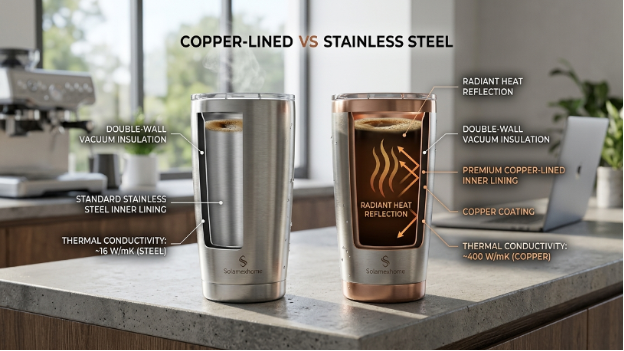
Potential to leak is reduced when it comes to heat. It proceeds inside, and it goes three ways. Conduction is carried out by the solid material that is in contact with the liquid. Convection is the means by which air is transported. For radiant heat transfer, no medium is required since the energy of heat is carried through empty space, in the form of infrared energy, as the case of a car parked in the sun in a sealed glass does!
Remove the air from the steel alignment between the two steel shells and you eliminate two of those three routes with a single motion. Little, if anything, has changed since Dewar silvered his first flask in 1892, that is the whole concept of a double wall vacuum insulated tumbler.
A vacuum gap (1–3mm) is more than enough. However, the larger the area the worse it is as there is no more room to insulate against.
The difficult part comes from here. By the standard of metals, steel is a mediocre conductor, ranking around 16 W/mK, compared with about 400 W/mK for copper, which is about 25 times as thick. thermal conductivity Within a vacuum it is not true. No contact anything with whatever so copper does not conduct anything at all into anything. It is just sitting there, reflective.
Kill two birds with one stone and ask two questions before spending a cent. Is your cup on a desk that is air conditioned or in a truck cab in August? Do you finish a drink in two hours or put them away over 10? Your answers are more important than the spec sheet!
Does A Copper Lining Actually Keep Drinks Colder?
Yes, measurably, although not as much as the price difference would indicate. With air evacuated from the gap, the remaining heat flow path is primarily by radiation, and along it there is a layer of reflective copper. The honest gain is around 30 to 60 mins of additional ice on a 20oz cup during production testing.
That is copper as radiant barrier doing its job as physics suggests. In the case of polished copper, it has emissivity that drops much lower than 0.05, while Bare Stainless is in the range of 0.15 to 0.25 depending on finish. Fewer emissions result in fewer emissions of energy across the void.
But do copper lined tumblers actually work? They do. Only the same 45 minutes is lost in a lethargic weld, an inexpensive gasket or a sloppy toleranced vacuum on Friday afternoon.
Warning: You do not see copper doing something, you see it doing nothing. On the other side of the vacuum, there is a beautifully designed, decorative copper finish that plays no thermal part at all. It is pretty finished, but will not perform at all.
Stainless Steel Tumbler Vs. Copper-Lined Tumbler Compared!
There are two different types of tumblers: Stainless Steel Tumbler and Copper Lined Tumbler. The same goes to 3-Ply Stainless Steel Cookware. There are 7 checkpoints the order that our QC team walks them during the line at Wuyi. Compare two cups in a store by what weight.
1. Inner Shell Grade
An 18/8 stainless steel tumbler refers to an 18% chromium and 8% nickel stainless steel. The passive oxide film which protects against corrosion is made up of the chromium, while the nickel is added for toughness and to maintain alloy nonmagnetic characteristics. Those chemistries are defined by ASTM A240, and any supplier that you can talk to will call out a grade, not premium steel.
Grades You'll Meet
-
Grade 304 / 18-8: Most common material for quality drinkware. Safe with FDA compliant food contact regulations and tolerant of all but salt spray.
-
Grade 316: Contains 2 to 3% molybdenum to make it chloride resistant. 316 marine grade is a work horse on the sea. The answer is that the increased cost of 316 stainless steel drinkware really lies in the increased cost of pressing and welding, not into marketing.
-
Grade 201: A low nickel content and low cost, but will pit within a year. As for us, we would leave the situation.
2. Wall Thickness and Draw Depth
The thickness of the wall of most quality shells is a wall thickness 0.4–0.6mm per layer. Thinner flexes when it is subjected to strong grip. Thicker takes a 30 oz cup and it becomes a dumbbell no more after week three. That size is typically a 14 to 16 oz empty with a 0.5mm build. Thicker does not equal better, it is just thicker.
3. The Vacuum Pull Itself
It is something that no one can see from the outside, and it is something everyone should ask about. Plant pump down quality is very variable; any air that is left in the gap will affect the performance from the first day of the cup's life.
What the Base Tells You
-
Seal Point: The end finish of a point seal characterized by a small sealed nub that is usually under a silicone plug and is centered flush.
-
Off-Center Weld: Rushed line work will be shown by an off-center weld. The best-known early failure predictor.
-
Rocking Base: Distortion under the influence of the sealing heat. Access a flat counter.
4. Where the Copper Actually Sits
The tumbler that is a copper plated tumbler where its outer skin finishes warm copper is jewelry. The inner film between the gap is vapor deposited and is engineering. It is the same metal completely different work. It is rare for listings to differentiate between the two so look for the word interior in the description or just simply ask.
5. Two Walls, Three Walls, or Foam
A triple wall insulation tumbler is a tumbler with an extra layer of insulation, sometimes containing foam. Against a good double wall, this thermal gain will be minimal, since gap one did the heavy work.
What the Third Wall Buys
-
Exterior Comfort: Colder outside surface touching the palm of the hand.
-
Dent Resistance: True protection against vacuum!
-
Added Weight: This is generally added weight 15 to 20% that people will feel when driving on the commute.
6. Exterior Finish
Powder coating applies as baked polymer usually in a layer of 60 to 100 microns and it does two things: it grips when hands are wet and a little bit helps resist heat from palming. It also chips. The majority are susceptible to chipping.
Never does the bare brushed steel, and turns slippery the moment condensation makes its appearance. Choose your compromise deliberately as there is no winning compromise. The same goes to Die Cast Aluminum Cookware.
7. Lid, Gasket, and the Part Nobody Tests
Lids die first. Silicone gets hard, sliders can become cracked and threads can pull out on over tightening.
Questions to Ask a Supplier
-
Replacement Availability: Are replacement lids kept aside or are their cups disposable?
-
Gasket Material: Food Grade silicone and BPA Free under EU Regulation 2024/3190.
-
Seal Type: The gasketed screw lid keeps more ice in category one, noticeably longer than any slider. That is the only one that is debatable. If you see a brand offering replacement lids and they know they are not always going to last longer than the cup body, that is an indicator of their secret expectations of their vacuum.
How Long Does An Insulated Tumbler Keep Ice?
It takes eight to 14 hours for a well-constructed 20 to 30 oz cup located in a room temperature of 70 degrees with a secure lid. Place the same cup in a car that is 90 degrees and the window goes to 4 or 6. Lid choice is a greater number than lining.
Most published ice retention hours (12–24hr claims) are of ice being still visible and not of a pleasant drink. Those milestones are hours from each other, and the second milestone has already been reached. Lab state is also set using a pre chilled cup of ice water, to the top, and a closed lid plus a constant room. It is not your Tuesday morning.
|
Setup (30 oz, room start) |
Ice left at 8 hrs |
Cold window in practice |
|
Sealed screw lid, 70 degrees room |
55 to 70 percent |
12 to 14 hrs |
|
Straw lid, 70 degrees room |
30 to 45 percent |
7 to 9 hrs |
|
Sealed lid, 90 degrees car |
20 to 35 percent |
5 to 6 hrs |
|
Open top, desk |
10 to 20 percent |
3 to 4 hrs |
But what really happens after you leave the tumbler world and how long do tumblers keep drinks cold once you factor in reality? We found that a roughly two thirds majority of the box claim is accurate. If you get two free habits it makes up for most of the gap!
Empty cup with cold water to chill for five minutes, and properly fill. Heating metal is a lot faster in a full cup than in a partial cup, thanks to the heat holding potential of the air above your ice.
Narrow openings also result in real tumbler ice retention. The very same idea but with a vacuum insulated water bottle constructed of exactly the same wall specification will last longer than a tumbler, PROOF! because it is smaller at the mouth.
The Melbourne Thermo Bottle is the ultra-compact version of the logic, whilst the Seattle Explorer Thermos Line is the same thinking just brought around to a larger size for those people who call once a day sufficient for them.
Top Tip: Quality over quantity when working with ice. Melt rate is not based on mass, but rather surface area so one large cube can hold a lot more than the same mass of crushed.
The 60-Second Inspection We'd Run At The Counter
Most of the quality of a cup can be determined without a laboratory. I have seen buyers do it before our inspectors have managed to!
|
Check |
Pass signal |
Fail signal |
|
Base seal |
Flush, centered, plugged |
Off center, proud, bare weld |
|
Empty weight (30 oz) |
14 to 16 oz |
Under 11 oz, over 20 oz |
|
Grade marking |
304 or 316 print |
Premium steel, no number |
|
Lid gasket |
Soft, seated, removable |
Stiff, glued, molded in |
The weight test is more effective than any of those listed in detecting bad cups. If it is too light, it is because the walls are too thin, or the gap is too small; if it is too heavy, it is most likely a foam filled shell which is masquerading as a vacuum. The 80% counter version is able to pick up on what matters, and our inhouse lab does the rest through ice water baths and surface probes.
Why Does My Tumbler Sweat On The Outside?
Or due to vacuum seal failure. No condensation occurs on the outer wall of the working cup, as it remains within a few degrees room temperature, and there is no cold wall for airborne moisture to condense on. When the seal is broken cold permeates that outer skin and beads develop in minutes on a humid morning.
If there is condensation on a vacuum cup it is a diagnosis, not a problem. It means vacuum seal failure, and there is no repair for any price. Sweat proof tumbler makes it a working thing in the description, instead of a feature. The same goes to the condensation free cup language in a list. The proposal to both is that this is being upgraded and it is for the Vacuum to hold.
Test yours tonight. Ice water, and run finger down the side, 20 minutes. Dry means healthy. Damp equals Finished easy as that. One of our salespeople when the weather was damp was taking a cup around for three months and was saying it had got to do with the weather. Since buried in the car park it had been dead.
Year Three: What Actually Fails
The life expectancy of a cup is akin to that of an old man. These die from handling. Dishwasher cycles are hot enough to set gaskets and over years of thermal cycling will work at the seal weld. Machine washable means cup survives. Non machine washable does not survive over time.
The chipped outer coat is superficial and does not change the thermal effect of the coat being on the outside makes no difference unless you do care about appearance. The real danger are dents. Even when the finish is flawless, if the knock has been hard enough to bend the outer wall, the sweating will commence a week later.
The best insulated tumbler for the most will generally not be the most expensive. A true grade 304 walled, mid weight cup with replaceable gasketed lid. The band Miami Pop tumbler falls in is exactly that. That is why Miami Pop does not stock boutique shops, but instead grocery stores in Europe. Quality construction matches the Premium Cookware with Silicone Grip durability.
Is there anything more than that that the copper upgrade is worth for? Look at what happens to your cup and whether it is indoors or in direct sunlight, decide upon that not the marketing.
People Also Ask
What Does 18/8 Stainless Steel Mean?
220V Internal Heater with 18% chromium, 8% nickel by weight. Chromium forms anti corrosive surface film, Nickel provides toughness. Equal to grade 304 and found in all quality food contact drinkware.
Are Copper-Lined Tumblers Worth The Extra Money?
Sometimes. The copper will cost 20 to 40% more and provide an additional 30 to 60 minutes of cold holding time. Only worth it if it is also improving the grade or seal performance!
Can You Put A Stainless Steel Tumbler In The Dishwasher?
Dishwasher safe only if it is labeled as such. Heat cycles cause stress to the seal weld and increase the stiffness of lid gaskets. Hand washing is effective for double service life.
What Happens When A Tumbler Loses Its Vacuum Seal?
Performance collapses immediately. There is no repair, the cup sweats and the ice melts every two hours. No other choice but to replace.
Do Bigger Tumblers Hold Ice Longer Than Small Ones?
Yes, considerably. A larger body, 1000ml would have less surface area per liquid than a 350ml and would buy 3 to 5 hours more.
Conclusion
Defective vacuum seals ruin cup performance quickly. Material grades determine long service life expectancies. Exploring copper lined tumbler vs stainless steel clarifies buying decisions.
Smart buyers inspect base seals carefully. Coating choices affect exterior durability directly. Please visit SolamexHome online right now. Discover our extensive drinkware catalogues today. Upgrade your daily hydration experience immediately forever.
The Wok Buying Guide: Flat Bottom vs. Round Bottom – Which Works on Your Stove?
Plastic Tritan vs. Glass Water Bottles: The Durability vs. Purity Debate