Commercial Cookware Essentials: Materials, Maintenance & Trends for Modern Professional Kitchens
Introduction
In the high-pressure world of professional kitchens, selecting the right commercial cookware can dramatically influence efficiency, food quality, and overall profitability. Commercial cookware comprises heavy-duty pots, pans and specialty vessels engineered for intensive, high-volume operations. As restaurant lines accelerate and cleaning cycles become more frequent, durability and performance become non-negotiable traits.
This article will guide you through the essentials: from defining commercial cookware to exploring materials, selection criteria, care protocols, and cutting-edge trends. By the end, you’ll have a clear roadmap for specifying the ideal cookware to match your kitchen’s unique demands.
The Role of Commercial Cookware in Professional Kitchens
Efficiency and consistency are at the heart of every successful restaurant service. Properly matched cookware ensures even heat distribution, reducing hot spots and achieving uniform results across batches.
Equally critical is durability under pressure. Commercial-grade cookware is designed to resist warping, corrosion, and repeated thermal shock—traits essential for pans and pots that see continuous high-heat use.
Finally, dependable cookware streamlines workflow, enabling multiple chefs to execute tasks in parallel without equipment failure slowing service.

Moreover, by operating a direct factory-to-wholesale model, Solamex offers premium-grade cookware at competitive bulk pricing, reducing total cost of ownership for foodservice operators.
This blend of professional-grade quality and attractive wholesale advantages makes Solamex the ideal partner for restaurants seeking both performance and value.
Core Types & Materials
Primary Cookware Types
- Stock Pots & Sauce Pots—Deep-drawn for broths, sauces and large-batch soups.
- Fry Pans & Sauté Pans—Flat bottoms with straight or sloped sides for rapid searing and tossing.
- Specialty Pieces (Woks, Roasting Pans, Steamers)—Add these for niche applications like stir-frying or sheet roasting.
Material Breakdown
| Material | Pros | Cons |
|---|---|---|
| Stainless Steel | Non-reactive, durable, low maintenance | Poor heat conductivity unless bonded |
| Cast Aluminum / Forge Aluminum | Excellent heat distribution, lightweight | Reactive with acids if uncoated |
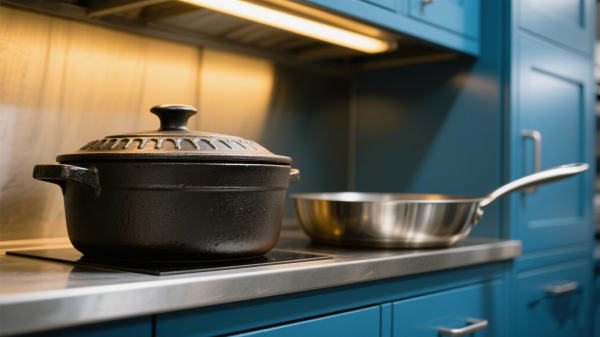
| Cast Iron | Superior heat retention, builds non-stick patina | Heavy, requires seasoning and rust prevention |
| Copper | Unmatched responsiveness to temperature changes | Costly, requires polishing, reactive with food |
This comparison helps chefs match material properties to cooking techniques and maintenance capacity.
Key Selection Criteria
First, consider heat conductivity and distribution. Thick-gauge metals and multi-ply cores deliver uniform warmth, minimizing hot spots that cause uneven cooking.
Next, evaluate corrosion resistance and chemical reactivity. Non-reactive surfaces preserve sauce integrity; avoid uncoated aluminum when handling acidic ingredients.
Solamex’s cookware features advanced marble and ceramic non-stick coatings that are inherently non-reactive, ensuring that acidic ingredients such as tomato sauce and lemon juice do not leach metal ions into your food. These coatings offer superior scratch resistance—up to ten times more durable than traditional PTFE surfaces—protecting the cookware from abrasion caused by metal utensils and high-volume use. The naturally slick surface significantly reduces the need for added fats or oils, promoting healthier cooking and simplifying cleanup in fast-paced kitchen environments. Additionally, both marble and ceramic finishes withstand high temperatures without degrading, maintaining non-stick integrity and long-term performance through repeated thermal cycles.
Compatibility with heat sources is crucial: gas, electric, and induction ranges each favor specific base constructions. Finally, weigh cost versus longevity by calculating total cost of ownership, factoring in replacement cycles for high-turnover lines.
Maintenance & Longevity
Implement daily cleaning protocols while cookware is still warm: deglaze pans with hot water and mild detergent, avoiding abrasive tools that damage surfaces.
For cast iron and carbon steel, regular seasoning builds a natural non-stick layer and prevents rusting. Apply a thin oil coat after each wash and heat gently to bond the oil.
Recognize end-of-life signs—warping, pitting, and flaking coatings—to schedule timely replacements and maintain food safety standards.
Emerging Trends & Industry Standards
Gastronorm Sizing
The Gastronorm standard introduces modular pan dimensions (e.g., GN 1/1 at 530×325 mm) that ensure cross-compatibility across ovens, refrigeration and display units.
Sustainable Materials & Coatings
Demand for PFAS/PFOA-free non-stick and recycled-metal cookware is rising. Brands like Xtrema, GreenPan and Solamex meet FDA and California Prop 65 criteria with ceramic coatings that eschew harmful chemicals.
Integration with Smart Kitchens
Smart cookware and equipment featuring embedded sensors, Bluetooth or IoT connectivity enable remote monitoring, automated temperature control, and data analytics for precision cooking and preventive maintenance.
This integration frees staff to focus on culinary tasks while equipment self-optimizes, reducing downtime and improving consistency.
Conclusion & Actionable Takeaways
Matching cookware to your kitchen’s volume, menu and equipment ensures maximum efficiency, safety, and ROI.
Next steps:
- Create a checklist of required cookware types and materials.
- Prioritize multi-ply stainless steel or aluminized steel for versatility.
- Adopt Gastronorm sizing for modular flexibility.
- Select PFAS-free coatings to meet sustainability goals.
- Plan maintenance schedules and sensor integration for smart oversight.
With this knowledge, you’re ready to specify the ideal commercial cookware lineup that will stand up to the demands of modern professional kitchens—today and into the future.
Commercial Cookware: Ultimate Guide to Selection, Maintenance & Industry Trends
The Evolution of Quart Pots: From Micro to Macro Cooking