EU Regulation (EU) 2024/3190 — What Cookware & Drinkware Manufacturers Must Do
Commission Regulation (EU) 2024/3190 tightens or bans the use of bisphenol A (BPA) and certain harmful bisphenols in a range of food-contact materials. This article explains the rule, ranks which product types are most affected, and provides a practical, time-sequenced compliance roadmap for cookware and drinkware manufacturers (coated aluminium, insulated bottles, stainless steel, cast iron, and related components).
I. Regulation core — key points & short quotes
High-level: Commission Regulation (EU) 2024/3190 restricts and, in most cases, prohibits the use of bisphenol A (BPA) and certain bisphenol derivatives in specified food-contact material (FCM) categories; very limited exceptions are listed in Annex II and are subject to strict conditions. (Official text: EUR-Lex.)
- "on the use of bisphenol A (BPA) and other bisphenols … in certain materials and articles intended to come into contact with food." — Regulation title / recital.
- "adhesives; rubbers; ion-exchange resins; plastics; printing inks; silicones; varnishes and coatings." — Article 1 (scope).
- Annex II provides very limited exceptions; where exceptions exist, migration must in many cases be "not detectable" (industry guidance points to ~1 µg/kg detection limit).
Important regulatory mechanics — summary in plain language:
- Scope: the rule targets specific FCM categories (coatings, plastics, inks, adhesives, rubbers, silicones, ion-exchange resins).
- Ban with limited exceptions: BPA and certain harmonised-classified bisphenols are banned in those categories except where a strict Annex II exception applies.
- Transition & deadlines: the Regulation entered the Official Journal and provides staged transition periods — typically 18 months for many products; varnishes/coatings have up to 36 months in certain cases.
- SML / migration stance: industry and labs report that the former SML for BPA (0.05 mg/kg) has been effectively superseded by the prohibition in many FCMs; where exceptions apply migration is typically required to be non-detectable (labs reference ~1 µg/kg LOD).
II. Which industries are affected — overall ranking
Before drilling into cookware and drinkware, it helps to see the broader picture. The regulation most strongly hits industries that used BPA as a monomer, polymer precursor or as functional component of coatings and liners.
| High → Low | Why it's affected |
|---|---|
| Coatings & can-liners | Ring-epoxy coatings historically used BPA or derivatives; high migration risk into acidic foods. |
| Food-contact plastics | BPA used as monomer/precursor in some polymer chemistries; plastics with liners are at risk. |
| Printing inks, adhesives, rubbers, silicones | These formulations sometimes contain bisphenol-containing resins or precursors. |
| Filtration/membrane assemblies | Some limited, technical exceptions exist (Annex II) — highly specific industrial use cases. |
| Metalware (stainless steel, cast iron) | Less affected if uncoated; risk arises if there are organic linings, printed decorations, adhesives or bonded layers. |
Authoritative summaries and implementation notes are available from SGS, TÜV and PackagingLaw — useful for technical interpretation and lab testing guidance.
III. Impact on cookware & drinkware — ordered by severity
This section lists product types from most affected → least affected, with practical implications for each.
Most affected
1. Coated aluminium cookware (e.g., non-stick / enamel-like internal coatings)
Why: Many aluminium cookware inner coatings historically used epoxy or resin systems formulated from bisphenol-containing monomers. Under 2024/3190, those coatings fall squarely into the regulation's restricted categories (varnishes & coatings). If the coating contains BPA or a harmonised-classified bisphenol, it will be prohibited unless an Annex II exception applies.
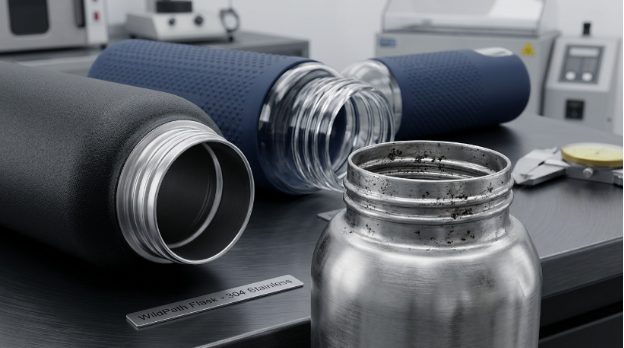
2. Insulated bottles, vacuum flasks, thermoses with inner liners
Why: Inner liners/epoxy-type sealants in insulated bottles (especially liquid epoxy liners) may use BPA-based resins. The Regulation lists varnishes/coatings and plastics as targeted materials; liners are functionally coatings. Annex II lists very limited large-capacity and technical exceptions only under strict non-detectable migration conditions — so most consumer-sized lined bottles will be in scope.
Moderately affected
3. Clad (multi-layer) stainless steel cookware
If adhesives or bonding layers between metal plies use bisphenol-based resins, those layers are in scope. Bare metal surfaces are not directly affected, but any organic interlayer, printed decoration, or glued handle must be checked.
4. Plastic drinkware & 'BPA-free' plastics
Not all plastics are equal. Some polymers are marketed BPA-free (e.g., Tritan®) — but the regulation focuses on bisphenol substances and harmonised-classified derivatives. Validate supply-chain declarations and test migration for real-world conditions (hot liquids, acidic beverages, long-term reuse).
Least affected
5. Bare stainless steel & traditional cast iron
When truly uncoated and without organic adhesives or printed decoration, these are the least affected categories. But check handles, packaging inks, or glued components.
Quick comparison (what to inspect right away)
| Product area | Immediate check | Suggested next action |
|---|---|---|
| Coated aluminium (inner) | Coating formulation — does it contain bisphenol resins? | Require supplier DoC; test migration; pilot alternative coatings (ceramic, anodised, silicone, PTFE alternatives). |
| Insulated bottle liner | Liner resin type & curing; migration after heat cycles | Test accelerated use; replace liner with certified BPA-free alternatives or seamless stainless inner. |
| Clad stainless (adhesive) | Adhesive resin chemistry | Ask supplier for resin statement; test bonded samples. |
| Printed decoration / inks | Ink formulation | Switch to certified FCM inks; obtain supplier declarations. |
IV. Technical checks & recommended tests (practical checklist)
For each product line, run a standard checklist: A = formulation verification; B = migration testing; C = durability & stress tests; D = documentation & DoC.
- Formulation verification — supplier Declaration of Composition (DoC), SDS and specific statement on presence/absence of BPA or other named bisphenols.
- Migration testing — simulate hot beverages, acidic foods, abrasion, and dishwasher cycles. Use food simulants and methods consistent with Regulation (EU) No 10/2011 test conditions; labs recommend LOD ~1 µg/kg for "non-detectable" claims.
- Thermal cycling & mechanical stress — repeated heating/cooling, drop, abrasion; these often increase migration and reveal weak coatings.
- Accelerated aging — UV/chemicals if relevant to paint/ink durability.
- Batch traceability — record formulas, supplier lot numbers, test reports and DoC in product technical file.
Partner with EU-accredited labs early (SGS/Eurofins/Intertek/TÜV). Their technical notes discuss detection limits, sample prep, and migration protocols aligned with the new regulation.
V. 12+ step compliance roadmap — timeline & priorities
This roadmap is prioritized for manufacturers whose product mix includes coated aluminium cookware and lined drinkware. The timeline maps to the regulation's transition windows (general: ~18 months; coatings: up to ~36 months in certain cases) — check the official text for exact dates and your product's classification.
Phase 0 — Immediate (0–3 months)
- Inventory audit: compile BOM for all cookware & drinkware; flag any coatings, liners, adhesives, inks.
- Supplier demand: send a standardized DoC request to all coating/liner/ink suppliers (require explicit statement on BPA & listed bisphenols).
- Risk triage: classify SKUs into High/Medium/Low risk using the product ranking above.
Phase 1 — Short term (3–9 months)
- Lab engagement: book accredited lab slots for migration tests (specify desired LOD ~1 µg/kg if claiming "not detectable").
- Pilot alternative coatings: trial ceramic sol-gel, anodised aluminium, or proven BPA-free polymer systems; generate pilot test reports.
- Procurement clauses: update contracts to require ongoing DoC and notification of formula changes.
Phase 2 — Medium term (9–24 months)
- Pilot to production: ramp alternative coatings for high-risk SKUs and verify full production samples.
- Inventory planning: plan sale/clearance of legacy stock in line with allowed transition periods; document dates and sales channels used.
- Labeling & comms: craft compliant marketing copy—"EU 2024/3190 compliant" only when full data supports the claim.
Phase 3 — Long term (24–36+ months)
- Full technical files: prepare and store DoC, test reports, batch trace records and any migration data required for market surveillance.
- R&D investment: consider a product roadmap to use inherently non-organic linings (anodised/ceramic) where possible to avoid future bisphenol risks.
- Policy watch: monitor Annex II updates and EFSA/ECHA follow-ups — if your use case might ever need an Annex II authorisation, start data collection early.
VI. Conclusion & next steps
Bottom line: Regulation (EU) 2024/3190 is a material change for manufacturers whose products rely on epoxy/varnish/liner chemistry. Coated aluminium cookware and lined insulated bottles are the immediate priorities — they should be triaged, tested, and re-engineered where necessary well before the end of transition windows.
If you want, I can now:
FAQ about EU Regulation (EU) 2024/3190
Q: Which cookware will be banned by EU Regulation 2024/3190?
A: Any cookware product whose coating, liner, adhesive or printed layer uses BPA or a listed harmonised-classified bisphenol will be prohibited unless a specific Annex II exception applies. Bare metal cookware without organic linings is generally not affected.
Q: Does the regulation ban BPA in water bottles and travel mugs?
A: Yes — if the bottle's inner liner or coating contains BPA. Many lined/epoxy-lined insulated bottles fall within the scope. Manufacturers should validate liners and replace BPA-containing liners with compliant alternatives.
Q: What testing limit should I request from labs?
A: For Annex II exceptions or "non-detectable" claims, labs and technical briefs point to detection around ~1 µg/kg as the working LOD target; always confirm with the accredited lab and reference test method details.
Q: Can I sell legacy stock after the regulation's entry into force?
A: Transitional provisions allow limited market placement for products made before the applicable cut-off, but you must follow the regulation's specific transition rules (dates differ by material). Keep documentation proving manufacturing date and applicable stock.
Sources
- Commission Regulation (EU) 2024/3190 — Official Journal (PDF)
- SGS: "EU Regulates BPA and other Bisphenols in Certain Food Contact Materials" (implementation summary)
- TÜV Rheinland technical brief: "Ban on bisphenols in Food Contact Materials - Regulation (EU) 2024/3190" (Annex II & LOD interpretation)
- PackagingLaw: legal analysis & implications for packaging and varnishes
- Eurofins / Intertek lab notes on migration testing & SML status
Are Aluminum Pans Safe? The Complete Guide to Aluminum Cookware Safety in 2025
Are Aluminum Pans Safe? What Science, Regulators and Chefs Say