Deep Pots vs. Wide Pots. Which One Should You Buy for Your Cooking Style?

Introduction
The short answer is to get both, just not in the usual sizes that people think of. Depth represents liquids and pressure; width represents surface area and speed. When selecting between deep pots vs. wide pots, one must always consider what is being prepared on average every week, not what will look the best hanging over your kitchen island.
The Verdict in 30 Seconds
-
Depth wins volume, width wins evaporation, everything else is detail.
-
A 12-inch shallow pan cuts cooking time for stocks in half.
-
Shallow pans cannot provide the 3-inch freeboard that frying requires.
-
Wide bases brown beef in one batch, not three.
-
Deep bodies are less expensive per quart above 12 quarts.
Numbers That Decide It
-
Any height to diameter ratio above 1:1 indicates deep, below 0.5:1 indicates wide.
-
Ten quarts of stock will weigh about 21 lbs before the pot.
-
Service grade walls are 2.8 mm, throwaway walls are close to 1.4 mm.
-
EN 12983 applies to domestic cookware, NSF applies to commercial service lines.
Depth or Width: The Matchup That Settles Most Kitchens
Two pots. Identical 24 cm base, identical burner ring, identical ceramic coating. The first one is 11 cm tall and eats 5 quarts, the second is 4 cm tall and only gets past 2. Same metal, different occupations.
Over the last 20 years I have worked on the buying end of this business, filling the shelves and catering accounts, and the sizing error repeats time and time again. People purchase to their height when they need some space underfoot, and then complain when it will not brown.
Thus, this division is bluntly given. Deep pots move volume. Wide pots move water. Any guide that rates one over the other has never simmered stock for 8 hours and then attempted to reduce it prior to serving it.
|
Spec |
Deep pots |
Wide pots |
|
Height-to-diameter ratio |
1:1 to 1.3:1 |
0.3:1 to 0.5:1 |
|
Evaporation at low simmer |
4 to 6 oz per hour |
12 to 20 oz per hour |
|
Burner ring usable capacity |
5 to 20 quarts |
2 to 6 quarts |
|
Safe frying freeboard |
3 to 5 inches |
Under 1 inch |
|
Metal per quart at 12 qt |
Least expensive in range |
Approx. 25% more expensive |
It is the last line that is more significant than buyers think. A base plate increases with the square of the diameter, so increasing the diameter of a pot costs a lot rawer aluminum than increasing the height of a pot.
Deep Pots vs. Wide Pots Comparison!
1. Volume Per Square Inch of Hob
Here the straightforward answer is depth. The 10-inch-deep pot holds approximately twice the volume of the 10-inch-wide pot when burners occupy the same space. With a four-burner stove top, that difference determines whether you prepare one batch or two. This should be the first thing to consider in small kitchens.
2. How Fast Each Shape Reduces a Sauce
It is a landslide, and width is the winner. Evaporation is dependent on surface area, so a 12-inch shallow pan evaporates two or three times more than a tall stockpot at the same simmer. This is the home of braises, ragùs and pan sauces.
-
1. Surface Area Rules: A 12-inch pan makes 113 square inches of liquid available, an 8-inch stockpot makes only 50 square inches available.
-
2. Lid Off Always: Once a lid is placed over the pan, the reduction comes to a stop as the condensation returns to the sauce.
-
3. Simmer Not Boil: Fat will be bubbled into the stock and turn it cloudy if you hard boil, so cook gently instead.
3. The Distance Heat Has to Travel
Tall columns of liquid stratify. The bottom remains hot, the top remains cooler, and everything that rests on the bottom burns while the top barely moves. Wide pots help to keep all the elements of a dish within a few inches of the heat source, which is why the same dish would not work in a stockpot.
4. Room to Sear Before Food Starts Steaming
Crowding kills browning. Wide bases allow water to drain rather than pool, so beef cubes brown rather than gray out. In a narrow deep pot, you brown in three batches, lose 15 minutes, and still get uneven coloring on the last one.
-
1. One Layer Only: Add a space between pieces to allow the steam to pass through, or the steam will take away the crust you desired.
-
2. Blot Before Browning: Surface water resists evaporation and has to rise off first, at the cost of about 90 seconds per batch.
-
3. Rest Between Batches: Allow the base 30 seconds of heat recovery, or batch two sits in cooling fat.
5. Boil-Over, Splatter, and the Cleanup Tax
Height is free insurance. Try this: the pasta water climbs a high wall and settles rather than landing on the burner, but in a shallow pan it overflows onto your hob. Oil splash also travels far less inside deep, vertical frying walls.
-
1. Freeboard Rule: Never fill with liquid above two thirds of wall height for anything starchy or foaming.
-
2. Splatter Guard Fit: Measure the rim, not the base, since most splatter guards are dimensioned by outer diameter.
-
3. Starch Foam Watch: Watch closely at minute three, as this is when the pasta and beans foam the most.
6. What Each Shape Weighs When Full
Ten quarts of stock, excluding the pot, weigh approximately 21 lbs. That weight is focused over the small base of deep pots, so two side handles are essential. Wide pots distribute the same weight and require two hands and additional counter space.
7. Cabinet Space and What Actually Nests
Nesting shallow wide pots four high in a cupboard is quite nice. Tall bodies take up too much space unless you purchase graduated bodies. I believe a great deep drawer organizer for pots and pans will eliminate half of the issue, and lids have been the bane of every kitchen I have ever been in.
-
1. Nest By Diameter: Each increment in size is 4 cm, so the size of each body nests inside the other.
-
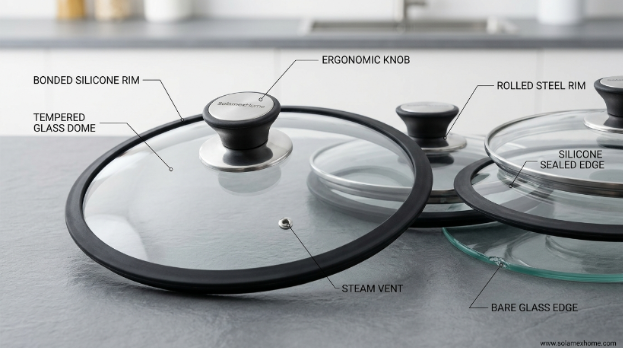
2. Lids Stored Upright: Flat stacked glass lids break at the silicone lid rim within a year of everyday use.
-
3. Handle Clearance Check: Cast side handles take 6 cm on each side, which quietly eliminates a 60 cm cabinet.
8. Oil Depth, Frying Safety, and Freeboard
The winner by far is deep pots. There should be at least three inches of space above the oil line of the pan, and a shallow pan cannot provide this. Deep fryer pots shall have a wall height of not less than 5 to 6 inches to prevent the hot oil from splashing out when battered foods fall into the fryer.
-
1. Half Full Maximum: Fill up to half way up the wall no matter what the recipe calls for.
-
2. Thermal Mass Matters: Thick bases keep the heat in when cold dinners are dropped in, reducing the amount of grease substantially.
-
3. Thermometer Clip Depth: The tips of probes must be in oil, not in metal, or your reading will be 30 degrees higher than it should be.
⚠ Warning: Do not use a shallow pan that has less than a three-inch clearance above the oil when frying. Water in frozen foods expands violently when it is placed in hot oil, and a shallow pan will provide nowhere for it to go but towards your burner.
9. Cost Per Quart Once You Scale Up
Deep pots provide greater capacity at a lower cost per quart due to the lower amount of sheet metal used per quart. At the same volume, the cost of wide pots increases as the base plate increases the most. That difference intensifies beyond 12 quarts, and importers are the first to feel it.
Which One Should You Buy for Your Cooking Style?
Think hard and answer this question: what did you cook three times during last month? Your form will be chosen by that dish of food, rather than the ideal dish of food. I pose the same question to every buyer, and the answer is usually surprising.
The Batch Cook Who Freezes Portions
You need depth. Soups, chili, stock and bone broth all require vertical room with slow evaporation, and no solidification of the liquid for four hours. For a family of four, stock pots & multi-pots deep enough to hold 8 to 12 quarts will make enough plus leftovers.
The Lyon Stock Pot Set is very convenient in this aspect, because the bodies go from 18 cm to 22 cm to 26 cm, with each pot fitting inside the other.
The Weeknight Braiser and Sauce Maker
You need width. The wide base and short height walls are helpful for short ribs, curries, shakshuka, or any tomato sauce that needs to thicken. The Bali Ultra-Light Sea Green Shallow Casserole is the perfect geometry to reduce liquid on schedule, at 28 cm across with a low profile.
The Fryer, the Steamer, the Pasta Household
Again, you have to get deep, only this time for a different reason. There is a requirement for headspace for boiling and frying, for foam and splatter. Saucepans & sauciers deep pots holding 3 quarts are also needed for blanching, and the Salamanca Gold Press Deep Frying Pan at 28 cm with 6 cm walls straddles the gap between the two.
If You Can Only Buy One Piece
Cook in wide pots for cooking at 28 cm, with tallish sides near 8 cm. That shape is great for the browning, great for the simmering, and holds enough fullness for four servings. It is not flawless in any respect. That is the trade, and most one pot kitchens welcome it with open arms.
Metals, Coatings, and Wall Thickness That Survive Daily Service
Your shape determines the type of food you prepare. The metal determines the length of time you keep cooking in it.
For acidic, long simmer work, stainless steel deep pots are the best, and a three-ply pot with an aluminum core will be 2.5 mm in all, which heats evenly with no hot ring like a single wall steel pot. Ceramic deep pots and ceramic wide pots release food beautifully for the first two years, but then have to be handled gently in order to maintain their slickness.
In between, with a body of 2.1 mm and a base of 2.6 mm, is pressed aluminum, and the Ruby Press Alum Sauce Pan Set sits at exactly that thickness. On high output burners, warping ceases to be a concern when 2.8 mm walls are achieved with 3.6 mm bases, using either die-cast or forged aluminum.
There is one honest drawback. No matter how good the coating, nonstick surfaces wear off. Set the price based on the likelihood of a 3-to-5-year service life before its release quality deteriorates.
Pot Types on My Shelf and the Jobs Each One Owns
-
Stockpot: Tall and narrow, between 8 and 20 quarts in volume, constructed for liquids in volume and longer, unattended simmering times.
-
Dutch oven: Heavy bottomed, about a 1:1 ratio, the compromise between braising and boiling.
-
Rondeau: Big wide pots, low and open at 4 to 6 quarts, where professionals brown and then braise in the same pot.
-
Sauté pan: Straight sided, wide, 3 to 5 quarts, in which anything requiring a crust before the liquid is added gets sautéed.
-
Saucier: Medium width with a curved base, designed so that a whisk will reach every corner.
Extra deep pots and extra wide pots larger than 20 quarts should be used for commercial service. I once saw a buyer place an order for a 40-quart body for a two-person family, and it was parked in the garage after one month.
Where Does Your Energy Bill Actually Go, Depth or Width?
While a wide pot requires more energy per burn because the larger pot footprint takes longer to reach temperature, it can also reduce liquid quicker, which counteracts much of that disadvantage. Deep pots reduce power consumption per hour and have an extended runtime. Over a year of cooking, the two shapes land within approximately 10% of each other.
|
Scenario |
Deep pot, 8 qt |
Wide pot, 5 qt |
|
Time to boil 2.5 qt water |
12 to 14 minutes |
8 to 10 minutes |
|
Reducing 2 qt stock by half |
75 to 90 minutes |
25 to 35 minutes |
|
Lid needed to make it more efficient |
Yes, always |
Only when simmering |
|
Annual energy use |
About 55% |
About 45% |
⚠ Pro Tip: Make sure to use the right pot base for your burner ring, plus or minus 2 cm. A 24 cm base on an 18 cm ring will lose around 20% of the heat you paid for, and it results in a burn in the middle with cooler edges.
Sourcing Guides for Home Cooks, Cafés, and Retail Buyers
Capacity Bands That Map to Real Orders
Wholesale catalogs still band capacity in gallons, while domestic buyers measure in quarts. Home kitchens are covered with under 5 gallons deep pots. Deep pots from 5 gallons to 10 gallons are appropriate for small cafés.
Larger 10 gallons to 19 gallons deep pots and 19 gallons to 45 gallons deep pots go to institutional kitchens, while over 45 gallons deep pots means a steam-jacketed setup, not a burner.
Bands of width are smaller. Under 5 gallons wide pots and 5 gallons to 12 gallons wide pots make up the bulk of pots produced for commercial rondeaus, while 12 gallons to 25 gallons wide pots and over 25 gallons wide pots are a special type you would contract for, so buy wide pots at that size only with volume assured.
Color, Finish, and Why Retail Shelves Care
Black deep pots and black wide pots always beat anything else, because they conceal stains. White deep pots and white wide pots look great and then stain in just a month of working with tomatoes.
Gray deep pots and gray wide pots fill in between. Blue deep pots and blue wide pots shift with the seasons, brown wide pots shift with farmhouse ranges, and stone wide pots plus terra cotta wide pots read as tableware, not cookware.
Buying New, Buying Used, Buying at the Right Moment
Buy deep pots new and you are guaranteed warranty coverage for the coating, which matters because the coating is the part that breaks.
New deep pots for sale via authorized parties are also traceable by batch number. Used deep pots from restaurant closings work fine as bare steel or aluminum, and a nonstick pot is not a good choice, because there is no way to determine the remaining coating life.
One favorite method of finding a deal is to look for either a wide pots sale or a deep pots sale late in January and late in August, when catalogs are being turned over.
When one types deep pots near me or wide pots near me, one tends to get restaurant supply outlets rather than large box retail, and their stock of bare aluminum is actually a bargain. Anyone hunting deep pots nearby or wide pots nearby should call before, as floor stock rarely reflects the website.
Deep pots under $10 and wide pots under $20 exist, but they are all 1.2 mm walls, and they warp. Anything posted as wide pots for sale at that price is display stock, not cookware.
If You Landed Here Looking for Planters
Many who type this search are looking for garden needs, not pots to cook in. That would be another aisle. Deep plant pots, wide plant pots, nursery pots, deep tree pots and large plant pots are dictated by the soil and not by heat conducting properties.
Deep pots for tomatoes should be 12 inches deep, wide pots for succulents should be shallow and wide with quick drainage, and plastic plant pots beat containers of both types on price. Plastic deep pots and plastic wide pots belong there, never on a burner.
Tips That Keep Both Shapes Working Past Year Five
Taking care of deep pots and pans is different, due to the way each one fails.
Tall bodies burn from the bottom up. Always stir from the bottom of the pot, not from the middle, and remember not to leave dairy or tomato alone in a deep pot on high. Wide bodies start to warp at the rim first, usually caused by thermal shock, so allow a hot pan to cool for five minutes before placing it in water.
Indoor deep pots and indoor wide pots stored in humid cabinets pick up surface pitting on bare aluminum. Any outdoor deep pot or outdoor wide pot used for camping, plus patio wide pots and yard wide pots fired on propane, requires a complete dry-down prior to storage, or a damp lid seal will cause odor within a week.
-
Heat Discipline: Medium heat reaches the same final temperature and results in doubling the coating life.
-
Utensil Choice: Silicone and wood only, as one metal scrape begins a line of coating failure.
-
Storage Buffer: Place a piece of cloth or paper between the nested bodies, which prevents the scuffing that affects resale.
-
Handle Audit: Test the rivets and screws twice a year, because a loose handle on 20 lbs of stock is a real problem.
My previous sourcing manager told me the dishwasher is fine with all of them, and he is correct in the case of bare steel. With coated aluminum, he was quietly using up two new pans for every year in use.
People Also Ask!
Do Wide Pots Cook Faster Than Deep Pots?
Yes, for reduction and browning purposes. Exposed surface area is twice or three times as large in wide pots, so sauces thicken much more quickly. For unattended simmering and volume per burner, the deep pots prevail.
What Size Deep Pot Suits A Family Of Four?
Eight quarts covers most families. One can do a full batch of pasta, a full chicken for stock, or chili with two more meals of leftovers, all without risk of boil-over.
Can Wide Pots Handle Deep Frying Safely?
No, wide pots do not have the freeboard. At least three inches of space above the oil is necessary for safe frying, and a shallow pan does not have enough space for the eruptions when frozen foods are placed in hot oil.
Are Stainless Steel Deep Pots Better Than Aluminum?
Not universally. Stainless steel resists acids and scratching better, while aluminum is a better conductor of heat, about three times better. A three-ply design integrates both, and that is the reason professional kitchens invest in three ply construction.
How Much More Do Wide Pots Cost Than Deep Pots?
About 25% more at the same capacity. Base plates consume the most metal, and widening a pot increase that plate more quickly than an increase in height, so there is a material cost penalty to wide bodies.
Conclusion
If you do nothing else after reading this, at least measure your two most cooked foods by volume before you go ordering anything else. That one number settles deep pots vs. wide pots faster than any online review. When it is time for a reorder, visit the complete assortment of Solamex Home cookware, and order the shape your own recipes already demanded.
The Benefits of Using a Reusable Water Bottle! The Ultimate Guide!
Common Water Bottle Mistakes to Avoid. Tips to Fix Them!