Is Caraway Non-Toxic? A Clear Look At Materials, Safety Tests, And What To Know
How I Approached This Review
Below you’ll find a synthesis of three things: (1) Caraway’s public material and testing claims on its product and materials pages; (2) independent third-party testing and respected review sites that requested and evaluated lab data; and (3) citizen-science surface testing and how that method differs from certified lab work. I prioritized primary sources where possible and flagged uncertain or contested findings so you can follow up with the raw reports if needed.
What “Non-Toxic” Means For Cookware (Plain English)
The phrase “non-toxic” is not a legally precise term. For cookware, people generally mean:
- the coating does not contain PTFE (Teflon) or PFOA (manufacturing chemical historically used in some PTFE processes);
- the product does not contain PFAS chemicals (a broad family of persistent "forever chemicals"); and
- heavy metals of concern (lead, cadmium, mercury, etc.) are not present in amounts that can leach into food during normal use.
Those are separate technical questions. Something can be PTFE-free yet still contain trace metals on a surface — which is why the test method and the “what to measure” matter a lot. The two important lab methods are:

- Handheld XRF (X-ray fluorescence) — a surface screening tool that reports elemental presence at or near the surface. Useful for quick screening but not definitive of leachable contamination.
- Wet chemistry (e.g., ICP-MS) — the laboratory standard that measures dissolved or extractable metals and is what certificate-of-analysis (COA) lab reports usually use to demonstrate food safety.
Caraway’s Public Claims And How They Present Test Data
Caraway’s product and "Our Materials" pages state the cookware uses a proprietary mineral/sol-gel nonstick coating and that its products are free from PTFE, PFOA, PFAS, lead, and cadmium; product pages include a “See Lab Results” callout directing customers toward testing summaries or third-party results.
Practical note: Caraway sometimes surfaces lab summaries via product pages or modal windows rather than as a single public PDF index. If you need a COA for procurement or regulatory compliance, request the specific SKU COA from Caraway customer service — that usually returns the exact lab report (ICP-MS or targeted PFAS panel) you need.
What Independent, Reputable Reviews Found
Respected reviewers who asked Caraway for lab documentation and analyzed the data (LeafScore, The Filtery, and similar review outlets) conclude that Caraway’s published third-party lab work shows no detectable PFAS and no detectable lead/cadmium in the tested samples — and that the brand has made an effort to provide documentation on request. In short: when reviewers had access to certified lab data, the results supported Caraway’s "PFAS-free / heavy-metal-free" claims.
That said, reviewers also raised practical durability concerns — ceramic/sol-gel coatings vary by cookware manufacturer and may show wear over time; brands that are transparent about testing and warranties score higher on trust.
What Handheld XRF Testing Reported — And Why It Matters (But Not As A Final Answer)
Tamara Rubin (Lead Safe Mama) used handheld XRF devices to scan several cookware brands and reported the presence of numerous elements — including lead and mercury — on some samples, and she published the results to alert consumers and push for transparency. These surface scans are important conversation starters because XRF is the same type of instrument used by some regulators for screening.
But — and this is crucial — an XRF signal alone does not prove a food-safety risk. XRF detects the presence of an element at or near the surface; it cannot determine whether that element is chemically bound in an inert matrix or whether it will leach into food under cooking conditions. Confirmatory wet-chemistry (ICP-MS) tests — ideally run on extraction media that simulate cooking — are the accepted method to demonstrate leachable contamination.
The Recent NAD / BBB Review And Regulatory Context
In August 2025, the National Advertising Division (NAD) reviewed Caraway's marketing claims. The NAD found that Caraway had evidence supporting certain claims like "free of PFAS" and "non-toxic," but recommended Caraway modify or discontinue some comparative language that suggested other nonstick brands were definitively harmful. This is a nuanced outcome: NAD validated core chemical-free claims while pushing for careful comparative marketing.
Why this matters: regulatory scrutiny and advertising review decisions affect how brands must phrase claims — and they signal that independent proof (COAs, lab reports) is a major factor in whether a "non-toxic" claim is considered substantiated.
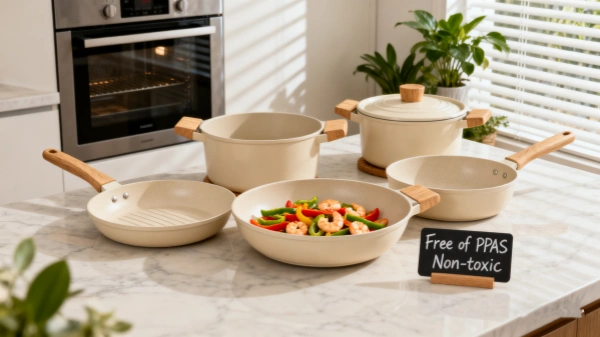
Practical Safety Guidance — How To Use Ceramic/ Sol-Gel Pans Safely
Even the cleanest coating depends on proper use. Here are concrete, easy rules that reduce risk and extend pan life:
- Use medium heat whenever possible. Metal coatings can degrade with repeated high heat cycling.
- Prefer non-metal utensils. Wood, silicone, or nylon reduce abrasion that exposes substrate metal.
- Follow the manufacturer's oven temp limits. Exceeding the stated maximum can change a coating's chemistry.
- Inspect new pans. If you see irregular discoloration, cracks, or chips out of the box, document them and contact the seller before first use.
- If coating chips, stop using it for food. Chips change the exposure profile and are grounds for warranty replacement in most reputable brands.
How To Evaluate Safety Claims
When you need to be certain (for example, procurement, food service, or personal health reasons), follow this checklist:
- Ask for the SKU-specific COA that shows the test method (ICP-MS or targeted PFAS panel). Test dates and lab name matter.
- Prefer COAs that include extraction methodology (simulated cooking extraction) rather than just total element analysis on a raw sample.
- Check whether the brand publishes third-party test summaries on product pages (Caraway displays a “See Lab Results” callout on product pages).
- Factor in warranty length and replacement policy for coating failure—longer warranties reflect brand confidence in durability.
Brief Brand Note — Solamex
At Solamex, we design cookware with traceable, third-party testing in mind. Our product pages include QA and COA access for wholesale buyers who require independent verification that products meet non-toxic labeling. If you want a Solamex COA for procurement, we’ll provide the SKU-level report on request.
Quick Bottom Line
Caraway’s public claims (PTFE/PFOA/PFAS/lead/cadmium-free) are backed by third-party lab summaries cited by reputable reviewers — and regulatory review (NAD) recently affirmed many of those claims while recommending caution in comparative marketing. Handheld XRF surface scans created debate but are not a substitute for certified wet-chemistry confirmation of leaching risk; if you need absolute certainty, ask for the SKU COA and a test that uses extraction methods representative of cooking conditions.
Frequently Asked Questions
Is Caraway cookware PFAS-free?
Caraway publicly states their cookware is PFAS-free and points to third-party test summaries on product pages; independent reviewers who obtained COAs found no detectable PFAS in the tested samples.
Do XRF positives mean a pan will leach lead into food?
No—XRF detects surface elements but does not measure leachable contamination. Confirmatory lab work (ICP-MS with an extraction protocol) is the accepted method to determine if elements can migrate into food during cooking.
What should I do if my ceramic coating chips?
Stop using the pan for food, photograph the damage, and contact the manufacturer or seller for replacement under warranty. If you’re a wholesale buyer, keep batch documentation and ask the brand for batch-level COAs for traceability.
Solamex — Wholesale Pots and Pans Expertise
Solamex offers wholesale non-toxic pots and pans, combining durable materials, precise craftsmanship, and flexible product customization. From premium stainless steel to advanced nonstick lines, our catalog is built for both retail distribution and demanding commercial kitchens — ensuring consistency in performance and presentation.
Is Caraway Cookware Truly Non-Toxic? Into Its Safety, Materials, and User Concerns
What Is Water-Based Oil Non-Stick Coating For Cookware