Common Cookware Mistakes That Can Damage Your Pans
Introduction
Why do quality pans degrade quickly? Replacing a warped pan or flaking skillet feels extremely frustrating. Modern cookware remains highly convenient, yet frequent cookware mistakes ruin these surfaces completely. Prolong your skillet lifespan by stopping common habits that harm the top protective cooking coating today.
Quick Action Guide
-
Do Not Plunge A Hot Pan Under Cold Water: Allow the skillet to cool completely on the burner for five to 10 minutes to avoid thermal shock and the permanent warping that occurs from a sudden drop in temperature.
-
Avoid Aerosol Cooking Sprays: Instead, dip a paper towel in a high-smoke-point oil and wipe the pan for a clean surface free of sticky lecithin.
-
Add Oil Or Butter Before Starting: Do not heat a non-stick pan when empty; the fat helps keep the pan at a more even temperature. Choosing the best nonstick cookware set provides a great start for your kitchen.
-
Hand-Wash With Care: Seasoned or aluminum pans, or items like a Salamanca Gold Press Casserole, should be hand-washed with warm water and a soft sponge to avoid harsh, highly alkaline dishwasher detergents.
-
Use Soft Pan Protectors: Consider using a dish towel between each skillet to help prevent scratching during pan stacking in the cabinets.
What Is Cookware Damage?
|
Material Type |
Vulnerability |
Common Result |
|
Cast Iron & Carbon Steel |
Sudden temperature changes |
Cracks or warps |
|
Aluminum |
Alkaline dishwasher detergents |
Pitting and corrosion |
|
Ceramic Coatings |
Metal spatulas and utensils |
Micro-fissures and flaking |
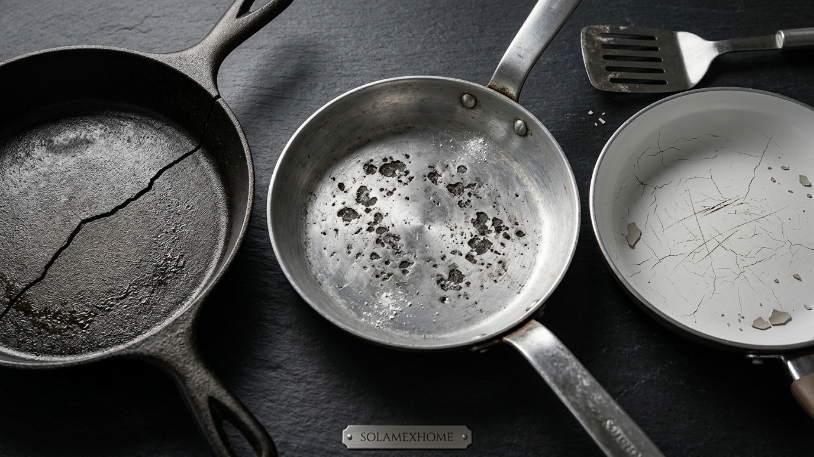
Cookware damage is the physical or chemical wear and tear that happens on the cooking surface, the structure of the pan, or the protective coating due to wrong ways of use, cleaning, and storage. It manifests in warped pots, pitted pans, and seasoning flaking or sticking, reducing the service life of any pot or pan from years to a few months.
All pan materials have their vulnerabilities, and the reason most cookware breaks down is that all pans are treated alike. Cast iron and carbon steel crack or warp when exposed to sudden changes in temperature.
Non-stick coatings are highly susceptible to high heat and aerosol residues. Aluminum pitting and corrosion occur in alkaline dishwasher detergents. Micro-fissures are formed in ceramic coatings by metal utensils.
Once the coating starts to disintegrate, it can continue to peel while cooking and may end up in your food. Although health experts do not consider exposure to PTFE a high risk because it is largely chemically stable in the body, many still wonder is nonstick cookware harmful to health when flakes of the coating can be ingested, making it highly recommended to replace damaged frying pans.
As the surface breaks down, it releases more flakes over time, particularly when heated and frequently used.
Beyond that, there is a very practical reason to replace damaged cookware: it will not function as it is supposed to. Cleanup becomes difficult, food starts to stick to the pan, and the pan might not heat evenly as the surface deteriorates. Once the non-stick layer or cast-iron seasoning begins to fail, the safest and easiest way is to change the pan or thoroughly re-season it.
7 Common Cookware Mistakes
|
Bad Habit |
Consequence |
Prevention Method |
|
Plunging hot pan in cold water |
Permanent thermal shock warping |
Cool completely on the stove |
|
Heating an empty pan |
Toxic fumes and degraded coating |
Add oil or butter first |
|
Stacking without protection |
Scratches and damaged slip layer |
Use felt protectors or soft towels |
Most people unwittingly damage their cooking gear with everyday activities in the kitchen. Here are the common problems that make cookware unsafe, from the actual causes of damage to the steps for prevention.
1. Submerging A Hot Pan In Cold Water
This error is not unique to non-stick pans, but it can be especially problematic for them. The sudden and extreme temperature change is enough to permanently warp a hot skillet if it is plunged into cold water.
Thermal shock is the term for what happens when a hot pan is suddenly dunked in cold water, causing the metal to swell unevenly.
When the steak is seared and the pan is hot, bringing it to the sink to wash under cold water causes self-destruction. That sizzle and hiss is the sound of the pan breaking down. When the outside surface of the metal comes in contact with the cold water, it shrinks immediately, while the inner surface keeps expanding due to the retained heat energy.
The resulting non-uniform contraction deforms the metal completely out of shape. If a pan is warped, it will not lie flat against the heat source and will cause hot spots while frying. The impact may break cast iron pans entirely or cause them to run around forever on a flat glass-top electric cooktop.
Key Actionable Steps
-
Let The Pan Cool Completely: On the stove top or the counter before washing.
-
Never Pour Cold Water: Over a still-hot pan.
-
Safely Accelerate Cooling: By moving the pan onto an unheated, room-temperature burner.
2. Heating a Pan Empty
Preheating the pan without food is common with stainless steel, but it is a big wrong with non-stick cookware. When the surface becomes overheated, the PTFE coating may degrade and cast noxious, unpleasant fumes that are threatening to people, birds, and other pets.
Finding the best quality non stick cookware helps immensely, such as the Forged Aluminium Dark Green Series Cookware Set.
Heating a dry pan ruins the protective coating, causing wear to happen at very high rates and reducing the pan's life. On a gas burner set to high, the coating can burn to 500°F (260°C) in less than two minutes, the exact temperature at which the PTFE breaks down.
This degradation causes a condition generally referred to as "Teflon flu," a flu-like illness resulting from the inhalation of the degraded polymer. The best course of action is straightforward: pour a bit of oil or butter into the skillet, then turn on the burner. The fat serves to absorb excess heat and maintain a more even surface temperature.
Key Actionable Steps
-
First, Add The Oil Or Butter: Into the skillet, and then turn on the heat.
-
Limit Any Pre-Heating: Of empty non-stick pans to 60 seconds or less.
-
Only Use Low To Medium Heat: In the initial stage of cooking.
3. Using Cooking Spray
You might think that aerosol cooking sprays go hand in hand with non-stick pots and pans, but they are a major issue. These sprays burn at lower temperatures than butter or most cooking oils, creating a sticky residue that will develop over time.
Commercial cooking sprays use soy lecithin as an emulsifier. On high heat, that lecithin polymerizes into a brown sticky material that adheres very hard to the non-stick surface. That residue is extremely difficult to get off and ruins the pan's non-stick properties.
You will notice this after some weeks as your eggs begin to adhere. Some brands even warn that they do not cover any instance in which cooking spray is used, as it completely negates the warranty of the cookware.
Key Actionable Steps
-
Apply A Light Coat: To the surface by dipping a paper towel in high-smoke-point oil and wiping the pan.
-
Use Your Favorite Cooking Oil: In a reusable spray bottle to add oil in a more controlled manner without the lecithin.
-
Pour Cooking Oil Straight: From the container and brush it evenly with a silicone brush.
4. Putting It In the Dishwasher
Even if the pan is specifically marked as dishwasher safe, hand washing is a better alternative to maintain the coating and structure. Cookware subjected to a dishwasher experiences extreme temperatures and harsh detergents, which over time cause the non-stick surface to deteriorate. Every top nonstick cookware brand warns against this damage.
These harsh environments dry the coating down and make it less effective. Dishwasher detergents are very alkaline (pH 10 to pH 11). This intense alkalinity leads to the quick pitting of aluminum cookware and the vigorous removal of polymerized seasoning oil from cast iron and carbon steel.
The alkaline solutions attack the aluminum metal, forming tiny pits around which the detergent works. The rough, discolored, and oxidized surface collects food and becomes highly ineffective. Furthermore, the wash cycle removes the oil coating essential for protecting cast iron, causing the bare iron to rust almost immediately.
Key Actionable Steps
-
Perform A Rapid Rinse: With warm water, mild dish soap, and a soft sponge, which is gentler and often faster.
-
Do Not Run Bare Aluminum: Cast iron, or carbon steel in the dishwasher.
-
Immediately Dry Pans: After hand-washing to avoid any moisture that might cause rust.
5. Cleaning With An Abrasive Pad
The wonderful thing about non-stick cookware is that it should not need to be strongly scrubbed. Abrasive surfaces such as metal scouring pads or harsh scrubbers will cause serious damage to the coating and permanently decrease effectiveness.
Scratches start to erode the coating, and as soon as the surface is broken, food will stick, defeating the main point of the pan. Scratches also impede easy cleaning, as debris tends to stick to the roughened surfaces. Using an abrasive pad is an aggressive cleaning approach usually resulting from an attempt to remove polymerized oil or burnt food, but it always causes irreparable damage to polymer and ceramic surfaces.
Key Actionable Steps
-
Scrub The Pan Only: With a normal sponge or soft dishcloth and warm, soapy water.
-
When Food Debris Is Still Left: Soak the pan in warm water for a short while and then wipe it clean.
-
Do Not Use Steel Wool: Or heavy-duty scouring pads on coated or seasoned surfaces.
6. Allowing Pans to Stack Unprotected
Stacked pots and pans are useful in many kitchens to fit into limited space, but setting a non-stick pan on top of another creates extra scratches on the coated surface. A made in nonstick cookware set can easily be ruined if one pan rubs against the cooking surface of another, eventually damaging the thin layer over time.
Each time a pan is removed from the bottom of a nested stack, the pan above it moves and rubs heavy metal on the lower pan's cooking surface. Due to that friction factor in storage, nearly invisible scratches build up.
Scratches on the non-stick surface ruin the important slip layer, while scratches on stainless steel create small gouges where food will collect and cleaning becomes much more difficult. This is a slow-motion type of damage that grinds away over weeks and months until the pan becomes unworkable.
Key Actionable Steps
-
When Stacking, Separate Skillets: With a dish towel, soft pan protector, or paper towel.
-
Buy Felt Pan Protectors: To prevent scratching; they can also help keep the warranty intact on some brands.
-
If You Have Space: In your kitchen cabinets, hang high-end or frequently used skillets on a special rack.
7. Using Metal Utensils
A non-stick or ceramic surface can be easily ruined by metal spatulas, spoons, and whisks. Just as with abrasive cleaning pads, the sharp edges of metal tools break the integrity of modern cooking surfaces. Never use metal spatulas on coated surfaces like the Tri-ply Hybrid Mirror Series; stick to safer options.
Even minor scratches spoil the coating, and as soon as the surface is broken, food will stick. Ceramic coatings are thinner and more brittle than PTFE coatings. When metal spatulas are used on ceramic pans, they do more than just scratch the surface—they make very small micro-fissures invisible to the naked eye. Water and hot oil seep into those fissures during the cooking process.
Over time, the pressure tremendously scours the coating, causing it to peel and chip away until the pan is completely useless.
Key Actionable Steps
-
When Using Non-Stick Cookware: Use only silicone, wooden, or heat-safe plastic utensils instead of metal ones.
-
To Cut An Omelet Or Frittata: Into wedges, slide the food onto a cutting board first instead of cutting it directly in the pan.
-
Do Not Leave Metal Whisks: Spoons, or forks against the fragile edges of coated pots and pans.
People Also Ask
Can A Non-Stick Pan Be Preheated Empty?
It is heavily not recommended, but if it must be done, it can be safely done for less than 60 seconds on low to medium heat. Heating a pan without food is a common mistake; PTFE coatings, when overheated, fragment and give off foul, health-threatening fumes.
An empty pan can exceed the 500°F (260°C) degradation temperature in less than two minutes. The safer way is simply to put some oil or butter in the skillet before turning on the heat to absorb the thermal energy.
How Do I Fix A Cast Iron Pan's Metallic Taste?
A pan will have a metallic taste if it is not completely seasoned or if the seasoned layer is stripped away. Many new cast iron owners complain this happens when they cook highly acidic food, such as tomato sauce or lemon glazes.
Acid strips away the thin layer that forms in the first seasoning, allowing raw iron to come into contact with food. To correct this, develop a strong seasoning layer through several cycles of oil-and-heat baking prior to trying an acidic dish again.
Is It Okay To Wash Aluminum Pans In The Dishwasher?
No, because dishwasher detergent can pit and corrode all aluminum surfaces. Handwashing is the treatment of choice even for pans marked as dishwasher safe. Utensils put in a dishwasher are subjected to high temperatures and strong alkaline chemicals (typically pH 10 to 11), which cause the metal to gradually disintegrate.
The detergent causes a rough, gray, oxidized surface that totally destroys the smooth finish. Hand washing bare aluminum with warm water and a soft sponge is always appropriate to maintain the integrity of the surface.
With Proper Care, How Long Should Cookware Last?
When well taken care of, the best nonstick cookware set on a budget can last from one to five years, whereas mid-range and premium cookware can last for several decades. Strictly avoiding thermal shock by cooling pans before washing, handwashing instead of using a dishwasher, using silicone or wooden utensils, and padding nested pans with soft protectors are key to longevity. If the coating is damaged, the pan will not work properly, making it vital to maintain the top layer.
What Kind Of Oil Should You Use To Season Cast Iron?
Smoke point is an important factor for seasoning oils, as they have to polymerize at high temperatures without turning to ash. Most culinary professionals find the most success with grapeseed oil, canola oil, or flaxseed oil. The objective is to apply a thin film of oil and bake it so it adheres tightly to the iron surface, providing a hard, smooth, non-stick surface that resists water and deters food attachment.
Building Better Cookware Habits
There is only one sure way to keep cookware in good shape: use the right methods for the different types of materials. The common habits listed above can easily scratch the coating, reduce the lifespan of the pan, or diminish the effectiveness of the cooking surface.
Avoiding these mistakes does not require expensive tools, commercial kitchens, or complicated daily routines; you actually just need some insight into the thresholds of the materials and to adapt your kitchen behavior.
To avoid warping, do not wash skillets right away while they are hot. Avoid aerosol cooking sprays; instead, use a paper towel moistened with a high-smoke-point oil to wipe the pan. Do not put delicate aluminum or cast-iron pans into the dishwasher.
Never use metal spatulas on coated surfaces; stick to silicone or wooden utensils, and put felt protectors or soft towels between stacked pans in the cabinet.
These basic, everyday practices cover nearly all avoidable cookware conditions. The benefit is no-nonsense: a cast iron skillet can last just as many years as a non-stick pan that costs twice as much if you keep it in good shape. Even inexpensive aluminum pans will last you years if you hand wash them and never heat or cool them quickly.
Otherwise, you will need to purchase new pans every few months because a damaged coating will not work as it should. Reading cookware set reviews helps you become familiar with the different needs of the products in your kitchen. Avoiding these pitfalls ensures your non-stick skillet lasts like new, saves you money, and makes your cooking life a whole lot of fun.
Conclusion
There remains only one sure way to keep pans in good shape. Avoiding everyday cookware mistakes ensures your skillet lasts like new. These basic practices cover nearly all avoidable damage perfectly. Familiarize yourself with different needs to save money. Visit SolamexHome to explore premium options and make your daily cooking life a whole lot better!
Dutch Oven Buying Guide: Uses, Sizes, and Materials
Best Cookware for Gas, Electric, and Induction Stovetops