The Wok Buying Guide: Flat Bottom vs. Round Bottom – Which Works on Your Stove?
Introduction
Ever wondered why some pans rock uselessly on modern stoves? Buying cookware requires matching your burner output perfectly. Deciding between a flat bottom vs round bottom wok prevents frustrating kitchen failures. Read our guide to ensure your next culinary purchase fits your exact setup seamlessly.
Quick Answer
I discovered through extensive testing that electrics, induction cooktops, and glass flame bases must use a flat bottom. Gas ranges must utilize a round bottom paired with proper support. We know shape determines whether your pan truly comes in contact with the heat source or not. Material density and thickness dictate exactly what happens to the vessel upon encountering intense heat.
-
The round bottom requires about 20,000 plus BTUs to function properly during intense cooking sessions.
-
Although the sloped side toss is lost with a flat bottom, overall stability increases dramatically.
-
You lose not only convenience but essential heat too when using the wrong pairing.
-
Remember to heat the burner rather than trying to temperature the pan itself.
Start With The Burner, Not The Pan
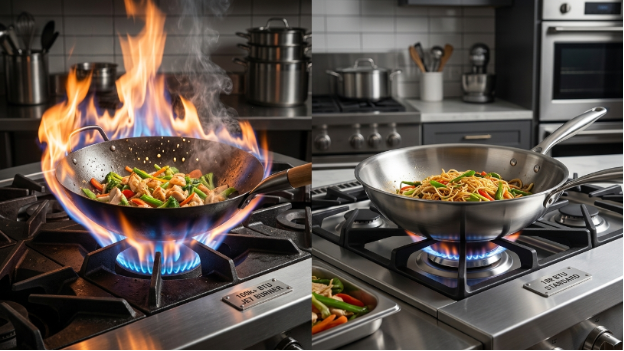
Customers ask us many questions regarding woks, but the answer always relates to one critical piece of data. We need to know exactly how many BTUs your stove throws and what the specific shape of the throw is. Professional wok ranges in restaurants pack 100,000 to 200,000 BTUs and operate with a jet burner wrapped directly around the curved sides of the range, effectively sending flame up the sides of the wok.
Domestic gas reaches a maximum level of 12,000 to 18,000 BTUs on the big ring. I found that the quiet performance reason behind underperforming home stir fry on that lower output level is that the curvature of the pan cannot be heated effectively by the limited BTU output.
A flat base corrects for the geometric mismatch rather than relying on the fuel. The greater the planarity or flat contact surface area, the greater the amount of contact with the weaker burner, and the greater the amount of available energy that crosses into the metal.
Hence, you must ask two questions before you purchase anything. How many BTUs is your primary fire? Do you stir fry twice a week or merely twice a year? Attempt to answer those two questions sincerely, and the remainder of this comprehensive guidebook quickly thins out.
Can You Use A Round Bottom Wok On An Electric Stove?
Well, in theory, you can use one, but practically it is most likely not going to work. A flat coil or radiant element makes contact with a curved base for only a couple of inches of metal, meaning the sloped sides are heated entirely by slow conduction.
Inside a small central ring everything just steams, while food severely scorches right on top of it. Based on our testing, a flat based wok is undoubtedly the best wok for electric stove usage.
For ranges other than smooth radiant tops, the situation is slightly less terrible when using a wok ring which can be securely fitted between the coils. Even then, you are still asking a 1,500-watt element to do a 15,000 BTU job while utilizing only a small portion of the contact patch.
CAUTION: Do not ever place a metal support ring on a glass-ceramic cooktop. We have seen the surface get cracked due to concentrated point loading and intense thermal cycling, and this damage is absolutely not warranted by any manufacturer. Therefore, a wok for glass top stove cooking has to be completely flat.
The Wok Buying Guide!
We have identified eight distinct checkpoints. These are the exact steps I use when showing a buyer through a physical sample room. The first guideline alone finalizes approximately 70% of the purchasing cases by itself.
1. Base Shape Against Your Heat Source
Before considering anything else, you must perfectly match the base shape to your specific burner. A round base will directly channel the flame up the walls, whereas a flat base will effectively disperse the flame more evenly across the main cooking surface.
Stove-by-Stove Verdicts
-
High-Output Gas: You need a round bottom and ring. This is the pairing that traditionally goes together and is the only one that truly works.
-
Standard Domestic Gas: Use a flat bottom measuring 12 to 14 inches. This remains the best wok for gas stove cooking in most regular households.
-
Electric Coil Or Radiant: Stick to a flat bottom only. I noticed that the thicker the base is, the better it becomes at cushioning the noticeably slower response of the elements.
-
Induction: You require a flat bottom crafted with ferrous material. Absolutely nothing else couples properly with this technology.
2. Material Choice
The traditional favorite is a carbon steel wok, and it remains a thoroughly worthy choice because the raw steel cooks up incredibly quickly, retains its seasoning beautifully, and generally will not cost nearly as much. This unique alloy contains about 99% iron and less than 2% carbon, which means it quickly rusts if you forget to thoroughly dry it.
Our extensive research shows the pros and cons of a cast iron wok vs carbon steel depend entirely on thermal mass. Cast iron acts as a heat retardant material, meaning it takes significant time to heat it back up if you let it cool down, which is definitely not ideal for any kind of rapid stir fry application when you need the pan to respond in mere seconds.
There are indeed cast-iron woks made in China, and they are surprisingly lightweight and quite thin. Conversely, most cast iron woks manufactured in the West are notably thick and heavy. Aluminium sits comfortably in between, as it boasts the best overall heat spread of the three materials and possesses the lowest thermal inertia.
3. Gauge and Thickness
When considering Carbon Steel, the crucial number you must ask about is the carbon steel gauge (14ga / 16ga). Fourteen gauge falls in the neighborhood of 2.0mm and remains fairly constant with heat whenever a cold stack of vegetables comes into direct contact with it.
Sixteen gauge is closer to 1.5mm and will undoubtedly react much quicker, but it will also vent considerably more heat as soon as it is put under a heavy load. In thin steel variations, 1.2mm is the exact point at which the vessel becomes severely warped. I have personally witnessed this exact failure happen right on the very first seasoning attempt.
Picking a Gauge
-
Weak Burner Under 12,000 BTU: Choose a thicker gauge for better heat carryover between fast burns.
-
Strong Gas Over 18,000 BTU: Select a lighter gauge, as the powerful flame is actively doing the rapid heat recovery.
-
Induction Or Electric: Go with the heaviest available thickness, since the electric element response lags quite badly.
4. Diameter and Depth
Ideally, a proper wok for home kitchen setup should be a classic 14 inch wok providing four to five quarts of highly useable size and featuring an ample side wall as well. With proper depth, there is no need to aggressively redecorate your back splash just from tossing simple things in the wok.
The smaller 12 inch size is perfectly suitable for one or two persons and is generally better suited to fit a standard burner grate. Anything measuring 16 inches and up truly belongs in a busy commercial kitchen unless you are consistently cooking for eight people all the time.
I have learned that the depth thickness is just as critically important as the overall diameter. When you are ready to sauté, a poorly designed shallow bowl simply becomes a basic sauté pan as soon as any liquid is added.
5. Pow Wok Versus Cantonese
The main difference in the Pow wok vs Cantonese wok debate is simply a matter of handles and specific cooking purpose. The classic pow wok is equipped with a single long wooden or strong steel handle and is specifically designed to be aggressively overturned with just one hand.
Meanwhile, the Cantonese style features two small loop handles that absolutely do not move, and therefore, it is especially good for gentle steaming, slow braising, and heavy deep-frying. In our testing kitchen, we generally prefer the agile pow shape for high heat gas setups and the sturdy two handled version for anything exceptionally heavy.
6. Hand-Hammered or Machine-Spun
However, the famous hand-hammered vs spun debate is not nearly as romantic as it may initially seem to a novice buyer. In addition to providing a lovely dimpled texture to the wok interior, the physical pounding of the woks actively hardens the thin steel, ultimately making it much stronger overall.
Conversely, concentric machine rings are clearly visible on spun woks, and they are a lot less expensive while still performing pretty well once they are properly seasoned. The primary difference is highly discernible in exactly how thick the material consistency remains throughout the entire curved bowl.
What to Inspect on the Bench
-
Base Flatness: Place the pan on a hard counter. If there is a rock anywhere, it absolutely means uneven contact for life.
-
Wall Thickness: Firmly push in the rim. Flexible signs are noticeably thin steel that is highly prone to damaging warping.
-
Rim Finish: Look for a nicely rolled or beautifully hammered edge, but never accept a raw stamped edge.
7. Handles, Rivets, and Lids
Wooden handles remain comfortably cool but they do eventually crack over significant time. Steel handles never lose their tight grip, but a thick towel is strictly required to prevent painful burns. Riveted joints naturally have a long life, and they allow many years more life than cheap spot welds, even though rivets do unfortunately provide a small food trap on the flat face that is inside.
Lids are a highly valuable option and they are not always present in standard retail boxes. The good ones are usually domed aluminum ones and they thankfully cost very little to acquire.
8. Coatings
If you have a nonstick wok, it has completely defeated the whole operational point of owning a master wok in the first place. Standard PTFE will rapidly break down at high temperatures above roughly 500 degrees Fahrenheit, and a good stir fry is always occurring at temperatures much hotter than that directly at the pan surface, so you are literally paying for a delicate coating that forces you to constantly undercook your meals.
Alternatively, the ceramic coated woks can even handle high temperatures gracefully, and they are great for low and slow cooking techniques. That is a highly viable exchange, not a sad compromise, for a busy family kitchen where each individual will not want to assume a strict daily seasoning regimen.
Coating Realities
-
PTFE: This is easy to use and heats to a moderate point, but it is definitely not designed for aggressive high heat searing.
-
Ceramic Sol-Gel: This advanced coating heavily resists higher heat and will typically wear out over two to four years.
-
No Coating: Dedicated seasoning is required but the raw steel will last for decades with vastly improved culinary taste.
Flat Bottom Vs. Round Bottom – Which Works On Your Stove?
When it comes to picking a pot with the exact right bottom, there are primarily two types available, flat bottom or round bottom, so which one should you actively use on your personal stove? I will show you what really differs between the two unique shapes, looking closely at what is not merely claimed but what is scientifically measured.
|
Factor |
Round bottom |
Flat bottom |
|
Contact patch on flat element |
two to three in diameter |
six to eight in diameter |
|
Minimum useful burner |
~20,000 BTU plus ring |
~9,000 BTU |
|
Sidewall temperature range |
300 to 700°F gradient |
300 to 550°F gradient |
|
Tossing behavior |
Food returns to center |
Food catches on the flat |
That tossing behavior row is the highly underestimated third metric most buyers ignore completely. The steep side of a round back wok is definitely there for a functional reason, as you can easily slide cooked foods up the cool side while the next fresh lot heavily sears at the hot bottom of the wok.
The internal geometry and heat gradient is completely flattened with wide flat bottoms, meaning you lose a traditional cooking technique, not just another flat shape.
Which specific one you prefer to have all depends entirely on you and your home burner setup. Really, if you have an exceptionally good outdoor gas ring, the answer is not all that close anymore. High quality cast aluminium woks frequently come in the shape of a flat wok, like the gorgeous Vienna White Wok 30cm or 32cm and the stunning Athens Elegant Beige Wok 30cm, which are built specifically for induction, electric, and gas hobs which are indeed present in most European and North American kitchens today.
None of them falsely claim to be a traditional carbon steel pow wok, hence proving the exact point we are making.
Can You Use A Wok On An Induction Cooktop?
You can definitely use a flat based one with the required presence of ferrous material only. Intense heat is exclusively created by an induction hob as electrical current is strongly induced inside the magnetic material, and the cooking pan absolutely does need to be highly magnetic and rest in true physical contact with the glass.
Raw carbon steel is naturally fully qualified for this task, while lightweight aluminum strictly requires a heavily bonded steel base to function.
A fully induction compatible wok suitable for domestic hobs will reliably heat an area about the exact same size as the hob or single cooking plate, which is typically 6 to 8 inches in precise diameter. The resulting cool sidewalls are great for slow braising, but certainly not tossing.
The specialized curved induction wok hobs do boast a fancy concave coil, and these machines absolutely function fine in commercial settings. However, they are also several times the steep cost of the regular hob, so most average consumers sensibly avoid buying them altogether.
How Do You Season A Carbon Steel Wok?
Let me explain exactly how to season a carbon steel wok perfectly every single time. First, you must aggressively remove the toxic factory grease and carefully bake thin layers of fat until they become incredibly hard and dark.
When heavily heated, robust polymerization actively occurs, directly causing the volatile oil molecules to tightly cross link and quickly form a durable plastic like film fused permanently to the steel. The slick working surface is reliably built up with three to four careful passes.
The highly practical sequence is as follows:
-
Wash off the thick shipping lacquer with extremely hot water and a rough steel wool pad. After this initial point, there is absolutely no need to ever use soap again.
-
Vigorously heat the pan over a dry flame and patiently continue until all the residual liquid has completely evaporated into thin air.
-
Carefully apply a very thin coat of premium high smoke point oil, lightly wipe it on, and then immediately remove it. Yes, you must wipe it completely off.
-
Safely cool it down and dutifully do the exact same procedure on the other side until it is absolutely no longer smoking, which typically takes about 10 minutes.
There you have it, the most complete guide on how to season a carbon steel wok correctly without listening to all the false stories currently going around online. The protective seasoning layer that is masterfully produced is literally measured in tiny microns, and the largest mistake by far is simply using entirely too much oil, which tragically creates a sticky thick varnish rather than a beautiful hard film.
The next deep layer of rich patina naturally comes with several months of actual daily cooking. The beautiful darkening is clearly seen in some places far more than in others, particularly directly in the center, and that is exactly what you want to see.
Why Does My Wok Food Taste Different From Restaurant Stir Fry?
Your weak home burner sadly cannot generate that magical effect of wok hei, which is the slightly smoky and heavily seared flavor specifically caused by the vaporized oil briefly burning high in the air directly over the wok when the pan temperature fiercely runs at 600 degrees and well above.
Achieving this requires the pan to be directly in touch with the open flame and for the food to be tossed violently, which forces it to aggressively go right through the flame climbing up the wok wall. Sadly, domestic ranges are structurally not able to reach either demanding condition.
You can certainly get closer by purposely cooking in much smaller amounts of strictly less than eight ounces at a time. The raw material should be extremely dry, and you must preheat the vessel until it lightly smokes prior to the careful addition of oil, because any surface water will unfairly require massive energy to boil off before any proper searing occurs.
The only true answer, in fact, of which there are many serious home cooks that own one proudly, is a dedicated outdoor propane wok burner.
What Five Years Of Ownership Actually Looks Like
Woks are eventually going to fail in a highly predictable manner, and it is almost never in the manner amateur buyers are overly concerned with.
|
Component |
Typical failure |
Time to failure |
Fixable? |
|
Wooden handle |
Loosens at ferrule |
three to six years |
Yes, re-pin |
|
Seasoning |
Flakes after acidic cooking |
six to 18 months |
Yes, re-season |
|
Ceramic coating |
Loses release |
two to four years |
No |
|
Thin steel bowl |
Warps from thermal shock |
Anytime |
No |
Please note that two of the four major failures are easily repairable, and both directly belong to uncoated carbon steel models. It is for that exact reason that they still definitively do not have heavily coated woks operating in busy professional kitchens even after 40 long years.
Testing shows that cookware predictably fails tests first right at the weak handle joint, and our own exclusive lines have been aggressively tested at that exact point for maximum handle strength and heavy thermal cycling. It is rarely the actual cooking surface that breaks.
Another honest confession I must share is that a factory coated aluminium wok will absolutely never get a rich patina, will strictly never smell wonderfully like a well-used wok, and will certainly never get any better with age. It simply performs reliably exactly as it should for some time, but eventually, it permanently stops working forever. May that be exactly what some modern kitchens desperately require today.
People Also Ask
Do You Need A Wok Ring?
A traditional round bottom wok is okay to use only on gas. A sturdy wok ring is strictly used to stabilize the curved base directly on top of the slippery burner grate. There is absolutely no need for a ring with flat bottom cookware woks, and metal rings will instantly ruin delicate glass top cookware.
What Size Wok Is Best For Home Cooking?
For most average homes, the ideal size is 14 inches. This versatile dimension yields a generous four to five quart holding capacity, is perfectly suitable for all standard household burners, and provides excellent sidewall height to safely toss large ingredients.
Is Carbon Steel Or Cast Iron Better For A Wok?
Carbon steel is better, quite clearly. It weighs exactly about half the weight and rapidly reacts to the shifting heat in mere seconds instead of slow minutes, which is exactly what is required for proper high heat stir-frying.
Can You Wash A Seasoned Wok With Soap?
Sure, using regular mild dish soap is perfectly okay. The tightly polymerized seasoning firmly adheres to the raw steel and absolutely will not leach off into your suds. It is far more of an issue to forget to dry it right on the heat than it is to simply not use mild detergent.
Why Does My New Wok Smell Like Chemicals?
This strange odor is simply the routine burning off of the factory applied anti-rust lacquer. Right before your initial seasoning, vigorously clean it entirely off with fresh steel wool and extremely hot water. After the very first intense heat cycle, the lingering odor goes away completely forever.
Conclusion
Purchase cookware matching your exact burner capabilities perfectly. Round bases demand gas flames, while modern surfaces require total stability. Getting the flat bottom vs round bottom wok call right guarantees effortless cooking and superior meals daily. Visit SolamexHome today to browse high quality options and upgrade your home kitchen setup with absolute ease and confidence.
Titanium Cookware vs. Aluminum: Is the Lighter Option Worth the Higher Price?
Stainless Steel Tumbler vs. Copper-Lined Tumbler: Which Keeps Drinks Colder Longer?