Cast Aluminum Cookware: Lightweight Powerhouse or Die-Cast Durability? Your 2025 Buyer’s Guide
Introduction & Market Context
In recent years, cast aluminum cookware has grown from a specialty item into a kitchen staple for home cooks and professionals alike. Its winning combination of light weight, rapid heating, and affordability has driven widespread adoption in both retail and foodservice channels.
As consumers seek cookware that heats evenly, resists corrosion, and remains budget-friendly, cast aluminum stands out for delivering on all fronts. In this article, we’ll explore its definition, how it’s made, performance traits, the relationship with die-cast variants, buying guidance, and upkeep best practices.
What Is Cast Aluminum Cookware?
Cast aluminum refers to cookware formed by pouring molten aluminum alloy into molds—either sand-based or permanent steel forms—then cooling until solidified. This contrasts with stamped or spun aluminum pieces, which start from sheet metal.
Key attributes include a light overall weight that eases handling, excellent thermal conductivity for fast heat-up and cool-down, and inherent corrosion resistance that outperforms raw cast iron. These characteristics make cast aluminum cookware ideal for tasks ranging from searing and simmering to one-pot meals.
Manufacturing Processes
1. Sand Casting & Permanent-Mold Casting
In sand casting, molten aluminum is poured into a sand mold created around a pattern. Once solidified, the sand mold is broken away, leaving a piece that often requires machining or polishing to smooth rough surfaces. Permanent-mold casting uses reusable metal molds for greater dimensional consistency but still yields a somewhat coarse finish compared to die-casting.
2. Die Casting: High-Precision Alternative
Die casting forces molten aluminum under high pressure into a precision steel die. This process produces cookware with uniform wall thickness, a near-net smooth finish, and tight dimensional tolerances—attributes prized in “die-cast aluminum cookware”. The downside is higher tooling cost and heavier final weight due to denser, uniform sections.
3. Cast vs Die-Cast Relationship
It’s important to note that all die-cast cookware is cast aluminum, but not all cast aluminum cookware is die-cast. Sand-cast and permanent-mold pieces fall under the broader cast category, while die-cast represents a premium, precision-manufactured subset. With manufacturing methods clear, let’s see how they translate into kitchen performance.
Performance Characteristics
Heat Conductivity & Responsiveness
Aluminum’s high thermal conductivity—up to ten times that of stainless steel—means cast aluminum cookware heats quickly and cools down equally fast, granting cooks fine temperature control for delicate sauces and rapid sears alike.
Weight & Handling
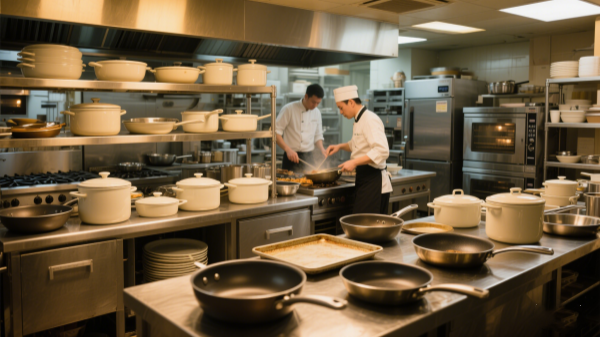
Compared to cast iron, cast aluminum pans weigh 40–60% less, reducing fatigue during stirring and flipping. This lighter profile makes them ideal for home kitchens and line cooks managing dozens of pans during service.
Durability & Warping Resistance
While thinner sand-cast cookware can warp under thermal shock, die-cast pieces—with their uniform thickness—offer enhanced warp resistance even when moved from stovetop to cooler surfaces.
Reactivity & Coating Options
Uncoated aluminum reacts with acidic foods, causing off-flavors and potential pitting. Most cast aluminum cookware is either anodized or finished with PTFE/ceramic coatings(like Solamex) to prevent reactivity and add non-stick properties.
Cast Aluminum vs Die-Cast Comparison
| Feature | Sand/Permanent-Mold Cast | Die-Cast Aluminum |
|---|---|---|
| Wall Thickness | Variable; often thicker base, thinner walls | Highly uniform across entire piece |
| Surface Finish | Rougher; needs machining/polishing | Smooth; near-net shape straight from mold |
| Dimensional Accuracy | ±0.5–1 mm | ±0.1 mm |
| Weight | Light; varies by design | Heavier; uniform density |
| Warp Resistance | Moderate; may warp under shock | High; uniform mass resists warping |
| Tooling Cost | Low | Very high |
| Best For | Small batches, intricate shapes | High-volume, precision cookware |
Selecting the Right Cast Aluminum Cookware
When choosing cast aluminum cookware, start by matching the piece to your cooking style:
- Searing & Sautéing: look for thicker bases (sand or die-cast) to resist warping and retain heat.
- Simmering & Sauces: lighter, thinner walls speed heat-up and cool-down cycles.
Next, balance budget versus longevity: sand-cast pieces offer lower entry cost, while die-cast variants command a premium but last longer under heavy kitchen use. Finally, verify any coatings (anodization, ceramic, PTFE) are PFOA-free and suitable for your cooking methods.
Care & Maintenance Tips
Cleaning: hand-wash with warm water and mild detergent. Avoid steel wool or metal scouring pads on coated surfaces to prevent scratches.
Seasoning Uncoated Pots: for raw cast aluminum, rub a thin layer of oil on the interior, heat gently, and wipe away excess to build a light non-stick patina.
Storage: stack carefully with pan protectors or paper liners to avoid abrasion. Store in a dry environment to prevent corrosion on uncoated rims.
Trends & Innovations
Anodized & Ceramic-Coated Finishes
Modern finishes combine aluminum’s conductivity with durable non-stick surfaces that resist scratching and withstand higher temperatures—bridging performance and health safety.
Hybrid Constructions
Newer cookware bonds an aluminum core to a stainless steel or magnetic base for induction compatibility without sacrificing heat responsiveness.
Sustainable Practices
Manufacturers increasingly incorporate recycled aluminum and optimize die-casting processes to reduce energy consumption and CO₂ emissions—aligning with eco-friendly cookware trends.
Conclusion & Action Items
Cast aluminum cookware offers unmatched versatility through its lightweight design, rapid heating, and cost-effectiveness, while die-cast variants elevate precision and durability.
Buyer’s Checklist:
- Identify primary cooking tasks (searing, simmering, one-pot meals).
- Choose manufacturing style (sand-cast for budget, die-cast for performance).
- Select appropriate coatings (anodized, ceramic, PTFE).
- Follow simple care routines to extend lifespan.
By understanding these factors, you can select cast aluminum cookware that delivers professional-grade results in your kitchen every time. Alternatively, you can trust Solamex, a highly recognized brand in the commercial aluminum cookware and wholesale cookware sectors.
Oven Safe Skillets and Pots: Your Expert Guide to Seamless Stovetop-to-Oven Cooking
The Ultimate Guide to Cast Aluminum Cookware: Unveiling Its Craft, Performance, and Modern Innovations