How Are Cooking Pots Measured: The Complete Guide to Pot Sizing
Those “6‑quart,” “8‑quart,” and “12‑quart” labels can be confusing. What do they actually measure—and which size do you really need?
Quick answer: Pots are sized by capacity to the rim. In the US this is in quarts; elsewhere, liters. The most useful home sizes are 6, 8, 12, and 16 quarts.
This guide streamlines the essentials: how pots are measured, what dimensions matter, and how to choose the right size for your cooking and storage space.
Primary Measurement Standards for Cooking Pots
Capacity (the main standard)
By total liquid capacity filled to the rim. Quarts (US) and liters (metric) are simply two ways to express the same thing. Capacity tells you the maximum volume, not the most practical day‑to‑day fill level.
Common household sizes cover most needs without overwhelming storage:
Small family meals, soups, pasta for 2–4
Versatile daily workhorse
Meal prep and larger batches
Entertaining, stock, canning
Unit basics: 1 US quart ≈ 0.946 liters. So an 8‑quart pot is about 7.6 liters. For real cooking, leave headspace—most recipes don’t use the absolute maximum.
Diameter and depth (supporting dimensions)
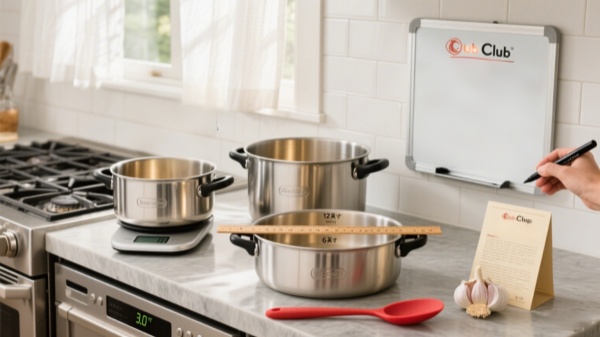
Diameter is measured inner rim to inner rim at the top. Depth is the interior height. Together they influence evaporation, browning area, and how easily you can stir or submerge ingredients.
Wider pots expose more surface for reduction and browning. Taller, narrower pots slow evaporation and are ideal for simmering soups and stocks.
- 6‑quart: ~10" diameter × ~5" depth
- 8‑quart: ~9.75" diameter × ~7" depth
- 12‑quart: ~11" diameter × ~8" depth
Common Pot Types and How They’re Sized
Stock pots and soup pots
Many 8‑quart stock pots are about 9.75 inches across and ~7 inches deep. This size comfortably handles pasta for a family, soups, and small stock batches without hogging storage.
Home stock pots usually range from 6 to 16 quarts. Their tall‑for‑width profile limits evaporation and keeps long simmers clean and efficient.
Dutch ovens and braisers
Dutch ovens are also rated by quarts but tend to be wider and shallower than stock pots, making them great for browning then braising, and for oven use.
Capacity Calculation and Verification
Quick math for round, straight‑sided pots
Capacity (qt) = π × radius² × height ÷ 57.75, using inches. Example: radius 5" and height 7" → 3.14 × 25 × 7 ÷ 57.75 ≈ 9.5 quarts.
Capacity in Quarts = (π × radius² × height) ÷ 57.75
Radius and height in inches; 57.75 in³ = 1 US quart
Irregular shapes and sloped sides reduce accuracy. In those cases, use the water‑fill method for a sure answer.
Practical at‑home measurement
Fill with water using a measuring cup and total the volume. Or measure inner top diameter and interior height, then compute capacity. Always measure inside the pot—ignore wall thickness.
Common mistakes: using exterior dimensions, measuring a tapered pot at a narrow point, or overlooking domed bottoms that slightly reduce true capacity.
Choosing the Right Size
Pick by household size
Think about whom you cook for most often, then add a little headroom for occasional guests or leftovers.
4–6 qt covers daily sides and small mains
6–8 qt hits the sweet spot for most meals
12–16 qt for big batches and hearty soups
16+ qt for holidays, canning, and parties
Pick by cooking task
Everyday (2qt–6 qt): Rice, eggs, small soups, sides.
Main meals (6–8 qt): Pasta for 4–6, stew, blanching, one‑pot dinners.
Batch & preservation (12+ qt): Stock, freezer meals, gatherings, canning.
Common Sizing Issues and Fixes
Advertised vs usable capacity
Manufacturers list to‑the‑rim capacity. Safe, practical capacity is usually 75–80% of that. An “8‑quart” pot typically cooks 6–6.5 quarts comfortably without boil‑over.
Leave space for boiling expansion, stirring, foam, and safety. That headspace protects your stove and your skin.
Metric lines may list exact liters that don’t round neatly to quarts, so you’ll sometimes see uncommon sizes (for example, 7.4 qt).
Replacement and upgrade decisions
If markings are worn off, use the water‑fill method to identify size before buying lids or parts. If you regularly run out of room or juggle multiple small pots, it’s time to size up.
Advanced Considerations
Material and construction
Wall thickness: Cast iron’s thick walls reduce interior space for the same external footprint; stainless steel or aluminum give more room inside at the same quart rating.
Base design: Thick multi‑ply bases slightly reduce interior height but improve heat distribution—usually a worthwhile tradeoff.
Coatings: Nonstick, ceramic or enamel add minimal thickness; the practical impact is small except on very tiny pots.
Storage and kitchen fit
Cabinet fit: Measure shelves before buying a big pot—volume that won’t store easily won’t get used.
Stovetop compatibility: Match base diameter to your largest burner for even heating, especially on induction.
Dishwasher limits: Pots over ~12 quarts often exceed standard dish‑rack clearances.
Professional kitchen context
Restaurants commonly use 20–40 quart pots for stocks and sauces, applying the same measurement rules. At home, staying within 6–16 quarts balances usefulness, storage, and burner size.
Key Takeaways
Pots are measured by total capacity to the rim. Diameter and depth shape how the pot cooks—wider for reduction and browning, taller for simmering.
Plan around usable capacity. Aim for 75–80% of the labeled size for everyday cooking; an 8‑quart pot is happiest around 6–6.5 quarts.
Choose for people, tasks, and space. A 6–8 quart pot covers most meals; add a small helper and a larger batch‑cooking pot if you have room.
With a clear sense of capacity, diameter, and depth—plus the reality of usable volume—you can pick pots that fit your cooking style and your kitchen. Measure what you own, fill the gaps with sizes you’ll use weekly, and let storage space guide how big you go.
5-Ply vs 3-Ply Stainless Steel Cookware: Which One Should You Buy?
How Are Cooking Pots Measured? — Capacity, Conversions & Practical Guide