How Big Is 6 Quarts? (Volume, Dimensions & What It Holds)
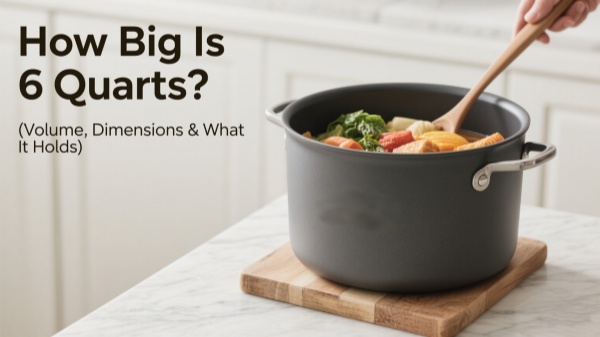
This page answers the simple question(How Big Is 6 Quarts?) directly and then walks you through how to visualise, measure, and choose cookware in the 6-quart range. Short explanations, a quick reference card for the top facts, and a brief B2B note near the end if you buy in bulk.
What is a Quart — and How Do We Convert it?
In most kitchens you'll encounter the U.S. liquid quart. Here are the most useful conversions so you can quickly switch between units when you read recipes or check product specs.
| Unit | Equivalent |
|---|---|
| 1 U.S. liquid quart | ≈ 0.946352946 liters (≈ 946.35 mL) |
| 6 U.S. liquid quarts | ≈ 5.678117676 liters (≈ 5.68 L) — commonly rounded to 5.68 L |
| 6 quarts in cups | 6 × 4 = 24 U.S. cups |
| 6 quarts in gallons | 6 ÷ 4 = 1.5 U.S. gallons |
Note: values above use the U.S. liquid quart. If you regularly use U.K. (imperial) volumes, those quarts differ slightly; most modern cookware specs use the U.S. standard.
What Does 6 Quarts Look Like as a Real Pot?
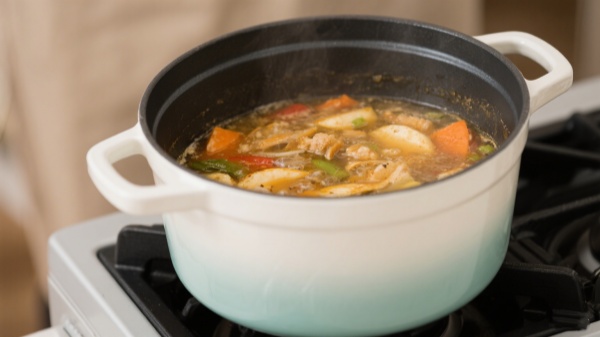
"Capacity" (how much liquid it holds) and "exterior dimensions" (diameter and depth) are related but not identical — two 6-qt pots can look quite different because of wall thickness and shape. Below are common, practical ranges you’ll see for cookware sold as 6 quarts.
| Type | Top diameter (in / cm) | Height / depth (in / cm) | Notes |
|---|---|---|---|
| Stockpot-style 6 qt | ~9–10 in (23–25 cm) | ~5–7 in (13–18 cm) | Tall-ish walls, straight sides — good for soups and boiling. |
| Wide/low 6 qt | ~10–12 in (25–30 cm) | ~4–6 in (10–15 cm) | Better for braising and large-surface sautés. |
| Multi-cooker / pressure-cooker inserts | varies | varies | Check manufacturer specs — "6-qt" labels usually mean usable capacity ≈6 quarts. |
If you need to confirm a physical pot is truly 6 quarts, see the measuring steps below — or check the maker's product page, where they usually list internal capacities and exact dimensions.
What Can You Make in a 6-quart Pot? (Practical Examples)
Numbers are a guide, not a rule — serving size, recipe viscosity and whether you add vegetables or pasta change how full the pot gets. Still, these examples give a realistic feel for everyday cooking.
- Soups & stews: 6–8 servings (family-sized batch)

- Boiling pasta: usually enough for 3–4 people, depending on portion size
- Stock / bone broth: one chicken plus vegetables and water fits comfortably in a 6-qt pot
- One-pot meals (rice, grains with additions): typically serves 4–6
This mid-range volume is why many home cooks prefer a 6-qt pot — it balances versatility and storeability.
How 6 Quarts Compares to Other Common Sizes — 2, 4 and 8 Quarts
To put 6 quarts in context, here’s a short side-by-side look. This comparison is intentionally concise so you can quickly decide what else you may need in the kitchen.
- 2 quarts: Small saucepan size — ideal for sauces, reheating, or small sides (1–2 servings).
- 4 quarts: Good for family sides and small stews (2–3 servings) — a popular everyday pot.
- 6 quarts: Versatile mid-range that suits most family soups, stews, and moderate batches (6–8 servings).
- 8 quarts: Larger batch or light commercial use — better for big families, entertaining or when you make stock often.
Put simply: 6 quarts sits comfortably between compact household pots (2–4 qt) and larger batch pots (8 qt). If you plan to cook both small daily meals and occasional large batches, a 6-qt plus a 2–4 qt pot covers most needs.
How to Measure if Your Pot Really Holds 6 Quarts
If the pot has no stamped capacity or you want to verify, measure with what you already have at home. This method is reliable and needs only a measuring cup or a marked liter jug.
- Place the pot on a level surface.
- Using a marked measuring cup (1 cup = 8 fl oz) or a 1 L jug, pour water into the pot and count the total until the water reaches the intended fill height (for safe cooking, do not fill right to the rim; measure to a practical fill line — for example, 1–2 inches below the rim).
- Add the measured cups or liters together. Example: 24 cups = 6 quarts = ~5.68 L.
- For convenience, use the following quick conversions: 4 cups = 1 quart, 6 quarts = 24 cups, 1 quart ≈ 0.946 L.
Tip: If you want the pot’s usable capacity (how much you can cook without spilling), measure to about 80–85% of the rim height and record that volume.
Buying Tips: Choosing the Right 6-Quart Pot
When you shop for a 6-quart pot, consider how you'll use it most often — boiling, braising, simmering or multi-purpose one-pot meals. A few practical factors matter more than fancy extras.
- Material: stainless steel (durable, non-reactive), die cast aluminum (excellent heat conduction — often hard-anodized for durability), and coated non-stick options each have pros and cons. See our cookware materials guide for full comparisons and care tips.
- Base & heat distribution: look for a thick, flat base or bonded layers (clad or tri-ply) for even heating.
- Covers & handles: a tight-fitting lid, sturdy riveted handles and oven-safe temp are practical features to check.
- Stovetop compatibility: verify if the pot is induction compatible if you use an induction cooktop.
If you have specific needs (stackability for small kitchens, heavy-duty use, or compatibility with professional ranges), include them in your filter when comparing models.
Frequently Asked — Quick Answers
How many liters is 6 quarts?
6 U.S. liquid quarts ≈ 5.678 liters (commonly rounded to 5.68 L).
How many cups is 6 quarts?
1 U.S. liquid quart = 4 cups, so 6 quarts = 24 cups.
What are typical dimensions of a 6-quart pot?
Typical 6-qt pots vary, but many stockpots fall in the range of 9–10″ (23–25 cm) diameter and 5–7″ (13–18 cm) depth. Always check manufacturer specs for exact measurements.
How many people will a 6-quart pot feed?
Roughly 6–8 servings for soup or stew, depending on portion sizes and recipe ingredients.
Is a 6-quart pot big enough for pasta for 4 people?
Yes — a 6-qt pot is usually sufficient for pasta for 3–4 people. If you prefer extra space for stirring, choose a wider pot.
How can I measure if my pot is really 6 quarts?
Fill it with measured cups or liters and add the amounts together until you reach a practical fill level. 24 cups ≈ 6 quarts.
Wholesale & Business Buyers — Solamex Support
If you source cookware for restaurants, catering or retail, capacity consistency matters. Solamex supplies cookware across sizes — from 2, 4 and 6 quarts to 8+ quart stockpots — and we support mixed orders, private-labeling and factory QA. Whether you're ordering a single model for a test kitchen or placing a mixed pallet for service kitchens, our wholesale team handles MOQ, sample shipment and compliance checks.
- Samples & QA: sample program available on request.
- Customization: branding, packaging and spec tweaks supported.
- Logistics: regular lead times, bulk pricing tiers and global shipping options.
Conclusion — is 6 Quarts the Right Size?
For most home cooks, 6 quarts is a highly versatile choice. It's large enough for family soups, one-pot meals and stock, but not so large that it becomes hard to store. If you regularly make large batches or cater events, consider adding an 8-qt option; for everyday sauces and sides, a 2–4 qt saucepan complements the set nicely.
If you want help choosing a specific Solamex model for your needs, use the cookware materials guide or contact our product team for recommendations.
Appendix: Quick Reference Table
| Measure | Value |
|---|---|
| 6 quarts (in liters) | ≈ 5.678 L |
| 6 quarts (in cups) | 24 U.S. cups |
| 6 quarts (in gallons) | 1.5 U.S. gallons |
How Big is 6 Quarts? A Complete Visual Guide for Home Cooks
The Complete Guide to Oven Safe Pots: Everything You Need to Know