Stock Pot Sizes Demystified: Match Capacity to Your Cooking Mission

Introduction
Selecting the right stock pot size is crucial for home cooks and professionals alike, impacting cooking efficiency, safety, and ease of cleanup.A mismatched pot can lead to uneven heat distribution, boil-overs, and strained backs when lifting heavy loads. In this guide, we’ll demystify quart measurements, explore typical size categories, dive into key selection factors, and provide cleaning and storage tips tailored to each pot size.
Ready to find your perfect match? Let’s begin by understanding what a “quart” really means in everyday cooking.
What Is a “Quart”?
A quart is a U.S. liquid volume unit equivalent to approximately 0.946 liters or 32 fluid ounces.In kitchen terms, 1 quart equals 4 cups, making conversions simple when scaling recipes.
While manufacturers base pot labels on interior volume, real-world capacity can vary slightly due to pot shape: tall, narrow vessels hold differently than short, wide ones, affecting evaporation rates during long simmers. Always leave ~20% headspace to prevent spills.
With this foundation, we’re ready to explore the full spectrum of stock pot sizes—from compact 4-quart models to commercial 100-quart giants.
Common Stock-Pot Sizes & Uses
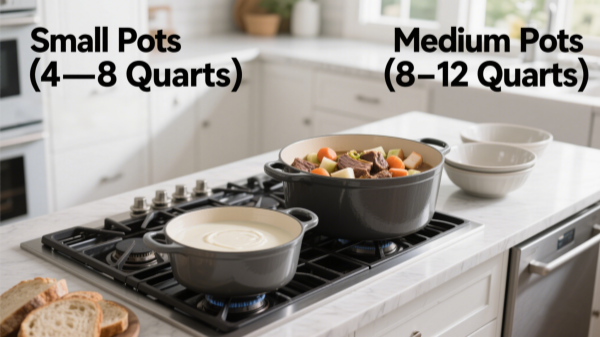
Small Pots (4–8 Quarts)
Capacity & Servings: Holding 4–8 quarts (approx. 1–2 gallons), these pots serve 2–4 people, perfect for making small batches of chicken stock, sauces, or side dishes.
Pros: Lightweight and easy to lift, fits most sinks for soaking and rinsing.
Cons: Limited headspace for boiling; large recipes require multiple batches.
Medium Pots (8–12 Quarts)
Capacity & Servings: With 8–12 quarts, these are the home cook’s workhorse, handling family-size stews, pasta boils, and 4–8 servings of soup.
Pros: Balances capacity and weight; widely available in quality clad and stainless models.
Cons: May be too tall for some cabinets; heavier to lift when full.
Large Pots (12–20 Quarts)
Capacity & Servings: Ideal for batch cooking, home canning, or seafood boils, these 12–20-quart pots accommodate 8–15 servings.
Pros: Ample headspace for long simmers; good for entertaining.
Cons: Heavy when full; often require two-handed lifts and reinforced shelving.
Extra-Large & Commercial (20 Quarts+)
Capacity & Servings: Catering to restaurants and large gatherings, these pots start at 20 quarts and exceed 100 quarts, serving 15+ people per batch.
Pros: Built for high-volume stock, soup lines, and brewing; durable materials.
Cons: Requires commercial burners, spacious storage, and often utility sink cleaning.
Understanding these categories sets the stage, but size alone isn’t the whole story.
Factors to Consider
Batch Size & Headspace: Always plan for at least 20% headspace to avoid boil-overs—so a 12-quart pot is best for ~9 quarts of liquid.
Stovetop & Oven Safe: Match pot diameter to burner size (overhang wastes heat) and check oven door clearance if you braise or roast with the pot.
Material & Heat Distribution: Stainless steel is durable and non-reactive; tri-ply clad (stainless-aluminum-stainless) provides even heating without hot spots; ceramic coating cast aluminum excels in lightweight design and rapid heat diffusion due to its high thermal conductivity, while hard-anodized surfaces enhance corrosion resistance for long-term durability
Ergonomics & Handling: Consider handle design, weight when full, and whether lids lock for secure pouring.
Budget & Brand Reputation: Mid-range pots from Cuisinart or Made In offer reliability; premium All-Clad and Vollrath excel in professional settings. Solamex stands out in the wholesale cookware sector with its cost-effective solutions and diversified product lines.
Next, learn how to confirm a pot’s true capacity before you click “Add to Cart.”
Measuring & Verifying Capacity
One simple method is the fill-and-weigh test: fill the pot to your intended line with water, weigh on a kitchen scale (1 kg water ≈ 1 L), and convert liters to quarts by dividing by 0.946.
Always cross-check manufacturer specs for interior diameter and depth, since labels may round up.
Once you’re confident in the true size, it’s time to consider long-term upkeep and storage—tailored by pot category.
Cleaning & Storage Tips by Size
Small Pots (4–8 Quarts)
- Cleaning: Fits easily in kitchen sinks; safe for soaking and standard dishwashers if stainless.
- Storage: Nest inside larger pots; hang from wall racks or pegboards to free cabinet space.
Medium Pots (8–12 Quarts)
- Cleaning: For stuck-on foods, soak 15–30 minutes and use non-abrasive brushes; avoid metal pads on clad interiors.
- Storage: Too tall for some cupboards—store in deep drawers or use lid racks to organize.
Large Pots (12–20 Quarts)
- Cleaning: Heavy when full—rinse with a sink sprayer before lifting; long-handled brushes reach the bottom easily.
- Storage: Requires sturdy lower shelves or open racks; keep lids upright in organizers to prevent tipping.
Extra-Large & Commercial (20 Quarts+)
- Cleaning: Use a utility sink or floor drain; baking soda paste removes stubborn stains without scratching stainless steel.
- Storage: Hang from heavy-duty ceiling racks or store on open shelving with good ventilation to prevent moisture buildup.
Buying Guide & Recommendations
Use this quick-reference table to match stock pot size to your cooking goals:
| Size | Ideal Use-Case | Servings |
|---|---|---|
| 4–8 qt | Small stocks, sauces, side dishes | 2–4 |
| 8–12 qt | Family soups, pastas, stews | 4–8 |
| 12–20 qt | Batch cooking, canning, boils | 8–15 |
| 20 qt+ | Commercial, catering, large events | 15+ |
Top Picks by Category
- Best Overall: Cuisinart 12-Quart Multiclad — Even heating, sturdy handles, versatile for home kitchens.
- Best Mid-Range: Made In 6-Quart Stainless Clad — Premium 5-ply construction, ideal for everyday use.
- Best Budget: IMUSA USA 12-Quart Stainless — Affordable, reliable for batch cooking and canning.
- Best Commercial: Solamex 7QT Rose Red Gradient Ceramic Stockpot — Customized, designed for restaurant use or retailers.
Conclusion
Matching your stock pot size to your cooking volume, kitchen setup, and cleaning preferences ensures less stress, better results, and a longer-lasting investment. Whether you’re crafting small stocks or running a catering line, consider headspace, handling, and storage before selecting your next pot.
We’d love to hear your stock-pot stories! Share tips or questions in the comments below.
Stock Pot Sizes: How to Choose the Perfect Kitchen Essential
Oven Safe Skillet Secrets: Material Mastery & Flawless Cooking Tactics