Cookware for Deep Frying: The Practical Buyer’s Guide to Pots, Pans, Safety & Long Life

Choosing the right cookware for deep frying affects safety, oil use, temperature stability, cleanup and—critically—how long your equipment lasts. This guide walks through materials, sizes, safety, upkeep, and a short B2B checklist.
Quick Answer
Pick a tall, heavy pot that holds the batch you need. For family-size deep frying we recommend a 5–7 qt enameled cast-iron Dutch oven or a heavy stainless multi-ply pot; use an accurate oil thermometer, leave ample headspace, and never leave the fryer unattended.
If you want the short reasons why: heat retention, stable temperature, safe handling and easy cleanup are the main drivers of the recommendation.
1. Why Cookware Choice Matters for Deep Frying
Deep frying looks simple—heat oil, drop food—yet the cookware you choose changes the result and the risk profile. The ideal deep frying pan keeps temperature steady when food is added, uses oil efficiently, provides safe handles and lids, and is easy to maintain so it lasts. Those priorities can push you toward heavier, thicker constructions rather than the light, fast-heating pans we like for sautés.
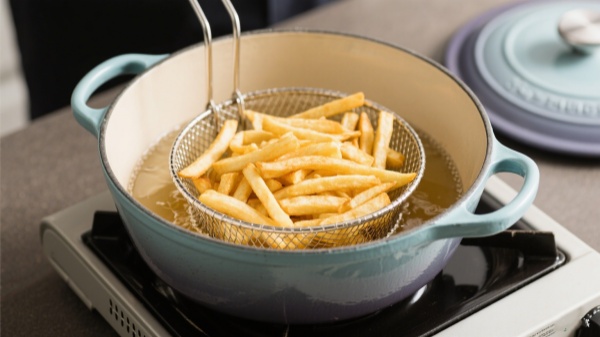
Practical note from the bench: when I tested a 6-qt enameled Dutch oven vs a thin stainless skillet for a 1 lb batch of fries, the Dutch oven’s oil temperature dropped much less when the fries went in—about a 10–12°F dip versus >20°F for the thin pan. That difference changes cook time and oil absorption.
2. What to Look for in Deep-Frying Cookware — the Decision Checklist
Below are the high-impact checks to make before you buy.
Volume & depth
Rule of thumb: choose a pot with enough internal depth and volume so you can fill oil to roughly half the height (or less) and still leave headspace. For personal use, 3–4 qt; for family batches, 6 qt; for larger events, 8+ qt.
Heat retention vs heating speed
More thermal mass (cast iron, heavy multi-ply stainless) holds temperature better when food is added. Faster-heating light pans (like cast aluminum pans) mean longer recovery time after adding a batch.
Material reactivity & cleaning
Enameled surfaces are easy to clean and nonreactive; bare cast iron needs seasoning; aluminum cookware can be fast but may deform or react depending on finish.
Shape & oil economy
Vertical walls (pots, Dutch ovens) need more oil but reduce splatter; woks require less oil but work best for small, quick batches.
Handles, lid and safety
Look for sturdy loop handles that let two hands lift, a well-fitting lid, and a pot shape that allows thermometer access.
Thermometer access
Thermostat control is great on electric fryers; stovetop pots need a clip-on or probe thermometer. If you can't fit a probe, it's not a safe candidate for deep frying.
3. Best Materials for Deep Frying — Pros, Cons and When to Pick Each
Enameled cast iron / Dutch oven
Why pick it: excellent heat retention and an easy-to-clean non-reactive surface. Great for family-sized batches and for cooks who want consistent oil temperature with each batch.
Example: most reviewers and tests (e.g., cookware reviews that repeatedly recommend Dutch ovens) cite a Dutch oven as a reliable multi-purpose pot for frying and braising alike.
Bare cast iron
Why pick it: outstanding retention and durability. Downside: requires seasoning, reactive to some acidic foods and heavier to handle.
Heavy-gauge multi-ply stainless steel
Why pick it: fast to heat, non-reactive, and often compatible with induction. Thicker multi-ply constructions reduce oil temperature drop, but you may still see a larger dip than cast iron.
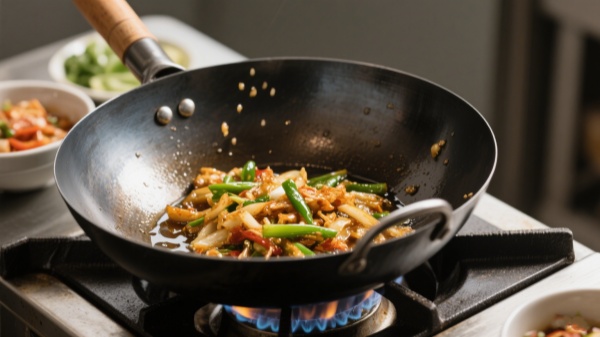
Carbon steel wok (for small batches)
Why pick it: optimal for shallow or stir-fry-style frying where you want less oil and faster turnover. Not ideal for large-volume deep batches unless you have a large, deep wok.
Hard-anodized aluminum
Why pick it: lighter and quick to heat; good for shallow frying and single-serve batches. Watch for warping and lower temperature stability on big batches.
4. Size & Capacity Guide
The table below maps common pot sizes to practical batch sizes so you can match cookware to cooking plans.
| Pot size (quarts) | Typical batch | Recommended cookware |
|---|---|---|
| 2–3 qt | Single-serve to 2 people (small sides or desserts) | Small saucepan or mini Dutch oven |
| 3–4 qt | 2–3 people | Medium Dutch oven or deep sauté pan |
| 5–7 qt | Family (4–6 servings) | Full-size Dutch oven, heavy stainless |
| 8+ qt | Party / turkey size | Large stock pot or dedicated fryer |
Practical tip: if you plan to deep fry whole poultry (turkeys), follow cookware manufacturer or fire-safety guidance for pot size and use the water test to determine safe oil fill height (see References).
5. Stovetop Pot Versus a Dedicated Electric Fryer
Dedicated electric fryers offer thermostat control, baskets, and splash protection—good for regular or large-volume frying. Stovetop pots are flexible and cheaper but require separate thermometers and careful monitoring.
- Use a pot when: you already own a heavy pot (Dutch oven) and occasionally fry family meals.
- Use an electric fryer when: you want precise temp control, basket handling and repeatable results without babysitting the pot.
6. Safety & Technique for Deep Frying
Short, actionable rules:
- Target oil temp for most frying: 325–375°F (160–190°C). Use an accurate probe or clip thermometer.
- Do not overfill—leave at least 25–30% headspace (more for tall items). Test oil level with water before filling with oil for very large items (e.g., turkey).
- Never put a partially frozen item into hot oil—ice causes violent splatter and can ignite oil.
- Keep a metal lid nearby to smother small oil fires. Do not use water on an oil fire; call emergency services if it grows.
Authorities advise testing fill levels by placing the food (or a water test) inside the pot and marking the level—this is a commonly recommended safety step for large fryers and turkey fryers in particular.
7. Maintenance, Lifespan & Troubleshooting
Care rules by material:
- Enameled cast iron: avoid sudden thermal shock; don’t heat empty; clean with warm soapy water; avoid metal tools that chip enamel.
- Bare cast iron: maintain seasoning; dry immediately after washing; re-oil lightly and heat to lock in coating.
- Stainless & hard-anodized: avoid abrasive cleaners for longevity; watch for warping if thin—replace if base no longer sits flat on the heat source.
When a pan warps, has flaking enamel or loose handles, it's safer to replace than to repair for frying use—those failure modes directly affect safety with hot oil.
8. Buying Checklist
Enameled cast iron / tri-ply stainless / carbon steel
3–4 qt (small) · 5–7 qt (family) · 8+ qt (large)
Loop handles for two-hand lift; heat rating
Well-fitting lid, cool-touch knob or metal knob noted
Induction? oven-safe? dishwasher-safe?
Re-enameling options, warranty length
9. FAQ
What is the best cookware for deep frying?
For most home cooks, a 5–7 qt enameled cast-iron Dutch oven is the best balance of heat retention, capacity and safety; heavy multi-ply stainless is a close second if you need induction compatibility.
Can I deep fry in a wok?
Yes — for small, quick batches a carbon steel wok uses less oil and recovers temperature quickly. For large batches, use a deeper pot to reduce splatter and ensure headspace.
How much oil do I need to deep fry?
Fill to a level that leaves at least 25–30% headspace; for reference, a 5–6 qt pot often uses 2–3 liters (about 2–3 quarts) for medium batches, but always test with water first when using unfamiliar pots.
What temperature should oil be for deep frying?
Most frying is done between 325–375°F (160–190°C). Use a calibrated thermometer and allow oil to refill to temperature between batches.
Is stainless steel OK for deep frying?
Yes—if it’s heavy-gauge or multi-ply. Thin stainless pans cool quickly when food is added and may make frying slower and greasier.
Conclusion:
Choosing the right cookware for deep frying isn’t just about crispier results—it’s about safety, efficiency, and longevity. Prioritize heat-retaining materials like enameled cast iron or heavy multi-ply stainless steel in a size that matches your typical batch (5–7 qt for families). Always leave ample headspace, monitor oil temperature rigorously, and maintain your cookware to prevent warping or damage. Whether using a stovetop pot or a dedicated electric fryer, these principles ensure safer frying, better food, and cookware that lasts. Remember: the right pot protects both your meal and your kitchen.
References & Further Reading

Solamex — Wholesale Pots and Pans Expertise
Solamex offers a comprehensive range of wholesale pots and pans, combining durable materials, precise craftsmanship, and flexible product customization. From premium stainless steel to advanced nonstick lines, our catalog is built for both retail distribution and demanding commercial kitchens — ensuring consistency in performance and presentation.
The Complete Guide to Choosing and Using Cookware for Deep Frying
The Truth About "Granite" Cookware: Is It Safe & Truly Worth Your Money?