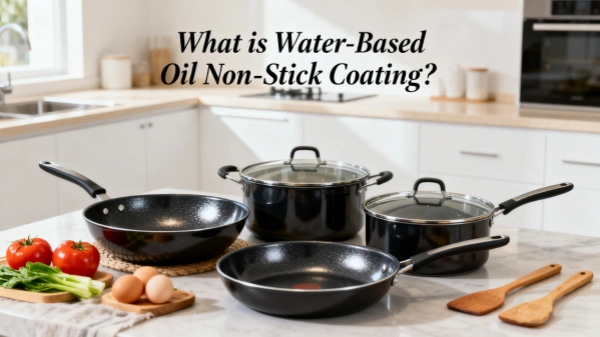
What is Water-Based Oil Non-Stick Coating?
Your Complete Guide to the Technology, Safety, and Hype Behind the Buzzword
If you're shopping for healthier cookware, you’ve likely stumbled upon terms like "water-based oil coating." It sounds advanced, eco-friendly, and maybe a little confusing. How can something be both "water-based" and "oil"? Is this a revolutionary new technology, or just clever marketing?
Let’s clear this up right away. "Water-based oil non-stick coating" is primarily a marketing term, not a standard scientific one. It typically refers to a modern ceramic-style non-stick coating that is manufactured using an environmentally friendly "water-based" process.
This guide will take you beyond the buzzwords. We'll break down what "water-based" really means—especially since it’s closely tied to ceramic cookware—and tackle the top concern many home cooks have: is ceramic cookware safe? We’ll also uncover the technology behind the coating, and put it head-to-head with traditional Teflon (PTFE) so you can make a truly informed choice for your kitchen.
Key Terms at a Glance
- Water-Based Oil Non-Stick Coating: A marketing name for ceramic or hybrid non-stick coatings. Its main selling points are its eco-friendly production process and the fact that it's made without PFAS chemicals.
- Water-Based Process: A manufacturing method where water, instead of chemical solvents, is used as the primary medium to apply the coating to the pan. This drastically reduces harmful VOC (Volatile Organic Compound) emissions.
- Sol-Gel Technology: The core chemical process used to create these hard, glass-like ceramic coatings from a silica ($SiO_2$) base at low temperatures.
- PFAS/PFOA: A family of controversial "forever chemicals" historically used in the production of traditional non-stick coatings. Water-based ceramic coatings are celebrated for being completely free of these substances.
Chapter 1: The Real Meaning Behind "Water-Based"
To understand the term, we need to separate the two parts: the process ("water-based") and the material itself.
It's About the Process, Not the Ingredients
The "water-based" part has nothing to do with the final coating's chemical makeup. Instead, it describes how the coating is applied to the pan. Traditionally, non-stick materials were dissolved in chemical solvents. When the pan was heated, these solvents would evaporate, leaving the coating behind but releasing Volatile Organic Compounds (VOCs) into the atmosphere.
A water-based process, as the name implies, uses water as the primary solvent. This is a much cleaner, more eco-friendly method that significantly reduces pollution, making it a huge step forward in sustainable manufacturing.
So, what about the "oil" part? Rest assured, the coating isn't made of oil. This is a marketing metaphor meant to convey an extremely smooth, slick, and oleophobic (oil-repelling) surface. The idea is that food—and oil—slides right off, just like water off a duck's back.
Chapter 2: The Tech Behind It: The Magic of Sol-Gel
If it's not a new material, then what is this coating actually made of? The technology behind most of these coatings is called Sol-Gel.
Without getting too technical, think of the Sol-Gel process like this: scientists create a liquid solution (the "sol") containing tiny particles, primarily silica ($SiO_2$), the main component of sand and glass. This solution is applied to the pan's surface, and through a controlled curing process at low temperatures, it transforms into a solid, interconnected network—a gel. The result is a hard, dense, glass-like ceramic layer that is chemically bonded to the metal(typically cast aluminum or other aluminum-based substrates such as aluminum alloys)..

This ceramic layer is naturally non-stick, very hard, and, most importantly, derived from minerals rather than the fluoropolymers used in traditional non-stick pans.
Chapter 3: Head-to-Head: Water-Based Ceramic vs. Traditional PTFE (Teflon)
So, how does this new wave of cookware stack up against the kitchen classic, PTFE? Here’s a direct comparison.
1. Composition & Health Safety
Water-Based Ceramic: Based on silica ($SiO_2$). It is completely free of PFOA, PFOS, the entire PFAS family, lead, and cadmium. This is its biggest selling point for health-conscious consumers.
PTFE (Teflon): A fluoropolymer plastic. While modern PTFE is made without PFOA, the material itself is part of the broader PFAS family, which remains a subject of environmental and health debate.
2. Heat Tolerance
Water-Based Ceramic: Extremely heat resistant. It can be safely heated to high temperatures of 450°C (850°F) without breaking down or releasing any fumes.
PTFE (Teflon): Has a lower heat threshold. It is recommended for use below 260°C (500°F). Overheating can cause the coating to degrade and release potentially harmful fumes.
3. Non-Stick Performance & Durability
Water-Based Ceramic: Offers excellent non-stick release when new. However, the surface is a hard ceramic, which can be more "brittle." Its non-stick properties may degrade faster over time, especially if scratched by metal utensils or exposed to sudden temperature changes (e.g., a hot pan under cold water).

PTFE (Teflon): Known for its exceptionally reliable and long-lasting non-stick properties. The surface is softer and more flexible, making it less prone to chipping, but it can be easily scratched.
Chapter 4: Pros and Cons: Which One Is Right for You?
Let's boil it all down. Here's a quick look at the advantages and disadvantages to help you decide.
✅ Why You Might Love It (Pros)
- Health Peace of Mind: Absolutely no PFAS, PFOA, lead, or cadmium.
- Eco-Friendly Manufacturing: The water-based process is much cleaner for the environment.
- High-Heat Hero: Perfect for searing meats and other high-temperature cooking tasks without worry.
⚠️ What to Consider (Cons)
- Requires Careful Handling: More sensitive to metal utensils, abrasive sponges, and sudden temperature shocks.
- Shorter Non-Stick Lifespan: If not maintained properly, the non-stick effect can fade faster than with high-quality PTFE.
- Often a Higher Price Point: The newer technology can sometimes come with a premium price tag.
Chapter 5: Your User & Maintenance Guide
To get the most out of your water-based ceramic cookware, a little care goes a long way.
- First Use: Wash, dry, and wipe the surface with a small amount of cooking oil. This helps season the pan.
- Cooking: While it can handle high heat, most cooking is best done on low to medium heat. Always use a little bit of oil or butter to prolong the life of the non-stick surface.
- Utensils: Stick to wood, silicone, bamboo, or nylon utensils. Never use metal.
- Cleaning: Always let the pan cool down completely before washing. Use a soft sponge and mild soap. Avoid the dishwasher(click here to find dishwasher safe cookware), as the harsh detergents can degrade the coating over time.
The Final Verdict
"Water-based oil non-stick coating" is more than just marketing—it represents a genuine step forward in creating healthier and more sustainable cookware. It's an eco-friendly manufactured ceramic coating, praised for being PFAS-free and having high heat resistance.
Is it right for you? If you prioritize health and environmental concerns and are willing to treat your cookware with a bit of care, it's an absolutely fantastic choice. However, if you're looking for maximum durability and fool-proof non-stick longevity, a high-quality traditional PTFE pan might still be a better fit.
Now, you're no longer at the mercy of buzzwords. You have the knowledge to look past the hype and choose the cookware that truly fits your values and cooking style.
Solamex — Wholesale Pots and Pans Expertise
Solamex offers wholesale pots and pans, combining durable materials, precise craftsmanship, and flexible product customization. From premium stainless steel to advanced nonstick lines, our catalog is built for both retail distribution and demanding commercial kitchens — ensuring consistency in performance and presentation.
What Is Water-Based Oil Non-Stick Coating For Cookware
Is Aluminum Cookware Really Banned in Europe?