Cookware Set For Retail: Which Die-Cast Types Sell Best?
Introduction
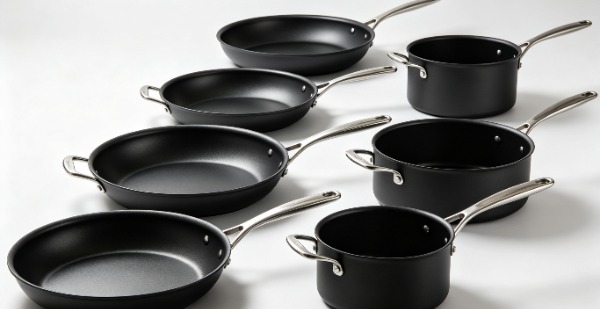
Watching modern die-cast specifications helps to ensure strong retail profits. Selecting the right cookware set for retail requires careful attention to detail. We examine heat transfer numbers and metal quality alongside refined coating strategies. Smart buyers use this specific technical data to ensure products sell, maintaining a strong, profitable business inventory.
Sourcing A Cookware Set For Retail: The Core Profit Problem!
Do you know the micron thickness of the base plates you stock? Misunderstanding base alloy specifications causes massive gross margin losses to retail buyers, and standard 200°C thermal stress causes warping during shipping.
Consequently, this leads to an average 12% return rate for big-box retailers. Inventory requires backing by evidence of merchantable metallurgy rather than willy-nilly guarantees from the manufacturer. How thick are those base plates of yours measured in precise microns? Without that vital data, buyers put the entire supply chain in unacceptable quality jeopardy.
Margin Compression in Die-Cast Lines
Identifying Baseline Alloy Grades
Consider a realistic sourcing scenario playing out in the manufacturing sector. Buyers purchase 5,000 pan units of cheap 319-grade aluminum to shave off 8% from the first invoice. Due to lower silicon content, the mold cools uneven, leading to a 4% out-of-box defect rate.
As a result, once buyers take return logistics and brand damage into account, profit margins disappear. Successful buyers demand detailed technical drawings before they authorize mass production to begin. Die-cast pans depend on precise grades of aluminum for structural consistency when subjected to extreme temperature swings.
To illustrate, ADC12 or A380 aluminum alloys represent the main choices for consumer gadgets mass production runs at about 90% of top-tier factories, much like the engineering behind our 3/5/7 Quart Die-Cast Aluminum Stockpot with Dark Green Non-Stick Coating.
- Silicon Integration: ADC12 features 9.6% to 12% silicon, and this increases the fluidity of the material when injected.
- Tensile Strength: This specific material density stops the sidewalls from micro-printing when the hot metal cools.
- Yield Metrics: A380 maintains a minimum 159 MPa yield, meaning the pan withstands heavy use without bending.
Copper and Zinc Tolerances
The overall lifespan of the pan depends upon its various secondary elements. Copper content reaches just 3.5% in premium lines to avoid galvanic corrosion around the rivet holes. Furthermore, to keep the bare metal under the protective coating rated food-safe, zinc levels must sit at less than 1.0%.
Evaluating Die-Cast Aluminum Types In A Cookware Set For Retail!
The selected casting process influences the cost incurred to reach final consumer prices, bulk density, and thermal responsiveness. Engineers form modern cooking vessels through two major operational ways in the industry today. Hence, the overall tolerances structure produced by each method remains different from one another.
High-Pressure vs. Low-Pressure Die Casting
High-pressure systems insert molten aluminum at a perfect 10,000 PSI into steel molds that are single use. This aggressive process allows the company to formulate thin and denser walls designed for speedy induction skillets.
Take the 11/12 Inch Nonstick Die-Cast Aluminum Deep Fry Pan as an example of pressure casting perfection. Alternatively, low-pressure gravity casting pours the liquid metal at 10 to 15 PSI. This slower process results in bases that are much thicker but reduces factory throughput per hour.
|
Casting Process |
Injection Pressure |
Wall Thinness Range |
P rate Speed |
Ideal for Retail Slot |
|
High-Pressure |
10000 - 15000 PSI |
2.0mm - 3.5mm |
120 units/hr |
Value for Mid-Market |
|
Low Pressure |
10 - 15 PSI |
4.0mm - 7.0mm |
45 units/hour |
Premium / Professional |
Pressure Casting Comparison
Wall Thickness Specifications
Modern, high-powered induction hobs require an optimal thickness so the pan prevents thermal warping.
- Base Plate Dimensions: The physical dimension must sit between 4.5mm and 6.0mm for a good heat service on the bottom.
- Sidewall Taper: The vertical walls must taper between 2.0mm to 2.5mm in order to remove excessive weight from the end-user.
- Rim Reinforcement: The top edge includes a 3.5mm reinforced bead to ensure the rim withstands heavy impact damages in international shipping.
Technical Components Of A High-Yield Cookware Set For Retail!
Selling naked aluminum to a consumer rarely works out well in a modern setting. The specific matrix of the non-stick coating differentiates a premium product from a cheap commodity.
Surgical cleanness and precision in temperature control determine the chemical mixture's application success. Are you paying attention to the application process at your chosen factory when ordering items like the 7QT Rose Red Gradient Ceramic Stockpot?
Non-Stick Coating Matrices
Factories use multi-stage spray systems to adhere synthetic polymers onto the aluminum base. Before applying the chemical spray, industrial sandblasters roughen the metal surface to a certain Ra level.
In addition, this purposeful micro-abrasion forms mechanical anchors so that the important primer layer can attach. Without this vital preparation step, the topcoat peels off within three weeks of someone using it at home.
PTFE vs. Ceramic Sol-Gel Applications
Retailers who select the right chemical compound rule their particular market segment.
- PTFE Systems: Polytetrafluoroethylene offers the greatest release factor available for cooking sticky protein options.
- Sol-Gel Ceramics: Sol-gel solutions rely on silica sand to provide an extreme scratch resistance rating, handling sustained 260°C temperatures. They cope with aggressive 400°C heat spikes but lose non-stick features faster than PTFE over an average three-year life span.
Coating Thickness Metrics
Are your suppliers providing verifiable thermal expansion reports for every batch they produce? Receiving a tub of stock to learn the factory applied a single 15-micron coat of PTFE to save money hurts. Consequently, retailers face constant bombardment with returns because the pans scratch on first use, racking up huge financial chargebacks.
- Primer Base: The primer base needs 10 to 15 microns to stick to the aluminum surface.
- Mid-Coat Insulation: The insulation layer requires 15 microns for the separation of the primer from the top surface.
- Top-Coat Sealant: The sealant layer requires 10 microns of pure release agent for passing natural health classifications.
- Total System Build: A high-quality pan boasts a blended coating thickness starting at 35 to 45 microns.
Matching A Cookware Set For Retail To Consumer Heat Sources!
Universal cooking compatibility acts as a strict imperative for modern retail environments. Consumers refuse to buy pans that do not turn on their expensive magnetic induction cooktops. Because aluminum repels magnetic fields, engineers require mechanical fusion of a ferrous plate to the base of the die-cast housing.
Induction Base Integration Techniques
Engineers use two different processes to bond the aluminum base to stainless steel plates. The specific selection impacts thermal effectiveness and the complete production price of the unit.
|
Integration Techniques |
Magnetic Efficiency |
Risk of Plate Clossing |
Capital Cost |
|
Stamped / Brazed |
85%–93% |
Low to Moderate |
Low |
|
Cold-Forged (Sprayed) |
98% |
Extremely Low |
High |
Base Plate Adhesion Methods
Hole-Punched Magnetic Discs
Standard production lines stamp a disc of 430 stainless into the soft aluminum bottom while the metal remains green. The magnetic disk consists of tens of small holes punched throughout its surface area.
Moreover, the growing aluminum fills these voids, providing a mechanical locking of the plate into place. Nonetheless, heating the unit to 250°C again and again leads the two metals with different expansion rates to separate from each other.
Full-Coverage Thermal Spray
High-end manufacturers spray a high-velocity oxygen fuel onto the pan base. The robotic arm fires streams of iron particles heated to a molten state over 300°C onto the aluminum base at supersonic speeds. Thus, this intense action results in a magnetic and continuous surface with no physical air gaps. This method optimizes the efficiency of transfer and prevents the risk of the plate detaching.
Quality Control Metrics!
Stringent quality control helps to protect your retail presence in a reliable manner. Visual inspection alone does not cut it in a competitive retail environment. Buyers need hard data, the kind that comes from standardized testing protocols in a laboratory.
Measurlabs expert says, ovenware should show zero damage during extreme thermal testing.
Thermal Shock and Warp Resistance Tolerances
Testing facilities force extreme thermal abuse on test units to ensure proper field durability. The dry pan heats up to 200°C, and then workers dip the hot metal into a 20°C water bath.
- Concavity Limits: The base cannot ever bulge outwards, and the inward concavity must sit from 0.3mm to 0.5mm.
- Flatness Recovery: After cooling down, the pan should sit flat on a glass surface with no noticeable wobble.
- Coating Integrity: The PTFE or ceramic layers cannot blister, flake, or delaminate due to the rapid temperature contraction.
Handle Assembly and Fastener Torque
A busted handle presents significant liability risks to the seller and the manufacturer alike. Manufacturers use strong aluminum rivets or screw fasteners to secure them to the pan.
- Torque Specifications: Automated drivers must throw 2.5Nm of torque at fasteners to attach them without breaking.
- Fatigue Testing: The machines raise a loaded pan holding 3kg of dead weight by the handle 10,000 times to test the shear strength.
- Flame Guards: The aluminum flame guard should extend a minimum of 25mm past the vessel body to cover synthetic handles from direct gas flames.
Current Market Trends Influencing Your Cookware Set!
Consumer needs change, requiring manufacturers to modify how they approach die casts. In a span of 24 months, static inventory becomes irrelevant to modern shoppers.
Keep your eye on structural changes to remain ahead in the retail marketplace. Likewise, these standards will comply with ISO 2747 for vitreous and porcelain enamels while imposing tighter limits on chemical emissions, motivating a shift towards cleaner production methods.
Shift Towards Multi-Layer Hybrid Constructs
Buyers now want the thermal retention of cast iron married to die-cast aluminum lightweight maneuverability. Engineers get around this obstacle by building a solid carbon steel core of the tool within the aluminum injection mold.
- Core Placement: A centered 1.5mm carbon steel sheet suspends midway in the middle of the mold cavity within a robotic arm.
- Aluminum Encapsulation: The molten ADC12 runs around the steel layer, sealing it from ambient moisture and rust.
- Thermal Mass: This hybrid solution increases the specific heat capacity by up to 40% while preserving a total weight of under 1.2 kilograms.
Eradicating PFAS Chemicals
Regulatory agencies restrain manufactures to restrict the usage of harmful PFAS chemicals. PTFE primers of the past relied upon PFOA and PFOS compounds to achieve proper coating adhesion.
- Compliance: All components in the entire supply chain must hold certified 100% PFAS-free formulations backed by SGS or TUV.
- Alternative Solvents: Chemists utilize water-based dispersion methods now to apply these complex non-stick matrices.
- Curing Times: These new friendly coatings need longer oven times at 420°C for proper coalescence, extending factory lead times.
Modular Handle Systems
Consumers living in metropolitan areas have little space for kitchen storage. Factories design pans today that feature removable, multi-stage handles to save cabinet space.
- Locking Mechanisms: The handle employs a dual-action, spring-loaded silicone clamp to grip the reinforced aluminum rim.
- Load Limits: The locking mechanism handles a 5kg dynamic weight with a secure and slip-free holding operation.
- Oven Compatibility: Take off the handle, and the stovetop skillet becomes an oven roasting dish with a 260°C rating.
Top 5 FAQs!
What Aluminum Grade Works Best For Die-Cast Retail Pans?
Factories use high-quality ADC12 aluminium for manufacturing durable die-cast pans. With a configuration of 12% silicon, it ensures extreme structural stability, preventing thermal warping.
How Thick Should The Base Of A Die-Cast Pan Be?
The best thickness of the base sits between 4.5mm and 6.0mm in size. This precise density ensures optimal heat conductivity and avoids annoying induction plate separation.
Why Do Non-Stick Coatings Fail Premature?
When factories put 35 microns PTFE and below coatings, the pans fail rather fast. Applying too little sandblasting when preparing a base ruins the mechanical bond.
Does Gravity Casting Produce A Heavier Pan?
Gravity casting depends on natural flow, so the sidewalls form thicker layers. This produces a heavier pan, but factories cannot produce it fast like high-pressure injection.
What Is A Safe Handle Torque Specification?
Commercial-grade manufacturing specifications require 2.5 Nm of torque for each handle fastener. Anything less causes a perilous wobble, while over-torque shatters the bakelite housing.
Conclusion
Sourcing a profitable cookware set for retail requires identifying proper base alloys and coating microns. Strict diligence prevents expensive product returns while establishing your permanent brand authority.
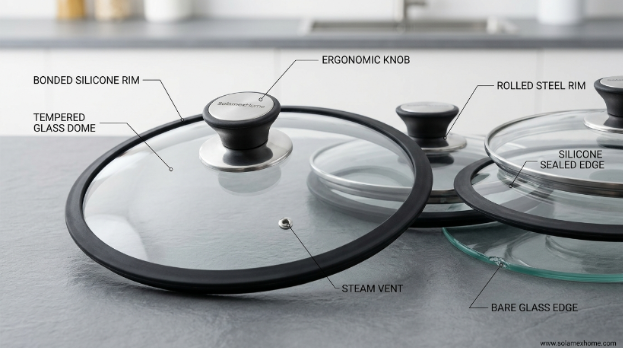
Enhance your inventory metrics by utilizing compliant manufacturing solutions that meet modern standards. Protect your profits and secure top-tier products today by partnering with SolamexHome for guaranteed quality, featuring excellent additions like the Forge Alum Sauce Pan w/Silicone-rim Glass Lid.
Nonstick Frying Pan Supplier: Ceramic vs Teflon Coatings? How To Choose?
Cookware Materials Explained: Stainless Steel, Copper, Ceramic & More