Stainless Steel Cookware OEM Guide: Master Elite Manufacturing?
Introduction
Constant quality dips from factories will destroy your market success unless you find the right supplier. Therefore, we define the technical specifications needed for advanced manufacturing with a trusted stainless steel cookware OEM. You require access to actionable data for the crucial ability to land big commercial production runs without experiencing massive delays.
The Foundation Of A Stainless Steel Cookware OEM Strategy!
Procuring factory production requires unyielding material specifications to ensure consistent commercial success when partnering with a reliable stainless steel cookware OEM. Furthermore, manufacturing facilities substitute cheaper metal materials during massive bulk production runs.
Smart buyers must stipulate specific metallurgical requirements within their legal contracts with suppliers. Securing initial material baseline requirements prevents massive product failures down the complex supply chain. Factory engineers need to know the exact chemical percentages of chromium and nickel for every order of Stockpots & Soup Pots.
During my early days auditing factories in Guangzhou, I watched a supplier swap premium steel for budget steel, which taught me the harsh reality of raw material verification. How many times does your current factory run chemical composition tests on their steel coils?
Material Grade Selection Protocols
The choice of metal alloy determines thermal performance and ultimate corrosion resistance. Elite manufacturing facilities segregate raw materials by their final commercial end-use. WebstaurantStore notes, type 304 stainless steel includes nickel, which offers superior corrosion resistance.
- Austenitic Grades: For premium 304 steel alloys, manufacturers require a mixture of at least 18% chromium and 8% nickel.
- Ferritic Grades: The standard 430 series contains 18% chromium and 0% nickel to maintain important magnetic properties.
- Molybdenum Additions: Engineers include 2% molybdenum to prevent extreme acidic corrosion in premium 316 marine grade materials.
- Carbon Limits: Factory specifications demand a maximum carbon content of 0.08% to avoid unwanted carbide precipitation.
- Tensile Strength: Heavy austenitic grades provide in excess of 515 MPa to resist stressed commercial impact forces.
- Yield Strength: The strong metal material withstands 205 MPa pressure limits during heavy commercial kitchen use.
Steel Grade Comparison Matrix
Understanding metallurgical differences helps procurement managers optimize manufacturing budgets for massive commercial orders of 3-ply Stainless Steel Cookware. Compare the primary chemical specifications below to make smart factory decisions.
|
Steel Grade |
Chromium % |
Nickel % |
Magnetism |
Cast Properties |
Primary Manufacturing Use |
|
304 (18/8) |
18% |
8% |
Non-Magnetic |
Vessel bodies & internal linings |
Premium vessels |
|
316 (18/10) |
18% |
10% |
Non-Magnetic |
Premium corrosive resistant cooking surface |
Chemical resistance |
|
430 (18/0) |
18% |
0% |
Magnetic |
Induction compatible exterior base Capsules |
Magnetic bases |
|
201 Series |
16-19.5% |
4% |
Non Magnetic |
Budget-tier cookware lines |
Budget pans |
How To Evaluate A Stainless Steel Cookware OEM Factory?
Basic visual inspections give buyers a superficial impression of operational factory capacity when evaluating a professional stainless steel cookware OEM. Variables like daily tonnage and machine automation display the way a specific scale operates.
Are you aware of the specific bonding pressure your supplier employs on a day-to-day basis? Enormous quantities of capital remain necessary to perform contemporary production through automated machinery.
Production Machinery Capabilities
Heavy mechanical force guarantees structural integrity during the mass production of these commercial products. High tonnage friction presses must operate at factories to forge perfect bottoms for pots.
I remember rejecting an entire shipping container of Deep Fry Pans because the impact bonding process lacked the necessary massive pressure, causing bases to warp under heat.
- Friction Presses: Elite facilities operate massive 2500-ton capacity friction presses to produce flawless impact-bonded cooking components.
- Hydraulic Stretching: Heavy hydraulic machines apply deep drawing force using 800 tons of pressure across several manufacturing steps.
- Annealing Furnaces: Facilities must heat a metal blank up to 1050°C to restore the original molecular structure.
- Edge Trimming: Automatic lathe machines trim excess flange material from the edges with a precise 0.1mm measurement tolerance.
- Automatic Polishing: Robotic arms polish the internal surface roughness values until they remain less than 0.2 microns.
Factory Quality Certifications
Trusting verbal promises from suppliers leaves your expensive shipments vulnerable to massive defects. Verifiable third-party certifications set elite manufacturers apart from standard assembly workshops in this competitive industry. The experts at SolamexHome verify these critical global credentials before starting any new production run.
- ISO Compliance: Operational factories must possess an active ISO 9001:2015 certification framework for systematic quality management systems.
- BSCI Audits: Strict social compliance audits ensure the observance of humanitarian labor practices throughout the entire production chain.
- Food Safety: Material migration testing for production lines follows strict legal standards according to FDA and LFGB guidelines.
Core Components In Stainless Steel Cookware OEM Production!
Each separate component of the pan requires dedicated fabrication processes to ensure ultimate commercial success for your stainless steel cookware OEM. Building a complete cooking vessel needs many complex metallurgic processes working in perfect combination.
The most important engineering challenge remains the base construction of the commercial cooking vessel. Effective heat transfer depends on the accurate joining of different conductive metal materials for items like Grill Pans & Griddles.
Encapsulated Bottom Engineering
Standard steel alloys possess low thermal conductivity for high-end professional cooking applications. Manufacturers must encapsulate conductive metal cores to achieve fast and even heating performance.
- Aluminum Cores: Standard base components feature pure aluminum disks ranging from 3 millimeters to 5 millimeters thick.
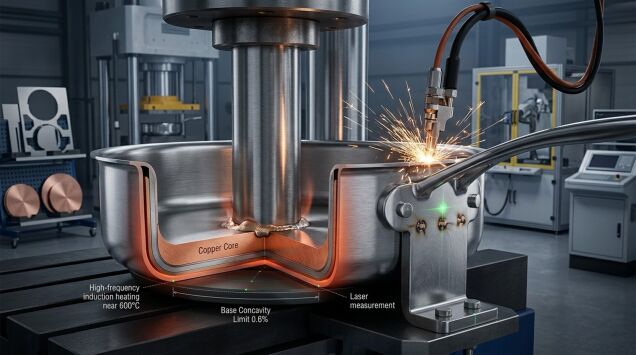
- Copper Cores: Professional chef lines utilize thick copper cores because they provide rapid responses to sudden temperature changes.
- Thermal Conductivity: Copper cores feature a thermal conductivity of 398 W/m·K while aluminum reaches 237 W/m·K.
- Impact Brazing: High-frequency induction heating brings the capsule to 600°C before heavy machines exert massive hydraulic pressure.
- Base Concavity: Engineering objectives specify a cold concave limit of 0.6% to permit proper thermal expansion.
Handle Attachment Systems
Ignoring attachment risks creates serious safety implications for consumers using these heavy cooking vessels. Factories utilize precise engineering methods to secure handles against the main metal vessel body on every Tri-Ply Hybrid Mirror Series unit. Does your production manager understand the precise temperature required for proper metal spot welding?
- Spot Welding: High-voltage electrical current fuses the heavy handle bracket onto the exterior pan surface.
- Multi-Point Welds: Commercial pans demand a minimum of five welding points on the exact same bracket face.
- Heavy Riveting: Heavy rivets made from aluminum mechanically lock the bracket by penetrating the exterior vessel wall.
- Bracket Alignment: Various laser-guided jigs maintain handle angle tolerances within 1.5 degrees of variation.
- Torque Testing: The attached handle must endure 150 Nm of heavy twist torque without experiencing structural slip.
Real-World Scenarios For Your Stainless Steel Cookware OEM!
Theoretical manufacturing knowledge remains useless unless engineers couple it with practical factory troubleshooting skills for a reliable stainless steel cookware OEM.
Production assembly lines face stiff technical friction during everyday commercial manufacturing operations. On-site technical experts ensure global manufacturing problems never ruin the Woks & Stir Fry Pans inside a shipping container.
Scenario One: Base Delamination During Induction Heating
Sudden base delamination can destroy your hard-earned product reputation in the retail market. This failure happens when a capsule bottom separates from the main vessel body under intense heat.
- The Root Issue: Insufficient heating during the brazing process leaves empty pockets where the aluminum fails to bond.
- The Engineering Fix: Engineers must hold the induction heating coil at 600°C and extend the press time.
- Validation Testing: Quality controllers place dry heated pans into frozen water to test extreme thermal shock.
Scenario Two: Pitting Corrosion After Acidic Food Contact
Angry consumers return pans suffering from intense black pitting after cooking acidic tomato sauces. Factories must execute a 48-hour salt spray test on each batch to guarantee material resistance. While working on a premium commercial line last winter, implementing a nitric acid passivation bath solved our pitting corrosion nightmare.
According to Marlin Steel, adding molybdenum makes 316 stainless steel more corrosion resistant.
- The Root Cause: Incomplete passivation leaves active iron particles remaining across the finished cooking surface of the pan.
- The Factory Fix: Facility managers must upgrade the passivation bath with a 20% nitric acid solution.
- Rinsing Protocols: Assembly lines must implement a three-stage deionized water rinse to stop the chemical response.
Types And Variations In Stainless Steel Cookware OEM Catalogues!
Diverse consumer demographics necessitate different underlying structural architectures for successful retail market penetration with a trusted stainless steel cookware OEM.
Product developers must define the ply count before initiating physical prototype development for Frying Pans & Skillets. The premium segment of the retail market currently revolves around durable Tri-ply development.
Multi-Ply Clad Configurations
Metal cladding bonds together flat sheets of metal before heavy machines stamp the vessel shape. This advanced technique brings the conductive metal core up through the tall vertical sidewalls.
- Tri-Ply Construction: The industry standard configuration uses 304 interior metal, an aluminum core, and a 430 exterior.
- Overall Thickness: Standard tri-ply cooking vessels feature a continuous 2.5-millimeter total wall thickness for optimal heat distribution.
- Five-Ply Construction: Elite commercial arrangements alternate layers of 304 metal, aluminum, copper, aluminum, and 430 exterior steel.
- Sidewall Conductivity: Clad walls transfer high heat laterally across the food volume, which reduces cooking times.
- Weight Metrics: Fully clad skillets weigh a minimum of 25% extra compared to impact-bonded models.
Base Construction Methods Matrix
Compare the top two manufacturing architectures to decide which configuration fits your brand portfolio.
|
Construction Method |
Core Material |
Heating Efficiency |
Manufacturing Cost |
|
Impact Bonded Base |
Thick Aluminum Disk |
High (Bottom Only) |
Low |
|
Fully Clad (Tri-Ply) |
Full Aluminum Sheet |
Very High (Uniform) |
Premium |
|
Copper Clad (5-Ply) |
Copper + Aluminum |
Exceptional |
High |
Technical Quality Control For Stainless Steel Cookware OEM Partners!
Trusting factory self-reporting documents almost always guarantees massive product failures during retail distribution for any stainless steel cookware OEM. Smart buyers must utilize stringent third-party inspection terms before authorizing pre-shipment container releases. Technical inspectors pass or fail a production batch of Saucepans based on precise numerical factory tolerances.
Critical Inspection Standards
Factory managers must enforce destructive and non-destructive testing protocols for every single production lot. Procurement teams must establish Acceptable Quality Limit standards for all commercial manufacturing runs.
- Visual Surface Checks: Inspectors look to ensure no polishing burns or unblended weld marks exist anywhere.
- Dimension Tolerances: The diameter of the finished vessel must remain within 1.0mm of the approved engineering drawings.
- Concavity Testing: Bottom concavity measurements must never exceed 0.6% of the total flat diameter measurement.
- Salt Spray Testing: Laboratories expose metal samples to sodium chloride solutions to validate critical anti-corrosive properties.
- Handle Fatigue: Heavy testing machines lift and lower weighted pans ten thousand times to test durability.
Packaging And Transit Protocols
Flawless factory manufacturing means nothing if the physical products suffer damage during ocean freight from your chosen stainless steel cookware OEM. Professional packaging engineers need to pinpoint exact corrugated cardboard ratings for safe global transit.
- Drop Testing: Master shipping cartons must withstand standard ISTA drops from 36 inches without showing internal damage.
- Moisture Barriers: Workers seal each individual pan inside a polyethylene bag containing active silica gel desiccants.
- Palletization: Warehouse workers must stack master cartons no higher than five layers to prevent lower-tier crushing.
Top Tips For Managing Your Stainless Steel Cookware OEM Run!
Efficient production requires synchronized supply chain logistics across the entire global manufacturing network for a busy stainless steel cookware OEM. Missing a single delivery of raw metal materials will back up the entire assembly line.
Smart buyers secure their complex procurement schedules ahead of busy peak retail seasons. Forbes notes that ignoring risks in raw material sourcing causes supply chain bottlenecks.
Lead Times And Procurement Strategies
Knowing how to schedule a busy factory keeps disastrous out-of-stock situations away from retailers who manage a high-volume stainless steel cookware OEM. Procurement experts advise planning your capital deployment around these standard commercial manufacturing milestones.
- Raw Material Sourcing: Factories procure premium quality steel coils from certified mills over a 15 to 20-day period.
- Tooling Development: Designing a new stamping die requires 30 to 45 days of intense precision machining work.
- Sample Approval: Expect the pre-production sample manufacturing and customer approval cycle to last 14 days.
- Mass Production: Ten thousand units pass through standard assembly lines in a 35 to 45-day period.
- Shipping Buffers: Project managers must insert 10 extra days to accommodate final inspections and port loading delays.
Top 5 Essential FAQs!
What Defines A True 18/10 Stainless Steel Specification?
The premium alloy contains 18% chromium to prevent rust during constant daily use. The specific addition of 10% nickel improves visual luster and resists severe acidic corrosion across all cooking environments.
Why Do Induction Cooktops Require 430 Grade Steel Bottoms?
The heavy 430 grade contains zero nickel because it consists of raw magnetic iron material. The raw iron creates the necessary magnetic field that induction heating coils need to function.
How Does Impact Bonding Differ From Traditional Brazing?
Traditional brazing relies on brittle chemical fluxes to join different metal pieces together. Impact bonding uses an enormous friction press and high-frequency heating to fuse heavy metals together.
What Causes White Calcium Spots Inside Newly Manufactured Pans?
Broken factory washing lines fail to remove hard water deposits from the polished metal surface. Swapping the final rinse system to pure reverse-osmosis water banishes those aggravating superficial visual flaws.
Can Standard Spot Welding Hold Heavy Commercial Cast Handles?
Standard welding works for light consumer products operating inside regular residential household kitchens. Commercial implementations demand multi-point high-voltage spot welding configurations to ensure decades of heavy structural stability under extreme physical stress.
Conclusion
Obtaining a full suite of factory audits remains a vital criterion when selecting a reliable stainless steel cookware OEM. Manufacturers must verify impact bonding pressures and exact metal grades. Contact SolamexHome today on our official company website to create your custom luxury manufacturing line and conquer the global kitchenware market without sudden production delays.
Glass Water Bottle Manufacturer: How To Source Elite Solamex Quality?
Cookware Sets for Supermarket: Why Do Clear Lids Boost Sales?