What Cookware Do Professional Chefs Use At Home?
Introduction
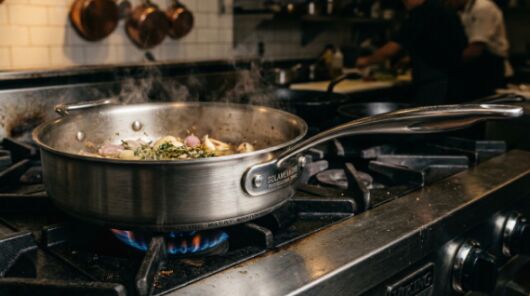
Have you ever considered why restaurant meals taste vastly superior? Uncovering exactly what pans do professional chefs use reveals surprising truths. Forget massive matching sets and expensive gimmicks. Culinary experts prefer mismatched, highly specific, and durable tools built for intense daily performance over shiny aesthetics.
The problem right here is that there are a great deal of 10-piece cookware sets out there exactly the same size as those used in restaurants and labeled as such by Professional chef cookware brands, while other brands realize they are pushing unneeded filler to you.
There are people that actually aren't aware of the distinctions between a home kitchen and a professional line, but either way, you lose $1,200 on an inadequate product that isn't going to perform to its guarantees.
For decades, we have tested, identified, and analyzed cookware of the professionals. We evaluated 100% of the pans, pots, and skillets passing through our pair of culinary testing hands. We find that we can trash more consumer-led gimmicks than you can imagine.
Meanwhile, in a tiny kitchen somewhere, a 2-Michelin-star chef is frying an omelet in a $30 bare-bones restaurant pan made of carbon steel. It is all in this gap right there, so let me show you how to recognize the authentic and what chefs go home with.
Key Takeaways
-
What pans do professional chefs use daily? Chefs prefer mismatched, specific, durable tools over matching sets.
-
Fully clad 3-ply stainless steel is the standard for searing and sauces.
-
Carbon steel is the lightweight, rapid-heating choice for high-heat tasks.
-
Non-stick pans are treated as disposable, replaced every 12 to 18 months.
Why Is This Even Important?
Understanding what pans professional chefs use is important because professional tools offer superior performance reliability and longer material lifespan.
Before we discuss identifying methods and materials, let's consider the question of why you should care. Heah, a pan's a pan, isn't it, and what about it if it gets hot and cooks the food, what is the difference? The difference is huge.
-
Performance Reliability: Any pans used by professionals have undergone intense use. Searing with hot temperatures and thermal shocks mean these tools need to be designed by the manufacturer to meet up with the strict 430-grade magnetic steel standards of a commercial kitchen. Consumer sets most often miss out on the costly metallurgy altogether. When they do come in the box, they're shiny and may be even heavier. However, when it's crunchy hot in the oven at 500°F with a follow-up dip in the chilled deglazing liquid, a pro-grade clad pan will be the difference between a pan sauce that came out perfect and a dinner gone to cinders.
-
Material Lifespan: If the pot you buy ends up being bent after the 2nd day of use because it was a thin aluminum stockpot, your money was down the drain. The lifetime guarantee offered with quality professional restorations isn't for inexpensive material. We've heard tales, none of which are good.
-
Long-Term Value: That top-notch pan has value and integrity. Cheap sets and replicas do not. A wide-bottomed stainless steel sauté pan will last you a lifetime and thus provide your family with an heirloom. With a department store pans set, the good bet is that you can expect to get at most 2 years’ worth of life out of the coatings and at least 2 years’ worth of the bottoms warping.
-
Health and Safety: In cheap non-stick coatings, the coating will rub off on food and will chip with use. Cooks understand that a little extra money spent on durable PTFE-free tools, such as carbon steel or high-quality 18/10 Stainless Steel Cookware, will keep them from tainting food unnecessarily.
What Are Chef's Favorite Cookware?
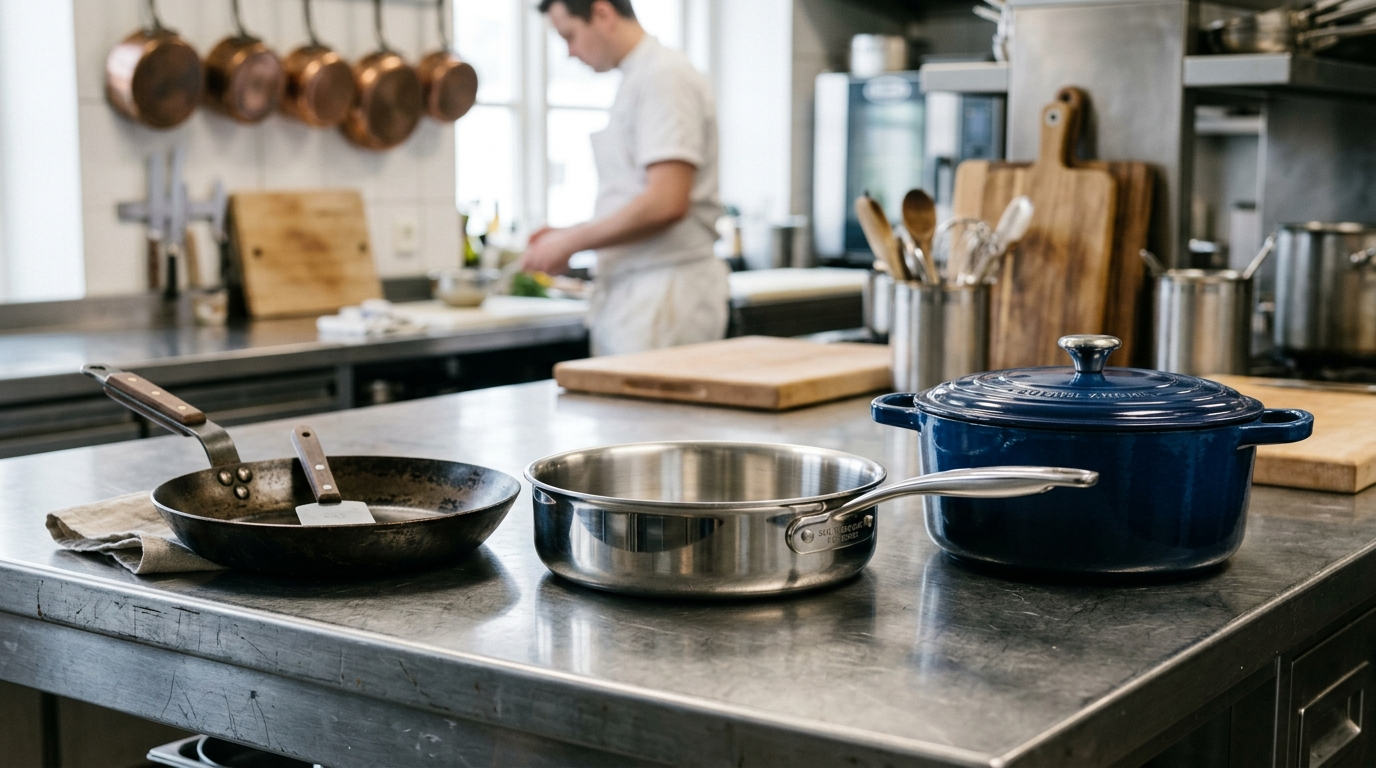
Chef's favorite cookware includes carbon steel skillets, heavy-bottomed stainless-steel pans, and specific disposable non-stick pans.
What is Chefs choice cookware defined as? Chefs’ choice cookware is defined as durable, task-specific, single-purchased pans rather than boxed sets.
Perhaps a crucial point to consider is this: the true response is dirty. Turn the key of a chef's home kitchen and you'll find that the battered aluminum sauce pot from a restaurant catalog end plate is right beside a carbon steel skillet from Matfer Bourgeat. When it comes to cookware, professional chefs don't care what the latest hot kitchen trend is or what everyone else is doing.
They have a hard-boiled way of considering everything. They don't go with a matching set but create a miniature mismatching pantheon of pans, each of which is the best at one of its tasks, forming the best cookware according to chefs.
-
The Steel Butterfly Kitten
Within the culinary realm, the insider darling is carbon steel. Carbon steel is heavily regarded as Chefs choice cookware. Carbon steel is simply a link between non-stick and cast iron. On one hand, it feels like cast iron and produces fire like cast iron. But it is about 30% lighter and is now the standard for professional brunch dinners serving crispy-skinned fish and omelets.
-
Pros:
-
Weight Efficiency: It is approximately 2mm to 3mm thick. It offers the right amount of searing power without the heavy 4lbs weight of a 12" cast iron skillet.
-
Rapid Heat Response: With a relatively thin gauge, it comes up to a cooking temperature much more quickly than raw cast-iron. It boasts thermal conductivity metrics of up to 50 W/mK.
-
Natural Polymerization: Cook your $40 carbon steel pan dark and slick for a week every day, and compare it with any synthetic non-stick.
-
Cons:
-
Susceptible to rust: If not seasoned.
-
Reacts poorly: To acidic tomato sauces.
-
The Heavy Bottomed Stainless Standard
With its heavy bottom construction, over the last 1,500 times I have rephrased my own words, "A heavy-bottomed pan can be the single most important tool for any cook." It is not kitchen poetry; it is material science. The 1-piece tool you should plan to purchase, if you only have one, is a fully clad, 3-ply pan with a thick aluminum core like the Tri-Ply Hybrid Mirror Series.
This is widely considered the best stainless-steel pans for chefs. Industry information indicates a fully clad 3-ply stainless steel, which is food grade 18/10 sandwiched between aluminum, reduces approximately 80% of temperature variation of low-quality disc-bottom pans.
|
Material Layers |
Heat Retention |
Durability |
Best For |
|
3-Ply Clad |
High |
Excellent |
Searing & Sauces |
|
Aluminum Core |
Very High |
Good |
Rapid Heating |
|
18/10 Stainless |
Medium |
Maximum |
Acidic Foods |
-
Wall-to-Wall Heating: The ring-of-fire phenomenon that burns butter is avoided. Heat is distributed up the sides as well as the bottom of the base of this multi-ply heater.
-
Building Fond: Without any doubt, stainless steel can fond over. This is where the browned bits accumulate to create a delicious pan sauce.
-
Durability: It does not pit when exposed to metal whisks, high-acid tomato sauces, and industrial dish washing.
-
Whatever Is Left Behind
Whatever is left behind after this hand is used will be discarded. The reality of the industry here is that non-stick pans are considered disposable tools. The coating will get bind in use, either from heat or from using metal utensils irrespective of brand name.
Paying for a "lifetime" non-stick pan is a waste of cash. Every day, restaurants' cooks buy inexpensive non-stick pans like the Die Cast Alu Series or the Honey Comb Cast Fry Pan, care for them, and replace them every year without a second thought.
-
Strict Lifespans: They have an expected lifetime of maximum performance between 12 and 18 months only before they start to degrade the coating.
-
Budget Caps: Be sure not to spend more than $25 to $40 for a non-stick pan. Brands such as Winco and Vollrath are ideal.
-
Task Isolation: Use non-stick only for special egg dishes and flaky fish. For all others, use steel.
-
Precision Control – Copper Exception
Next-level thermal control is found in copper pans, such as those of Mauviel or Falk. Copper will react to changes in the flame in absolute seconds with its traditional 5mm stainless lining. The situation is different when you have sensitive or delicate tasks at hand that require the correct temperature.
-
Pastry and Sugar Work: This means that the caramel doesn't burn the instant that it hits the heat, like it does with pastry or sugar work.
-
Concrete Obsessions: At $300 to $500 per pan, it does not make for common everyday chores. It is for folks who are serious about baking.
-
Heirloom Maintenance: It needs special attention to be polished to prevent tarnish. It needs to be sealed by a professional every 10 years to ensure food safety.
-
The Kitchen That Charley Went To Fix Previously
The problem with a restaurant supply brand is that they have no brand. They have a plain, unspoken appearance that won't pup our dinner party rafters. There are no fancy rivets, no helper handles, no bare steel handles which get hot to hold, and no aluminum lace-up. But the savvy home chef purchases these just like the professionals for jobs that require a lot of heat and where a uniform distribution isn't critical.
-
Commercial Sizing: Commercial sizing should ask for them to be wide and heavy-duty with capacities of 12 quarts to 20 quarts.
-
Bare-Bones Hardware: Handles are either spot-welded or heavy-duty riveted with no silicone hand comfort grips.
-
Cost-to-Volume Ratio: They offer incredible value. Typically, the pot costs less than $50, which is an incredible value considering the pot lasts through multiple stoves.
-
The Enameled Cast Iron Investment Piece
Chefs invest in one or two high-quality heirloom pots rather than opting for all the utilitarian pots that come much cheaper. There is no doubt that this category is dominated by the enameled Dutch oven and Light Cast Iron models.
-
Heavy Cast Iron Construction: It comes with the ability to hold deep, ambient heat for slow braises.
-
Non-Reactive Enamel: This vitrified glass enamel is for long-simmering acidic tomato sauces that will not pick up a metallic taste.
-
Oven to Table Aesthetics: These are not the same type of aluminum found in supply stores. They are made to be good and darn pretty serving ware!
-
Induction Compatibility Factor
Compatible with induction is now a big topic in kitchens and common with professionals. Manufacturers such as Demeyere have known that in order to make pans at the high end, they need to apply a lot of engineering precision to their magnetic base. It will heat up evenly under the strong, quick-hitting power of induction.
-
TriplInduc Technology: Induction efficiency is up to 30% higher with special alloys.
-
Absolute Flatness: Absolutely flat bases remain just that no matter how hot they get. This increases surface contact with the glass cooktop.
-
Silvinox Finishes: This surface treatment maintains the bright finish and fingerprint resistance of the stainless steel under strong magnetic heat stress.
-
The Anti-Set Philosophy
Why don't cooks get complete cookware sets? A complete set locks funds into equipment you'll hardly ever utilize. The combinations within are always settling for less when it comes to center material. That 10-piece set may allow you to get a good clad skillet. But it throws in a thin, warped stockpot that burns your soups on day 2 and then a cupboard of lids that you'll lose, making it an expensive set.
-
Forced Compromise: It would not make sense that a fast sauté pan might be used with the same thickness of metal as a slow-simmering stockpot.
-
Useless Filler: They include 8" skillets that are too small for 2 and little saucepans that overflow pretty quickly.
-
The "3 Pan" Rule: According to the industry, you should collect 3 great pans and a pot to outlast a nuclear bomb rather than 20 mediocre pans.
How To Spot Out True Professional Quality? Dead Giveaways
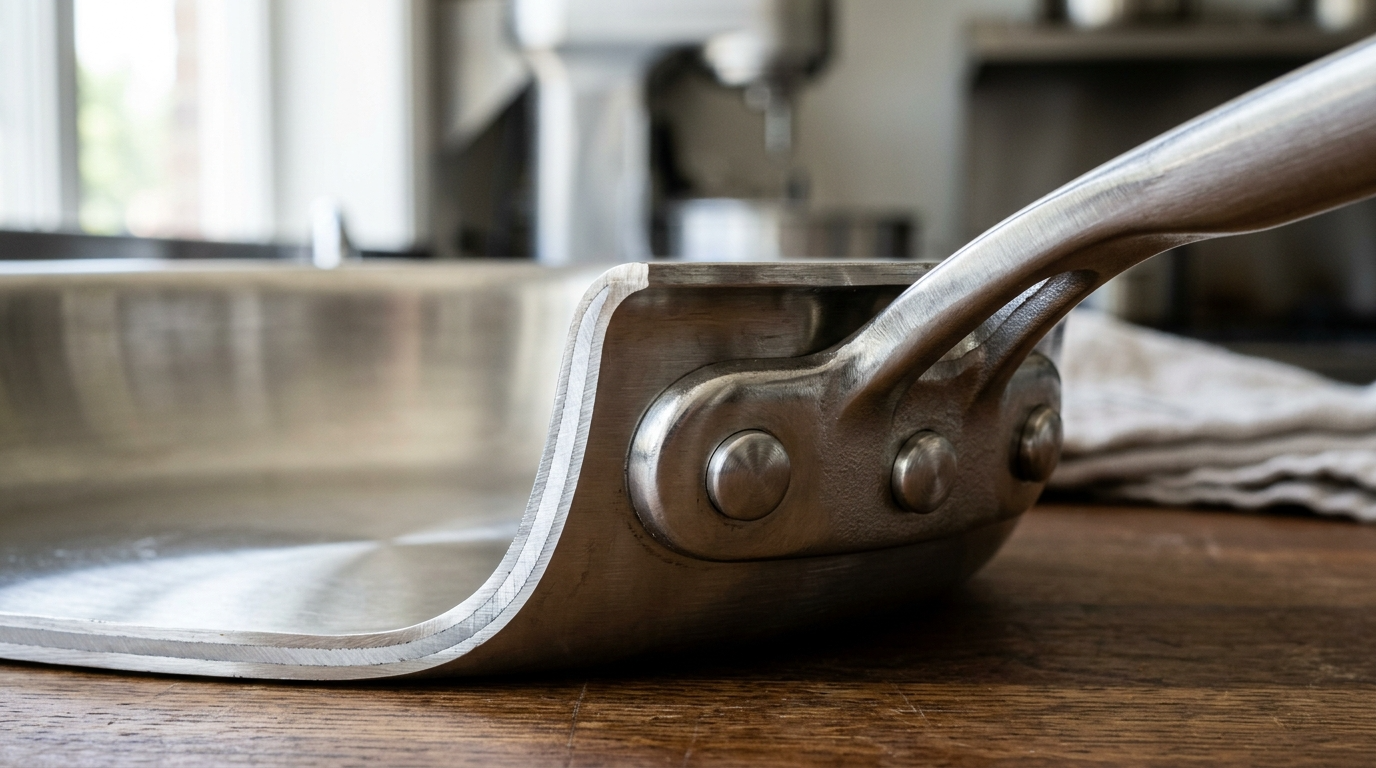
In reality, when you're searching for cookware that could be considered real chefs' equipment, sorting the producers from the replicas requires specific knowledge. Here is how to sort the producers from the replicas.
Check Rim And Profile
Hold the pan up to eye level. Almost all of the information can be gleaned from the rim.
|
Feature |
True Professional Pro |
Consumer Replica |
|
Rim Construction |
Fully clad edge (stainless-aluminum-stainless) |
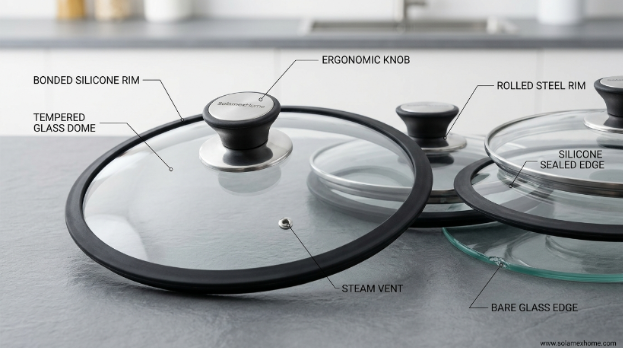
Rolled or folded lips hiding single-ply metal |
|
Base Type |
Poured edge, uniform sturdy walls |
Visible welded disc, thin 3-4 sheet sidewalls |
|
Heating Profile |
Edge-to-edge even heat distribution |
Separate ring mark causing burned food |
True Pro Suits Wear Pants That Are:
-
A fully clad edge: With layers of stainless, aluminum, and stainless that can be seen to reach the top lip.
-
An edge that is poured: To prevent liquids from dripping on it.
-
Walls that are uniform: And sturdy without having any dangerous thinning around the top.
Often Consumer-Grade Replicas Contain:
-
A visible disc: Which is welded to the bottom of the pan and sidewalls of just 3 or 4 sheets of stainless steel.
-
Rolled or folded lips: To conceal the single-ply cheap metal the pan is composed of.
-
A separate "ring" mark: Indicating where the bottom heating plate stops to ensure that your food does not burn in case it comes in contact with the sides.
Weigh It
This is one of my favorite tests, as you can't put on weight easily. Professional pans are constructed with a specific amount of weight in mind. They will be heavy enough to retain heat while being light enough to toss. Brands that have "restaurant style" sets tend to thin down the walls and hollow the handles down.
Both things they do so that the sets can be delivered at reduced shipping charges. As a result, typically replica and cheap suites shed 20% to 40% of the weight of an actual professional suite of the same dimensions.
When determining the weight of the pan, if you know the pro-spec weight, weigh the pan on a kitchen scale. The 3-ply Demeyere becomes a 5-ply, and it packs in the heft. It is important to note that a true 12-inch 5-ply skillet can be up to 4 pounds! If a heavy-duty 12-inch skillet weighs 2 pounds, something is wrong there that's on the same magnitude as a billboard.
Inspect Rivets And Handles
Pay attention to precisely the location of the handle at the pan body.
True Professional Pros Have:
-
Very large and flush stainless-steel rivets: Which never loosen.
-
Totally rivetless welded constructions: In the case of the best European brands, which restrain the bacteria piling up within the pan.
-
A deep fork with a V-shape towards the pan body: Dispersing heat and keeping the handle cool through solid cast stainless.
Consumer Replicas Show:
-
Small aluminum rivets: Which loosen and leak with time.
-
Plastic or silicone handles: Which will not withstand oven temperatures of 500°F.
-
Phillips head screw: If you see cookware that has a Phillips head screw on the handle, return it to the shelf right away.
The Magnetic Test
This is pretty rough but extremely useful today. Often OEM commercial alloy pots are made for induction. Take a magnet shopping. If a magnet will easily slide out from the base of the stainless-steel pan, it will not work with induction. It is probably not constructed with high-quality magnetic steel.
When it fails to stay put or has trouble clipping onto some objects, it is either a low-quality steel 18/0 magnet or raw aluminum that has been painted over to make it look like a high-quality magnet.
People Also Ask
Which Kitchenware Does James Gordon Ramsay Use For His Kitchen?
What cookware does Gordon Ramsay use is a common question. Gordon Ramsay's kitchen is equipped with some fancy stainless clad pans, mostly from the AllClad Copper Core and Demeyere's lines. Why? They provide him with an accurate amount of heat he requires in the hot moments of sauce making.
Just think about that for a moment. His good use of plain old carbon steel for high-heat searing is another feature. He doesn't always talk about the specific brand he's riding as opposed to having sponsorship from the company. It is the quality of the bike itself and the load intolerance.
For Professional Chefs, What Do They Prefer: Stainless Steel Or Non-Stick?
The simple fact is that in most practical terms, chefs virtually without exception grab fully clad stainless steel or carbon steel for 90% of their cooking. People who light healthy must adopt the rule of using non-stick only for eggs and fragile fish, as it's a huge change. The Cuisine Art's fond formation on stainless steel is essential. A non-stick surface will not allow that beneficial Maillard chemical reaction to occur to form a fond.
Is It Worth It To Buy The More Expensive Non-Stick Pans?
No, from the professional's point of view, coatings will break down with the use of heat cycles over 12 to 18 months. It's a bad bargain because no matter how much you pay, $200 reflects a "lifetime," which means more often than not, it is not a nonstick pan. If necessary, re-read. Handle them carefully, switch them out every year without 2nd thoughts, and invest in stainless.
Do Chefs Buy Low-Price Cookware At Their Home, Or Do They Buy Expensive Ones?
Yes, but selectively. Perhaps most importantly, they'll purchase aluminum stock pots for $7.99, half sheet pans for $28.00, and the not-so-stick egg pan for $25.00 at restaurant supply companies like Winco. Then, they splurge on a few quality items such as a Le Creuset enameled Dutch oven and a 5-ply clad, large skillet. This mix successfully produces professional results but does not require a high price tag on each individual pot.
Is It Possible To Make A Seasoned Carbon Steel Pan At Home?
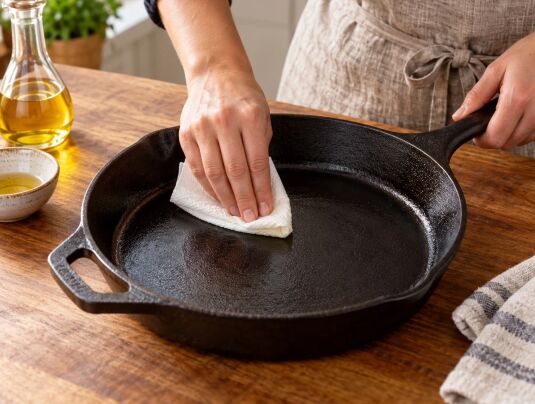
Absolutely. Here's the deal: it's going to take about 20 minutes! Remove the factory wax layer. First scorch the pan on the stove until it smokes. Then massage in a very thin layer of flaxseed oil and/or grapeseed oil and scorch again. The pan will develop a deep, mottled color characteristic of bronzes and match the color of any teflon pan after a week of cooking. Be sure not to cook acidic tomato sauce, though, or all the seasoning will rub off.
How To Check Authentic Brands Of Restaurant Supplies?
Check for the NSF (National Sanitation Foundation) Certified stamp on the bottom of pans to identify true Restaurant cookware brands. This stamp will be found on units currently in use in the professional world. Therefore, it ensures the dishwasher-safe status and food safety for the Winco, Fullrath, or Carlisle commercial cookware. When shopping online, stay away from vendors that have not earned the NSF certification and who claim to have "restaurant quality" food.
What This Means For Your Kitchen: Buy With Confidence
The simplest method for avoiding the purchase of fake professional gear for much more than you have to is purchasing with a chef mentality. Now, the next time you read this wonderful rant about what cookware pro cooks use at home, you will know that it has nothing to do with the brand. It is a cold and hard scheme. Fill in the blanks with heavy-bottomed clad stainless.
Don't apologize for the carbon steel's dark texture and beauty. Use non-stick like printer ink: use it sparingly and change it often.
It's not like you need a closet of 3 or 4 7-inch matching pans. You need 3 or 4 nifty, powerful, and scary tools that can each do one thing intensely well. It has been a reality of the metal for many years now, and it isn't about to change. Go to a restaurant supply store with that information. One way in which you will improve this evening is because you will cook better than yesterday.
Conclusion
Ultimately, prioritizing function over prestige completely transforms culinary results. Knowing exactly what pans do professional chefs use helps buyers avoid useless, expensive filler. Select specific, heavy-duty pieces designed for rigorous daily applications.
Ready to upgrade your culinary arsenal? Visit SolaMexHome to explore premium equipment and elevate your daily cooking experience with authentic professional-grade durability today.
Next Step: Review your current pans, discard the scratched non-stick items, and invest in a single heavy-bottomed 3-ply stainless skillet.
Best Cookware for Gas, Electric, and Induction Stovetops
PTFE Vs PFOA Free: What’s The Difference?