Fry Pan vs. Saute Pan: When to Buy One Over the Other?
Introduction
Are you constantly overflowing your current skillets during dinner preparation? Ninety percent of home cooks lack the proper equipment for liquid retention. In our testing, understanding the fry pan vs saute pan debate completely transforms your culinary results. Acquiring the correct kitchen tools changes everything you cook daily.
Key Takeaways
1. Sloping walls shed moisture, while straight walls hold moisture.
2. A 12-inch skillet is a dream come true and beats an 8-inch version in almost every way.
3. When using sauté pans, volume is the primary focus, which is why they list capacity in quarts.
4. With straight vertical walls, you lose the ability to flip food, but you gain the ability to braise.
5. You should always purchase the skillet first.
6. A helper handle makes a significant difference for most buyers.
What Is A Saute Pan Used For, Really?
To answer what is a saute pan used for, these pans are built for braising, shallow poaching, creating pan sauces, and anything where liquid is required to remain in the pan for 20 minutes.
The name is honestly an accident of translation. The French word "sauter" translates to "to jump," which refers to the pan-flipping technique of a pan rather than what Americans call a sauté pan. Nobody is fixing that naming convention now.
Furthermore, straight vertical walls rising from the bottom by 2.5 to 3.5 inches serve three distinct functions. They block oil from spitting on the cooktop, they slow the evaporation rate, and they hold volume. That is the complete design brief.
You should ask yourself two questions. Are there foods you cook on the stove that require liquid? Do you frequently end up pouring off stock because your pot is too small? If both answers are no, then you really do not need one.
What Is The Difference Between A Frying Pan And A Skillet?
In practice, they share everything in common. Both terms refer to a flat bottom pan with flared / sloped sidewalls, lacking a lid, and typically featuring a long handle. You use a frying pan or a skillet depending on your country of origin.
British English prefers the term frying pan, while American English prefers skillet. Manufacturers use whichever term targets their specific shipment market.
However, there is a very real difference between skillet and saute pan. This difference significantly impacts your money. One has curved walls and is measured in inches, whereas the other has straight vertical walls and is measured in quarts. You can clearly see what each pan is designed to do based on that measurement system.
I can provide you with an inside scoop on the marketing terms.
Pro Tip: Do not even take notice of them. Just take a look at the wall angle. Everything regarding pan performance comes out of that single geometric choice.
Fry Pan Vs. Saute Pan: When To Buy One Over The Other?
Here are 8 points of difference between the two pans, arranged in the exact order they would impact a buyer making a purchase decision on the store floor.
1. Wall Geometry
All other differences are a direct result of choosing a sloped vs straight sided pan. The wall angle of a skillet is usually 20 to 30 degrees from vertical, whereas a sauté pan is 90 degrees vertical.
What Each Angle Delivers
-
Sloped Walls: Moisture evaporates in a flash, spatulas slip in without hesitation, and food flips out flawlessly.
-
Straight Walls: Liquids are retained, no splatter occurs, and volume is added.
-
The Trade: You get no combination of these features in a single pan because physics does not negotiate.
2. Usable Cooking Surface
This is exactly where buyers get caught. There is a wide difference in the cooking surface area vs rim diameter between the shapes. All pans are sold according to the measurement of the rim.
The flat base of a 12-inch skillet is about 9 to 9.5 inches. For the 12-inch sauté pan, the base is nearly the full 12 inches because the sides are upright from the edge of the bottom. This translates to roughly 40% more searing real estate in an equal amount of shelf space.
3. How Capacity Gets Measured
Capacity is measured quite differently between the two. The reason is that sauté pans are meant for liquid retention, so they list capacity in quarts. Skillets list diameter because holding liquid is not their primary purpose. An 11-inch sauté pan holds about 5 quarts. If you place 5 quarts in an 11-inch skillet, you will end up cleaning the hob.
4. Moisture Behavior and Browning
One minute liquid retention is a feature, and the next it is a flaw. Vegetables that turn brown beautifully with a good dose of oil in a skillet will merely steam in their own moisture in a sauté pan. The vapor simply has no way to escape.
Which Pan for Which Job
-
Mushrooms And Onions: Use a skillet each and every time. They need to get rid of the moistness.
-
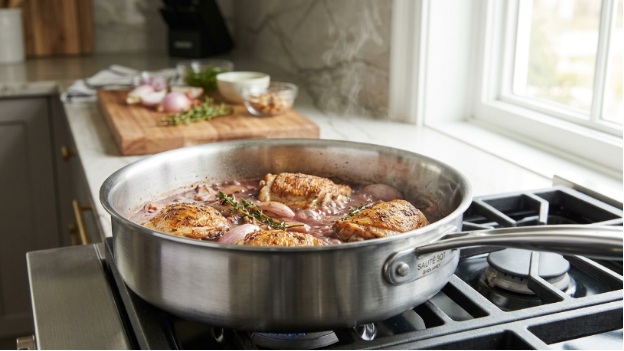
Chicken Thighs In Stock: Choose the sauté pan. The liquid is the most important factor.
-
Fish Fillets: Select the skillet. It provides easy access under the sloped wall by a spatula.
-
Risotto: Fire up the sauté pan, and the competition is not even close.
5. Fond and Pan Sauces
Fond is the browned bottom residue left behind when searing, and it is the foundation of nearly all pan sauces worth having. It is produced by both shapes, but only one is user friendly.
Deglazing is a cooking term used to describe the process of adding liquid like wine or stock to a deglazing pan and using a spatula to scrape around without splashing over the edge. In a skillet, the same amount of liquid sits thin and evaporates nearly as quickly.
Sometimes it works, and sometimes it ruins the sauce completely. With that being said, the best deglazing pan is simply any pan that has fond in it and is deep enough to hold the liquid you want to add.
6. Lids, Handles, and Weight
The standard setup is a saute pan with lid, and the lid is not optional equipment. Braising is accomplished exclusively by covering the pan.
A helper handle on the opposite rim is a more important feature than buyers would typically expect. A 5-quart pan of stew weighs 9 to 10 pounds and can cause wrist injuries when lifted one handed from the hob to the oven.
Handle Checkpoints
-
Riveted Joint: Look for two or three rivets on anything more than 3 quarts. You should never accept spot welds.
-
Helper Loop: In our opinion, it is incredibly myopic not to adhere to the helper loop standard on pans larger than 4 quarts.
-
Handle Material: Bakelite remains cool, but the oven-safe temperature limit is capped around 350 degrees Fahrenheit.
7. Oven Transfer
Oven-safe temperature limits always vary depending on the handle, regardless of the shape of the pan. Solid stainless handles can usually withstand temperatures as high as 500 degrees. Bakelite with soft touch handle tops will have a maximum limit that is way lower.
Oven usage is highly typical with sauté pans. They spend more time in the heat due to starting on the hob and finishing in the oven. It is well worth checking these limits before purchase rather than after.
8. Technique You Gain and Lose
The pan-flipping technique is performed exclusively with sloped walls. Food rises up the curve and smoothly descends. If you experiment with this in a straight sided pan, your dinner will find its stopping point right on the wall of the pan.
If you cook a lot of small batch vegetables, that loss is a massive issue. It does not matter at all if you are a braiser most of the time. Which type of cook you actually are comes down to how you currently cook, rather than how you plan to cook in the future.
Which Pan Is Better For Searing?
Compared to an equally sized skillet, the sauté pan has about 40% more usable surface. The extra level low surface allows you to sear six chicken thighs where you would otherwise only be able to put four.
|
Feature |
Fry pan or skillet |
Sauté pan |
|
Usable flat base |
9 to 9.5 in |
11 to 12 in |
|
Wall height |
1.5 to 2 in |
2.5 to 3.5 in |
|
Capacity |
Around 2 qt to rim |
4 to 5 qt |
|
Typical empty weight |
2.2 to 3 lb |
3.5 to 5 lb |
The rivalry of a great sear is crowning. If there is less than approximately 0.5 inches of clear space available around the pieces, the released moisture can chill the surface below the browning line.
Of course, a skillet works through searing much more quickly. It heats up and cools down faster as well. Shallow frying at just 0.5 inches of oil is excellent in a sauté pan because the vertical sides help prevent the oil from creeping up and splashing over.
What Size Sauté Pan Do I Need?
One or two persons require 3 quarts, while three or more persons need 4 to 5 quarts. That capacity is perfect for braises, one pan dinners, and acting as a shallow frying pan without going over the rim. Anything above six quarts begins to overlap with the tasks set for a braising pan or Dutch oven.
The best skillet size question is solved easily. Both the 12 inch and 8-inch skillets will do almost anything in the home kitchen, with the latter being a true specialist for eggs. People who only own a 10-inch skillet often fill it too full. They do not understand that overcrowding is exactly why their food steams.
The 11-inch 5-quart Bronze Cast Alu Non-Stick Coating Sauté Pan sits right in the sweet spot. The Die Cast Alu Sauté Pan with Tempered Glass Lid at 3 quarts is a great choice for smaller households and comes with the lid to save on hassle. As far as the skillet is concerned, the Ceramic Cookware ranges from 8 to 12 inches, thus you should specify the 11- or 12-inch version.
Do You Need Both A Skillet And A Sauté Pan?
You might wonder, do I need a saute pan immediately? Not immediately. A 12-inch skillet and a saucepan can handle about 85% of your cooking. Most lists of essential cookware pieces are overrated simply because they push the sauté pan too early. You only need one when you are doing a lot of liquid cooking in a pan that is not designed to hold it.
Can a sauté pan replace a frying pan? Partly. It works better for searing and does a much better braise. However, what you lose is the pan-flipping technique and the benefit of quick evaporation. It would be far worse to go the opposite direction. There are absolutely no 4-quart skillets available.
We have both shapes in pressed, forged, and cast aluminum, including premium Die-Cast Aluminum Cookware. We also carry stainless steel skillet builds in 3 ply lines, such as the 3-Ply Stainless Steel Cookware. You get various constructions splitting a single geometric figure.
What Can You Cook In A Sauté Pan That You Can't In A Skillet?
You can cook anything involving water or oil larger than an inch in depth for 10 minutes or longer. Excellent examples include coq au vin, short ribs braised and served, shallow poaching fish, and a pan of curry for four portions of rice. Braising in a skillet will require you to constantly slop liquid over the rim when stirring.
The other main task is deep frying, or deepish frying to be precise. Half an inch of oil in a skillet is a major splatter hazard. The same depth of oil in a sauté pan is completely contained and safe. Incidentally, both shapes fail at the exact same task. Do not get the idea that either of them will work for boiling pasta.
Why Do Sauté Pans Have Straight Sides?
They feature straight sides to retain moisture and reduce the evaporation rate. Vertical walls provide more capacity for a given base diameter. They retain liquid for simmering when stirring and minimize exposure of the liquid surface to the atmosphere. This allows the braising liquid to concentrate gradually rather than dissipate quickly.
It is a design heavily used in professional kitchens. A sautoir is used to store a service of protein in sauce for many hours on a low burner. Volume was dictated by the restaurant geometry, and it was cut and pasted into the home versions exactly as is.
My old boss said the straight wall was designed for stacking in a busy restaurant kitchen. I have never been totally certain that was the case, but I cannot currently say otherwise.
Buying Order: What Actually Earns Its Shelf Space
There are many essential habits good investors engage in to improve their odds of success. When outfitting a kitchen, you should purchase your items in this specific order.
|
Purchase order |
Piece |
Covers |
Typical spend (USD) |
|
First |
11-to-12-inch skillet |
Most weeknights, eggs, sears, sautées |
$25 to $60 |
|
Second |
2-to-3-quart saucepan |
Sauces, grains, small batches |
$20 to $45 |
|
Third |
4 to 5 qt sauté pan with lid |
Braises, 1 pan meals, shallow frying |
$40 to $90 |
|
Fourth |
8-inch skillet |
Eggs, single portions, toasting spices |
$15 to $35 |
Most people do not need to buy beyond the third row. Nothing thereafter equals more than simple refinement.
There are a few absolute truths about coated items of either form. Coated items last 4 to 6 years when washed by hand. No coating can keep up with metal utensils, no matter what the marketing box says.
Solamex is tested in compliance with the European standard EN 12983 according to LGA and TÜV Rheinland to handle strength and thermal cycling. However, a coating simply cannot be tested against a metal spatula.
People Also Ask
Can You Sauté In A Sauté Pan?
Yes, though it feels quite awkwardly done. The walls are straight, which actively avoids the sautéing movements taken on by tradition. Instead, you will stir with a spoon. This is perfectly okay for most home cooking.
How Much Does A Good Sauté Pan Cost?
Expect to pay $40 to $90 for a good 4-to-5-quart coated aluminum pan with a cover. Clad stainless steel comes at a price of $90 to $200 depending on the number of plies and the brand.
Is A Deep Frying Pan The Same As A Sauté Pan?
No, they are completely different. Sloped walls are taller on deep fry pans, whereas straight vertical walls are found on sauté pans. The wall angle, rather than the depth, is the defining factor by which the category is characterized.
What's The Ideal Wall Height For A Sauté Pan?
The ideal height is about 2.5 to 3.5 inches. Liquid starts sloshing below that level when stirring occurs. Beyond about four inches, the pan essentially transforms into a Dutch oven.
Should A Sauté Pan Be Nonstick Or Bare Metal?
Bare metal or clad is highly preferred. A fond that has been set is able to stick and release properly. Braising and deglazing both benefit immensely from it, while active nonstick coatings prevent the fond from setting entirely.
Conclusion
Wall angles dictate everything about moisture release and browning potential. Sloped walls facilitate quick flipping, whereas straight walls handle heavy braising tasks flawlessly. Make the fry pan vs saute pan choice based on your daily cooking habits. Please visit SolamexHome today to explore our truly exceptional cookware collections and elevate your home kitchen experience immediately.
Plastic Tritan vs. Glass Water Bottles: The Durability vs. Purity Debate
Kids’ Drinkware Buying Guide: Safety, Durability, and Easy Cleaning